.png)
nowing when to hire your first employee in a reselling business comes down to one test: is there a genuine bottleneck left after you've automated what software can automate, and does removing it create more value than it costs? There's no fixed listing count that triggers this. The right point depends on your category, average selling price, sell-through, storage and fulfilment complexity, sourcing model, and how many marketplaces you're running. What matters is the constraint, not the calendar.
Hiring is a big word for what's usually a small first step. It doesn't mean a full-time contract or an office. It could be someone doing 10 hours a week on packing, or a Saturday sourcing partner.
The distinction that matters legally is employee versus self-employed contractor, and this isn't something you get to choose for convenience. Employment status depends on the actual working relationship, including factors such as control over the work and whether the person is genuinely required to provide their own services, not simply what you call the arrangement on paper. Getting it wrong can result in additional tax liabilities and, depending on the circumstances, penalties. If you're not sure which applies, GOV.UK's employment status guidance is the place to check.
As a sole trader in the UK, you don't need to become a limited company to hire someone. You can employ staff directly, you just take on the employer responsibilities yourself, including personal liability if things go wrong with pay or contracts.
Every reselling operation runs through five stages: sourcing, prep and photography, listing creation, listing management, and packing and dispatch. The hiring decision should flow directly from these stages, not from a general sense of being busy:
The number that ties this together is expected profit per hour. It's not just profit per item times items per hour, sell-through matters too, since not every item you process actually sells in the period you're measuring. The full formula:
Expected profit per item processed = average selling price × sell-through rate × profit margin
Expected profit generated per hour = expected profit per item processed × items processed per hour
This is a framework for comparing operational efficiency, not formal accounting. Here's what it looks like in practice, for the same £25 item:
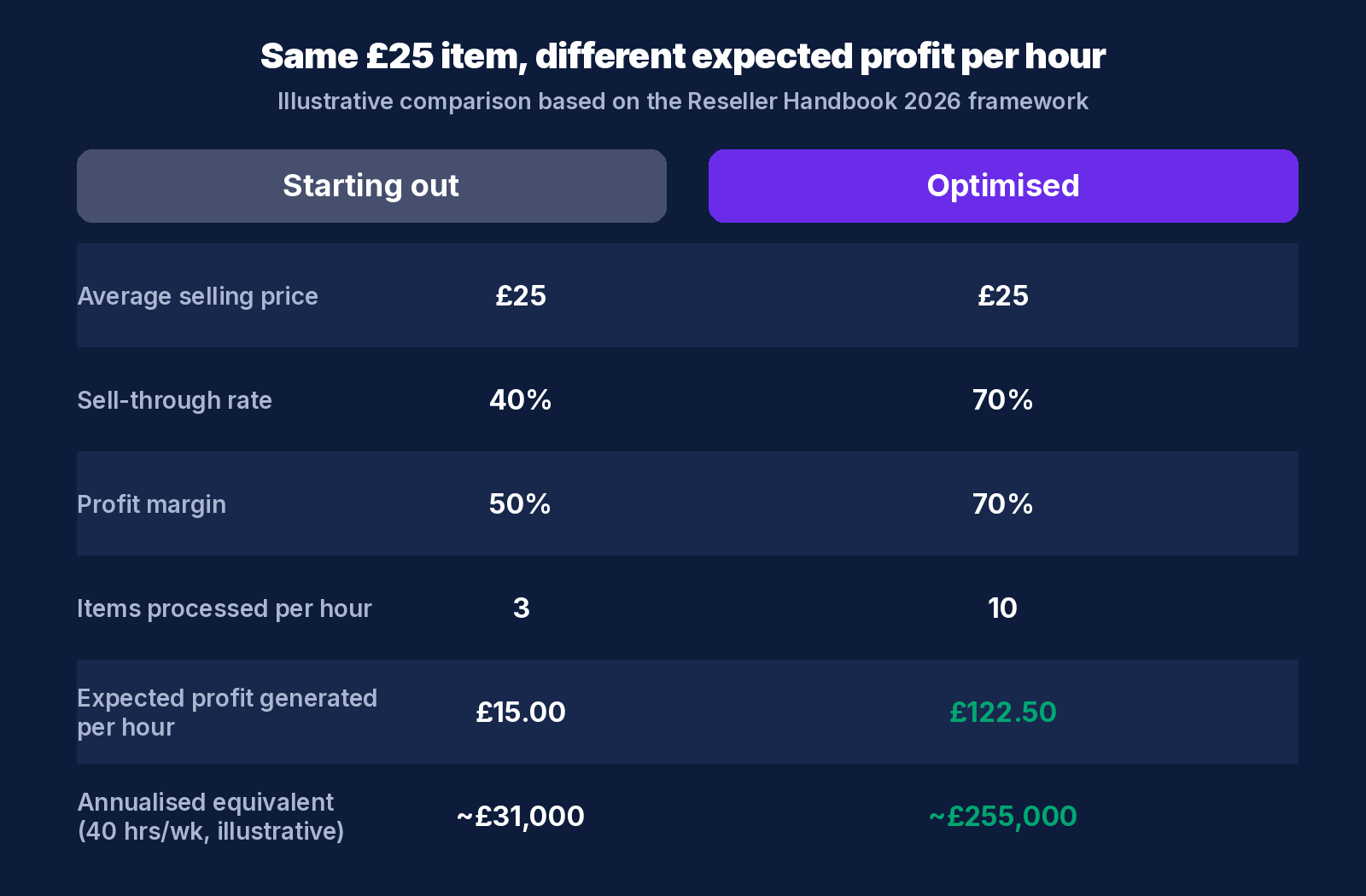
The annualised figures are illustrative equivalents to show the scale of the gap, not a prediction of what any individual reseller will earn. Much of that gap comes down to process: better sourcing, higher sell-through, stronger margins and faster throughput all compound together. Category, inventory quality, market demand and capital play a part too.
Automating the stages that are automatable, like listing creation and repricing, usually moves this number faster and cheaper than a hire would. Hire once you've done that and a stage still needs a person.
Being busy on its own isn't enough. Plenty of resellers are busy and profitable exactly as they are.
Say packing and dispatch takes you 10 hours a week, and you assume that hiring someone to cover it costs the business £160 all-in, a hypothetical figure for this example, not a UK employment benchmark. Work it out from actual incremental output, not from multiplying hours by your overall profit-per-hour figure:
That's a genuine margin of safety, but it only holds if you can actually source and sell 30 more items a week with the freed time. If you can't find the extra stock, or demand doesn't stretch that far, the real number is lower. If you're still at the "starting out" end of the framework, where each item is worth far less, the same 30 items might not clear the cost at all.
Revenue and expected profit aren't the same thing, and expected profit isn't the same as what you'll actually bank. Treat this as a planning tool to stress-test a decision, not a guarantee.
Hiring also only makes sense if the extra capacity connects to something valuable. It creates capacity, not automatically demand or profit. More hours of packing only helps if there's more profitable stock to pack, better sourcing to do with the time, or a genuine sales constraint being removed. Don't hire just because you can process more.
Don't compare an employee's hourly wage with the value of your own time; compare the fully loaded cost of employing them with the incremental profit their work allows you to generate.
Fully loaded cost includes far more than salary:
The exact uplift over gross pay varies by wage level, pension eligibility, and hours, so treat any single percentage as a rough planning figure rather than a fixed rule, and build your own numbers before deciding.
You can employ staff as a sole trader without incorporating first, but the responsibilities are real from day one:
For the full registration process, GOV.UK's guide to registering as an employer is the current authoritative source. Rules do change, so it's worth checking GOV.UK directly before your first hire rather than relying on any single article.
This is a common pattern, not a rule, different reselling models will have different bottlenecks.
Often first: packing and dispatch. Repetitive, teachable in a session, and doesn't require judgement calls about pricing or brand voice.
Often next: prep and photography, especially at high volume of similar items.
Changed by tools like Listing Monster: listing creation. Writing titles and descriptions from scratch used to require someone who could describe an item well and price it right. Automating that first pass changes what the role needs to be.
Usually retained longest: sourcing. It runs on judgement and relationships built over time, and it's usually the last thing full-timers hand over, not the first.
Listing Monster turns your photos into an optimised listing automatically. That reduces the listing-creation workload, which means one person can process more items per hour without adding headcount for the writing itself.
Practically, that shifts two things:
It doesn't touch the physical bottlenecks. Packing, dispatch, and sourcing trips still need a person, no software changes that. And for some resellers, photography, quality-checking, or listing operations generally will still end up being the constraint even with it in place. What it does is make listing creation less likely to be the first reason you need additional headcount.
For the full five-stage framework behind these numbers, the Reseller Handbook 2026 breaks it down in detail.
Yes. Sole traders can hire staff without forming a limited company first. You take on the employer responsibilities directly: registering with HMRC, running PAYE, providing a written statement on or before their first day, and personal liability for pay and contract disputes.
More than the wage. Employer National Insurance, pension contributions, holiday pay, and liability insurance all add to the true cost, and the exact uplift depends on wage level and hours. Build your own figure rather than relying on a single rule of thumb, then compare it against the incremental profit the role would free up.
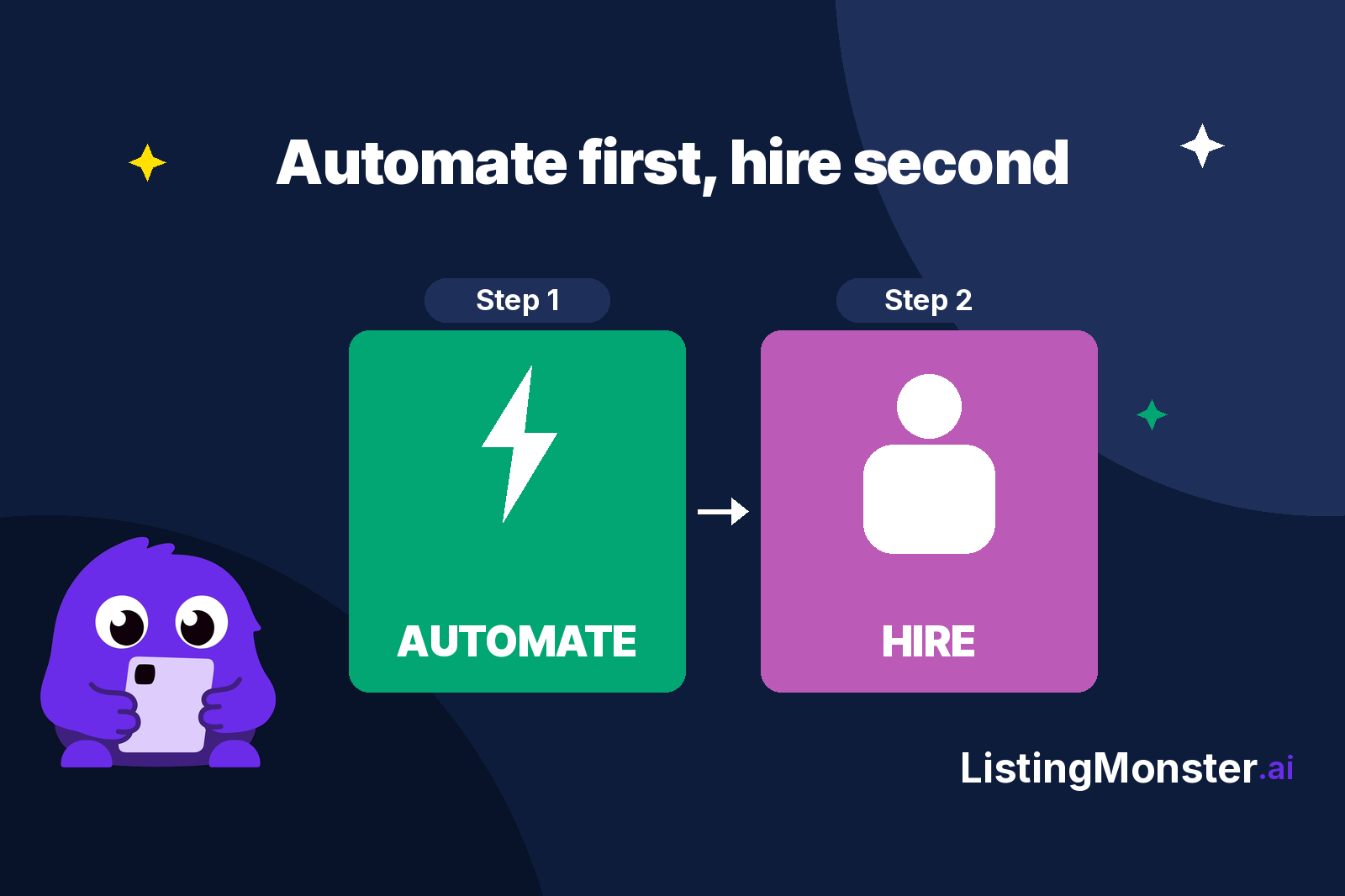
Automate first, hire second. Software handles repetitive, rules-based stages like drafting listing copy from photos, cheaply and immediately. Hire once that's done and a genuine bottleneck remains, commonly packing, sourcing trips, or quality-checking listings before they go live.
Packing and dispatch, for most resellers, though it depends on your setup. It's typically teachable quickly, doesn't touch pricing or brand voice, and frees up hours that are often the actual constraint.
.svg)