When Should You Start Buying Wholesale to Resell?
Start buying wholesale to resell when you are selling out of a category faster than you can source it by hand, and you have cash you can lock up in inventory without starving the rest of your business. Below that point, buying one item at a time keeps your money flexible, your risk low, and your finds unique. Above it, hand-sourcing becomes the ceiling on your growth, and buying inventory in bulk is how you break through it.
That is the short version. The longer version matters, because moving to wholesale is a change of strategy, not a promotion. You are trading the flexibility and fat margins of the hunt for the predictability and volume of the pallet. Plenty of full-time resellers never make the switch and do just fine. Here is how to tell whether it is right for you, and what actually changes the day you start.
What buying wholesale to resell actually means
Buying wholesale to resell means buying stock in bulk from somewhere higher up the supply chain, then selling it on one unit at a time for a markup. For a marketplace reseller, that usually looks like one of three things:
- Liquidation and returns: pallets or case lots of customer returns, shelf pulls, and overstock, sold by grade rather than by item.
- Wholesale lots: bulk quantities of a single item or a mixed lot from a distributor or clearance broker.
- Trade stock: new, often branded goods bought from a distributor at a bulk rate, usually with a minimum order quantity attached.
The common thread is that you commit to volume up front instead of picking items off a shelf one at a time. That single change touches your cash, your taxes, your storage, and the size of your listing pile. We will get to all four.
Wholesale vs retail arbitrage: the real trade-off
Most resellers start with hand-sourcing, whether that is thrift stores, estate sales, garage sales, or retail arbitrage. Wholesale vs retail arbitrage is not a question of which is more advanced. It is a question of what you are optimizing for.
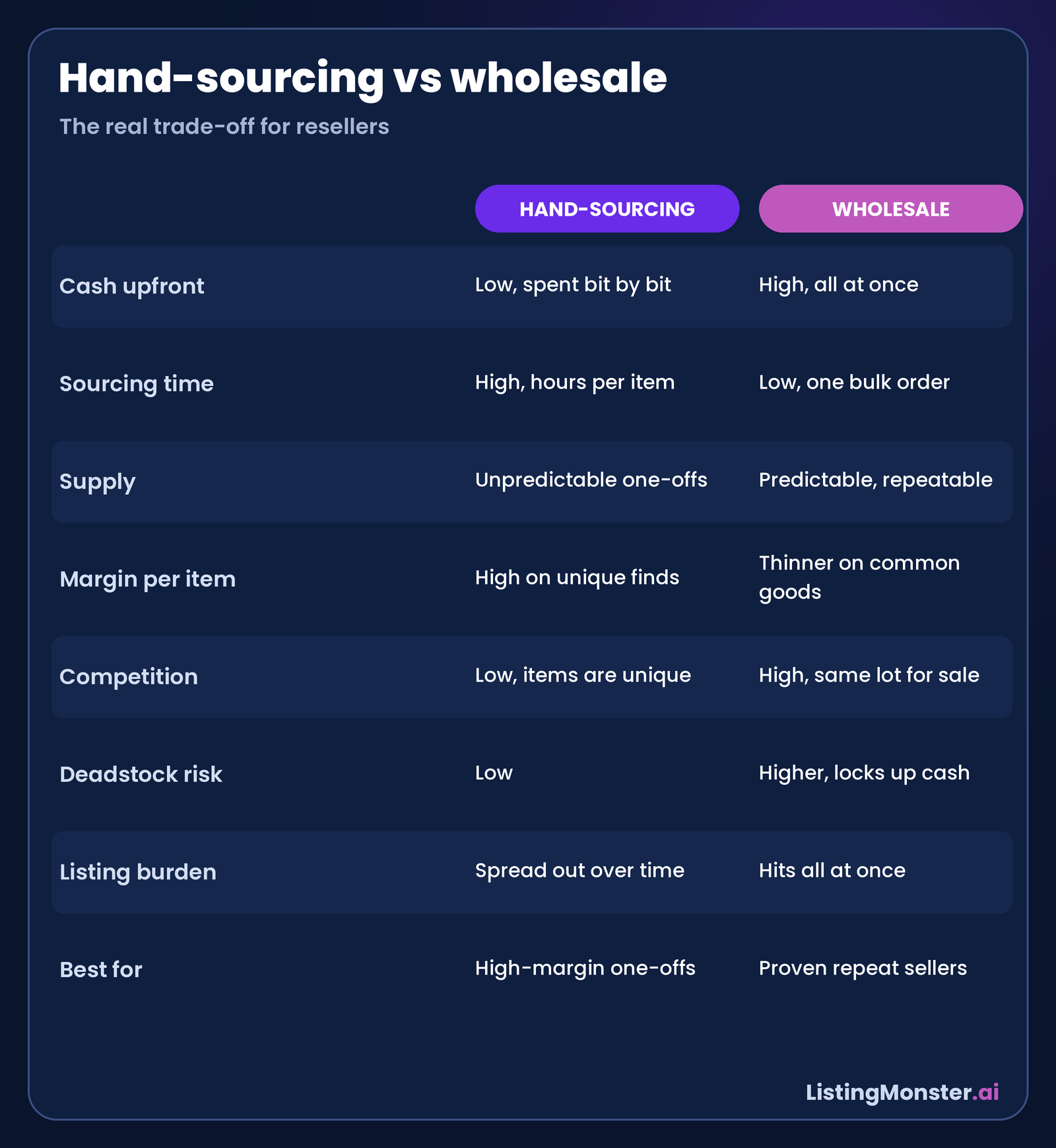
Hand-sourcing keeps your money flexible. You spend small, you spend often, and every dollar can move to the next opportunity. You also find items nobody else has, which is why a good thrift flip can carry a huge margin.
The catch, and it is the one most resellers underrate, is time. Every item you source by hand costs you hours: driving between thrift stores, digging through racks, standing in line at estate sales, all to walk away with one thing worth flipping. That is why the number that matters is not margin per item, it is your profit per hour. A $30 flip looks great until you count the three hours of sourcing behind it. Hand-sourcing has a hard ceiling because your time does not scale, and you cannot restock a winner on demand. The Reseller Handbook 2026 breaks down how to work out your real profit per hour.
Wholesale flips that. Supply becomes predictable and repeatable, so when something sells you can list the same thing again tomorrow, and one order can replace dozens of sourcing trips. Cutting sourcing time is the real prize here. It hands back the hours hand-sourcing eats and lifts your profit per hour even when the margin on each item is smaller. The trade-offs are real, though. Cash goes in up front and stays locked until the stock sells, margins on common goods are thinner because everyone else can buy the same lot, and anything that does not sell becomes deadstock sitting in your garage. Tariff movement through 2026 has also pushed landed costs up on a lot of imported wholesale, so the margin math is tighter than it was two years ago.
Neither model wins outright. The strongest resellers usually run both: wholesale for the proven, repeatable sellers, and hand-sourcing for the high-margin one-offs.
The signals you are ready to buy in bulk
You are ready to start buying wholesale to resell when most of these are true, not just one:
- You keep selling out of the same category and turning away demand you could have met.
- Sourcing time is what caps your growth now, and the hours you spend hunting are dragging your profit per hour down.
- You have a proven, repeatable seller backed by your own sales data, not a hunch about what might move.
- You have cash you can tie up for 60 to 90 days without sweating rent or the next sourcing run.
- You have somewhere to actually put it.
If only one of these is true, hold off. The classic mistake is buying a pallet because the per-unit price looked irresistible, with no proof the items sell and no plan for the ones that do not.
The cash flow reality nobody mentions
Here is the part the generic guides skip. Buying inventory in bulk converts flexible cash into locked inventory. A thrift flip returns your money in days. A wholesale lot can take months to clear, and until it does, that money cannot do anything else.
I learned this one the hard way, in reverse. Early on I did the opposite of a careful test. I bought too much wholesale too fast, in quantities far bigger than I could handle, because the deals looked too good to pass up. Then I had cash tied up in stock I could not process fast enough to sell, and the whole thing seized up. That was pre-AI, when listing was a slow manual grind, so the pile just kept growing. The lesson stuck: only ever buy what you can list in the next few weeks, then repeat. A one to four week window keeps stock moving from box to live before it turns into dead capital.
Cash flow, not profit, is what keeps a reselling business alive. You can be profitable on paper and still be stuck, because every dollar is sitting on a shelf as unsold stock. Before you commit to a lot, work out your sell-through rate on that category from your own numbers, estimate how long the lot will take to clear, and only spend what you can afford to have out of reach for that long. Never put your entire float into a single bulk buy, and reinvest from proceeds rather than dipping into money you need to operate. Our own Billy Burridge nearly wrecked a six-figure Depop business doing exactly this, which he breaks down in three stock mistakes that were killing his reselling business.
Sales tax and resale certificates: what changes
When you move from thrifting to wholesale, your tax picture changes, and this is where a resale certificate comes in.
A resale certificate, sometimes called a reseller's permit or seller's permit, is a document that proves you are buying goods to resell rather than for personal use. It lets you buy inventory from a wholesaler without paying sales tax at the point of purchase, because sales tax is collected later from your end buyer. To get one you generally need a registered business and often an EIN, and the exact rules and application run through your state's department of revenue, so they vary state to state.
This is a genuine shift from hand-sourcing. When you buy at a thrift store or a garage sale, you pay sales tax as the end consumer and there is no mechanism to recover it. Buy the same category wholesale with a resale certificate and you skip that cost on your inventory entirely.
Two more things worth keeping straight. Income tax is owed on your profit whether or not a platform sends you a form. For 2026 the 1099-K reporting threshold sits at more than $20,000 and more than 200 transactions, so eBay, Poshmark, and Mercari will not issue one below that, but the income is still reportable. And sales tax is a separate system with its own nexus rules that can be triggered by sales volume alone. None of this is tax advice, and the rules move, so confirm your own position with your state's department of revenue or a tax professional before you start buying wholesale at scale.
The hidden cost: a mountain of listings overnight
There is one more thing that changes the moment your first pallet lands, and almost nobody warns you about it. When you buy 200 units, you now have 200 things to photograph, title, price, list, and cross-post. Hand-sourcing spreads that work out naturally, a few items at a time. Bulk buying dumps it on you all at once.
This is where a lot of wholesale experiments quietly die. The lot arrives, the reseller gets through the first 30 listings, life happens, and the rest sits in boxes for months. Unlisted stock is not inventory, it is dead money. The bottleneck simply moved from sourcing to listing, and if your listing process cannot keep up with the volume you just bought, the bulk buy works against you.
This is the point where clearing a backlog fast stops being a nice-to-have. It is the difference between a pallet that turns into cash and a pallet that turns into clutter.
This is exactly the gap Listing Monster was built to close. Sellers who move over from a manual listing flow get through their listings two to three times faster, and that changes the math on a bulk buy. If you can list two to three times as fast, you can safely take on a bigger lot each cycle without building a death pile behind you. Once listing stops being the constraint, buying more stock becomes the growth lever again rather than the thing that sinks you. As GDT Trading put it, "Listing Monster is now the push forward to go each Sunday to source more stuff, that's no longer the bottleneck."
How to test wholesale without betting the business
You do not have to go all in to find out whether wholesale works for you. Treat the first buy as an experiment:
- Start with one proven SKU or a single small lot, not a mixed pallet you cannot verify.
- Ask for a sample or a photo manifest before you commit to a full lot.
- List the whole test batch quickly so you get a real read on sell-through, not a slow trickle.
- Track the numbers that matter: sell-through rate, days to clear, and true margin after fees, shipping, and any sales tax.
- Reinvest from the proceeds of the test before you scale the order size.
If the test clears at a healthy margin in a reasonable window, buy again and go bigger. If it drags, you have learned that cheaply, with one small lot instead of a garage full of them.
FAQs
Do I need a resale certificate to buy wholesale?
In most cases, yes. A resale certificate lets you buy inventory without paying sales tax at purchase, and most legitimate wholesalers require one before they will sell to you at wholesale rates. You apply through your state's department of revenue, and you usually need a registered business and often an EIN first.
How much money do I need to start buying wholesale?
There is no fixed number, but the real test is not the price of the lot, it is how long you can have that cash locked up. Only commit money you can afford to tie up for 60 to 90 days without affecting rent, bills, or your next sourcing run. Start small and scale from proceeds.
Is wholesale better than thrifting or retail arbitrage?
Neither is better outright, it comes down to your time and cash. Thrifting and retail arbitrage keep cash flexible and margins high on unique finds, but they cost hours per item, which quietly lowers your profit per hour. Wholesale cuts sourcing time and gives predictable supply, at the cost of cash upfront and thinner margins. Most established resellers run both.
What is the biggest risk of buying inventory in bulk?
Deadstock. If the items do not sell, your cash is trapped in a garage full of stock you cannot move. The second risk is listing capacity: a bulk buy creates a huge pile of listings overnight, and stock that never gets listed is dead money regardless of how good the deal was.
Can I mix wholesale and one-at-a-time sourcing?
Yes, and most successful resellers do. Wholesale covers the repeatable, proven sellers you never want to run out of, while thrifting, estate sales, and retail arbitrage feed the high-margin one-offs. Blending the two gives you predictable volume without giving up the finds that carry your best margins.