
Reselling full time is worth quitting your job for once your reselling profit has replaced your full take-home pay for at least 6 straight months, you have 3 to 6 months of expenses saved, and your operation can already handle more volume than your day job currently leaves room for. If any one of those three is missing, you are not ready yet. This guide covers the real income number, the reseller-specific traps that sink people, and a staged plan to make the jump without gambling your rent.
Here is the moment almost everyone quits on: you check your sales for the month, realize you cleared more flipping on evenings and weekends than a chunk of your paycheck, and think "what if I did this full time?"
It is a fair question. It is also the wrong one to answer on the back of one good month.
One strong month is not a salary. Reselling income is real, but it is lumpy and nobody guarantees it. When you quit, you also walk away from paid time off, sick pay, an employer retirement match, and an employer health plan. None of that shows up in your sales dashboard, and all of it lands on you the day you hand in your notice.
The real question is not "can I make money reselling." You already know you can. It is "can I make it consistently, every month, and do I actually want the life that comes with it."
When I was reselling full time, the swings were the hardest part to manage, harder than the workload. My rule was simple: don't get too high on the big months or too low on the quiet ones. In a strong, cash-positive month I would hold cash back, both for the slower stretches, when the buying opportunities are still there but the sales are not, and for the tax bill landing later. That buffer is what turns a volatile income into a livable one.
People make this move for different reasons, and your reason shapes the right call:
All four are legitimate. Your reason does not lower the readiness bar, but your personal risk exposure changes how much cushion is sensible. No dependents, low fixed costs, or a partner's income to lean on all lower the downside, and can justify moving on a leaner cushion than someone supporting a family. And if the job market is what is pushing you, build the business deliberately rather than pulling it like a parachute in a panic. A shaky job is still income while you get your systems and cushion in place.
Your target is not last month's best sales day annualized. Full-time reseller income has to cover your entire cost of living plus the costs your employer used to quietly absorb. Work out that number before anything else.
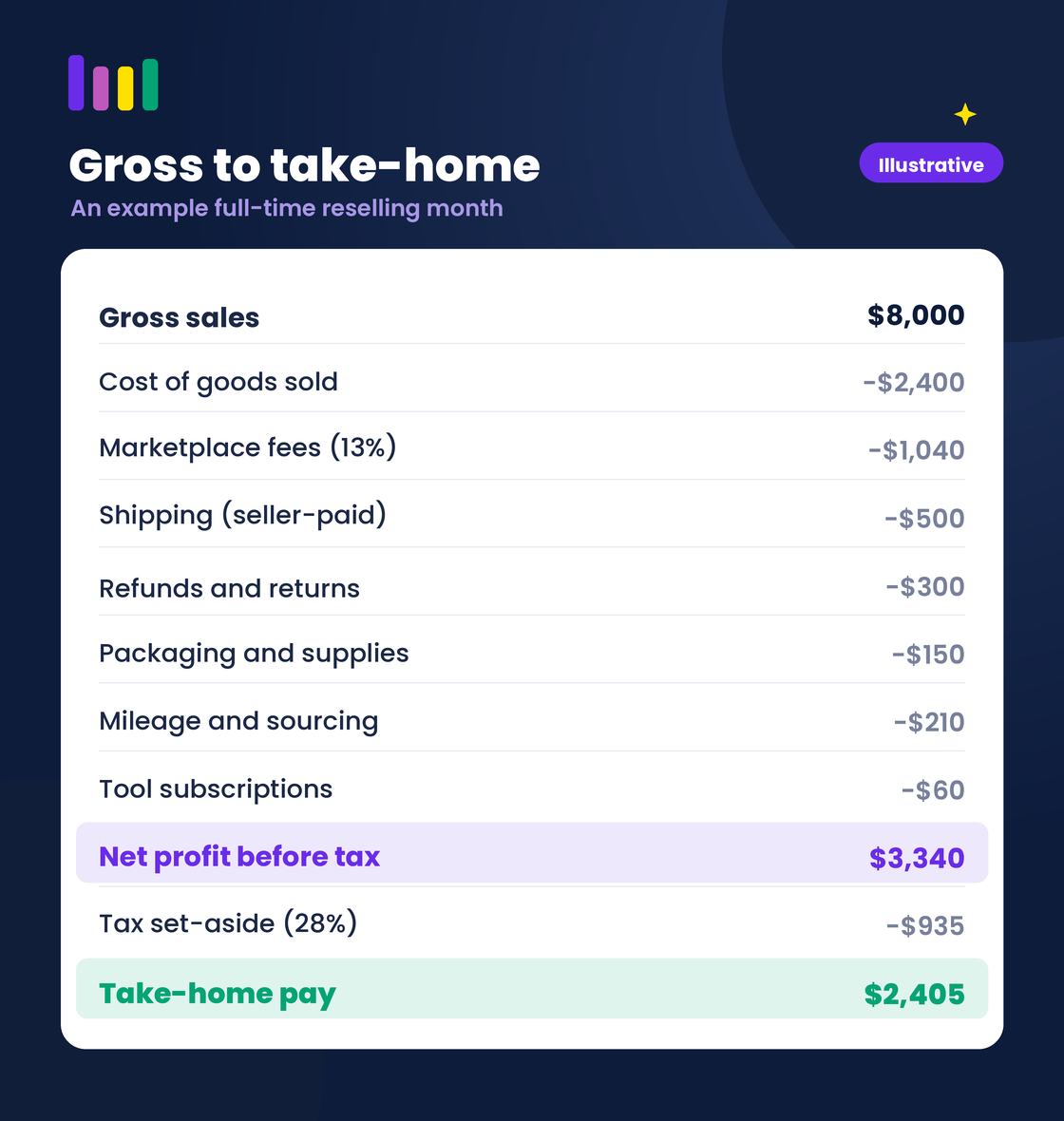
The figure on your seller dashboard is gross. It is not what you keep. Strip out cost of goods, marketplace fees, shipping, refunds, packaging, mileage, and your tool subscriptions, and what is left is net profit. That, not gross, is the number that has to beat your take-home pay.
A worked example of a full-time month might look like this:
As a full-time reseller you are self-employed, and the tax picture changes. You owe self-employment tax of 15.3% on net earnings above $400, on top of regular federal income tax, and likely state tax too. If you expect to owe $1,000 or more for the year, the IRS wants quarterly estimated payments, not one bill in April.
One thing that trips people up in 2026: the 1099-K reporting threshold is back to more than $20,000 and more than 200 transactions, and both conditions must be met. That only decides whether a marketplace files a form. It does not decide what you owe. Every dollar of profit is taxable whether a 1099-K arrives or not. A safe habit is to set aside 25% to 30% of net profit for tax from day one.
Most "should you go full time" advice is written for freelancers and consultants. Reselling breaks three of its assumptions.
A consultant's profit lands in their bank account. Yours often sits on a shelf as unsold inventory. To grow, you reinvest in more stock, which means the money looks like profit on paper but is not spendable. Before you quit, know how much of your "profit" is actually cash and how many months of runway you truly have.
Reselling has a calendar. Q4 into the holidays is usually a spike. January and mid-summer are often a slump. If you annualize a November, you will overestimate your income and get a nasty surprise by February. Judge your number on a rolling average across a full cycle, not your best stretch.
This is the one that quietly ends most attempts. You can only sell what you have listed. Doubling your income usually means doubling your active listings, which means multiples more hours sourcing, listing, and shipping. If listing already swallows every evening you have while you are part time, "just do more of it" is not a plan, it is the exact wall you will hit. It is worth being honest about how much time AI listing actually saves versus listing manually before you assume your current workflow can scale. The resellers who make the leap stick are almost always the ones who fixed their throughput before they quit, not after.
One seller described the shift once the listing bottleneck was gone: "Listing Monster is now the push forward to go each Sunday to source more stuff, that's no longer the bottleneck." That is the position you want to be in before you quit, sourcing capacity freed up because listing is no longer the thing capping your week.
For US resellers this is the single biggest cost most people forget, and 2026 made it worse. When you quit, your employer health plan goes with the job. Your main replacement is the ACA marketplace.
The catch: the enhanced premium subsidies that ran from 2021 through 2025 expired on December 31, 2025, and marketplace premiums rose sharply for 2026. The subsidy cliff at 400% of the federal poverty level is back, so earning a dollar over that line can wipe out your premium tax credit entirely. An unsubsidized mid-tier plan can run well over $600 a month for a single 40-year-old.
It is not all bad news. The large majority of marketplace enrollees still receive some subsidy, and if your business is profitable, the self-employed health insurance deduction generally lets you deduct 100% of your premiums. The point is simple: price your actual plan before you quit and budget it as a fixed monthly line, the same as rent.
Nobody sensible goes from side hustle to full-time reselling in a single leap. They build a bridge. Before you hand in your notice:
If you want the systems side laid out in full, our 2026 US reseller handbook walks through the sourcing, listing, and record-keeping setup that makes higher volume manageable.
You are ready to go full time when you can honestly tick all of these:
If you cannot tick the last one, fix your capacity before your notice period, not after.
Enough net profit, after cost of goods, fees, shipping, and tax, to cover your full cost of living plus health insurance and retirement, held for at least 6 straight months. Base it on a rolling average across a seasonal cycle, not your best single month. Gross sales are not the number that matters.
Most resellers who make the jump successfully run it as a side hustle for at least 6 to 12 months before quitting. That is long enough to prove income is consistent, see a full seasonal cycle, build a cash cushion, and confirm your systems can handle higher volume. Rushing the timeline is the most common reason the leap fails.
For some resellers yes, for others a profitable side hustle is the better outcome, and both are valid. Full-time reselling offers control over your schedule and no income ceiling, but it removes employer benefits, paid leave, and income stability. It is worth it when the numbers are proven and you want the lifestyle, not just the escape from your job.
You pay self-employment tax of 15.3% on net earnings over $400, on top of income tax, which an employee does not pay in full because employers cover half. You also handle it yourself through quarterly estimated payments. Tracking every deductible cost, from mileage to fees, is what keeps the bill down.
You lose your employer plan and typically move to the ACA marketplace. In 2026, enhanced subsidies have expired and premiums rose, though most enrollees still get some subsidy. Price a specific plan before quitting and treat the premium as a fixed monthly cost. If profitable, you can usually deduct your premiums.
.svg)
.png)

.png)