

For most UK resellers, the sole trader vs limited company decision comes down to profit, not turnover. Start as a sole trader while you are building up. It is simpler, cheaper, and keeps your figures private. Switch to a limited company once your profit is consistently high enough that the tax treatment and liability protection outweigh the extra admin, which for many resellers means tens of thousands of pounds in annual profit. And no, you do not need a limited company to sell on eBay, Vinted or Depop. Registering as a sole trader is enough for the vast majority of resellers.
This guide covers the real differences for a reselling business: the platform rules that actually affect you (Vinted Pro included), how each structure is taxed, the VAT threshold trap most people get wrong, and when switching is worth it.
This is general information, not tax or legal advice. Run your own numbers past an accountant before you decide.
A sole trader is you, trading as yourself. There is no legal separation between you and the business, so the profit is yours and the debts are yours. You register with HMRC for Self Assessment and pay Income Tax and National Insurance on your profit.
A limited company is a separate legal entity. You register it at Companies House, and it owns the business, the stock and the debts. You become a director and usually a shareholder. The company pays Corporation Tax on its profit, and you pay yourself through a mix of salary and dividends.
That one distinction, separate legal entity or not, drives everything else: how you are taxed, how much admin you carry, what is public, and who is on the hook if things go wrong.
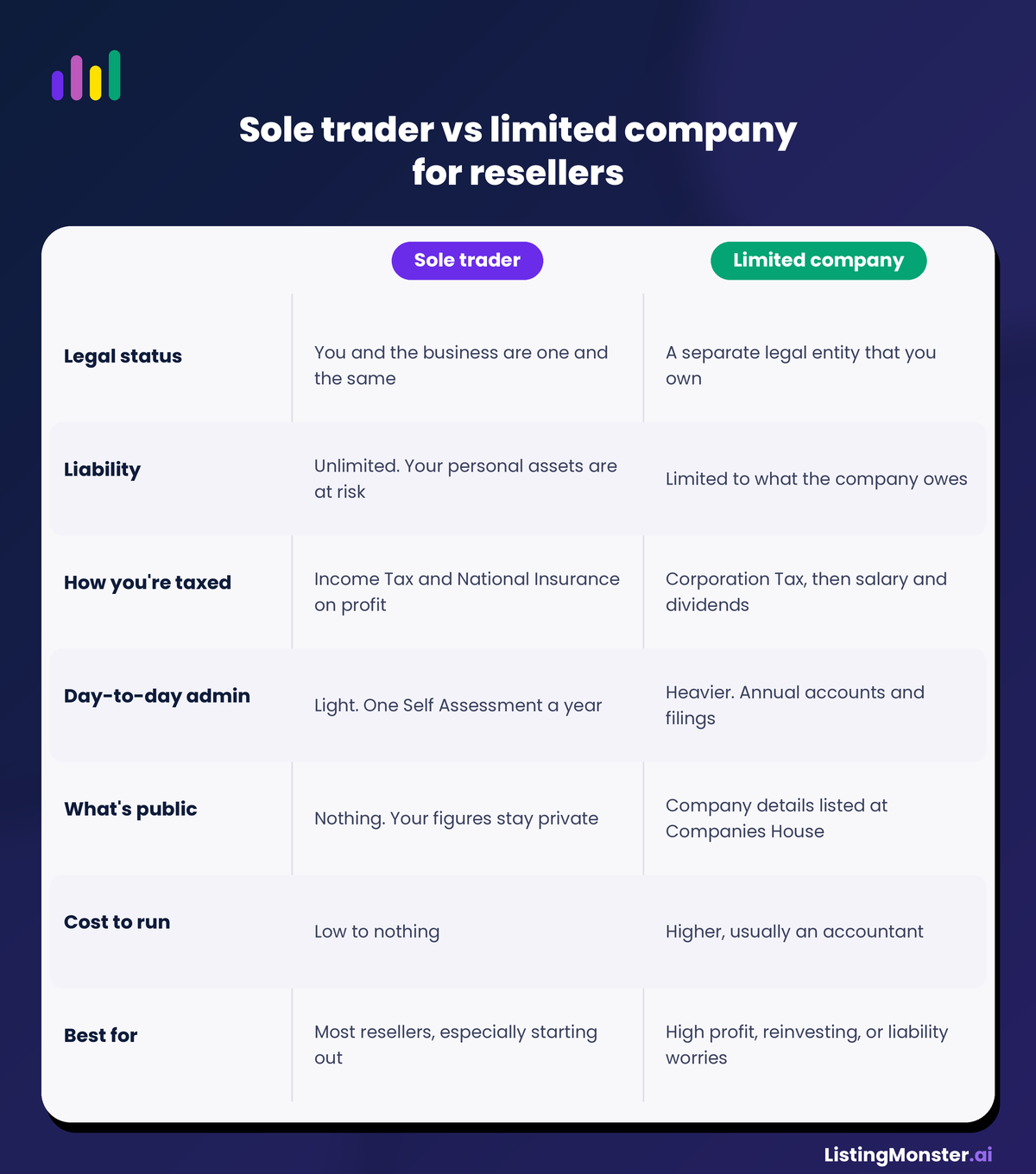
For resellers, the honest summary is this. Sole trader wins on simplicity and privacy. Limited company wins on liability protection and, at higher profits, tax efficiency and the ability to leave money in the business. Most resellers should start as the former and revisit the question as they grow.
No. You can sell on every major UK marketplace as a sole trader. What matters to HMRC is not your legal structure but whether you are trading at all.
If you are buying stock to resell for profit, you are trading, and you need to register as a business once your income passes the £1,000 trading allowance in a tax year. That is true whether you sell one item a week or a hundred. Selling off your own old wardrobe is not trading. Sourcing stock to flip is. HMRC calls the tests it uses the badges of trade, and buying with the intention to resell is the clearest badge of the lot.
Since 1 January 2024, eBay, Vinted, Etsy and other platforms report seller data to HMRC, and HMRC has been sending nudge letters to sellers whose declared income does not match. The takeaway is simple: if you are reselling for profit, get registered. Sole trader is the default and the easiest place to start.
For the full picture on when your selling becomes taxable, the trading allowance, and record-keeping, see our guide to reselling tax in the UK.
This is where your structure choice becomes real, and where most generic guides go quiet.
If you are a business seller, Vinted requires you to use a Vinted Pro account. Both sole traders and limited companies can register. The difference shows up on your public profile: a limited company must display its company name and registration number, while a sole trader can keep those details private. If you would rather not have your legal name and business details on show, that is a genuine point in the sole trader column.
Vinted Pro also carries obligations a standard account does not, including a legal 14-day returns right for buyers. On eBay, a business account is expected once you are trading, and it comes with consumer-law duties a private account does not. None of this requires a limited company. It requires you to be honest about the fact that you are running a business.
Tax is usually the deciding factor, so here is the shape of it. For the detailed mechanics our reselling tax guide goes deeper; this is the comparison that drives the structure choice.
As a sole trader, you pay Income Tax on your profit at 20%, then 40%, then 45% as it rises through the bands, plus National Insurance. Simple to run, but every pound of profit is taxed in the year you earn it, whether you take it out of the business or not.
A limited company pays Corporation Tax on its profit, currently 19% on profits up to £50,000 and 25% above £250,000, with marginal relief in between. You then pay yourself with a small salary and dividends. Dividend tax rates rose in April 2026 to 10.75% at the basic rate and 35.75% at the higher rate, with only a £500 tax-free dividend allowance, so the company route is less of an open goal than it was a couple of years ago.
The practical upshot for resellers: at modest profit, a sole trader is often no worse off and far simpler. The limited company advantage grows when your profit is high and, crucially, when you do not need to draw all of it. Leaving profit in the company to buy more stock, taxed once at Corporation Tax rather than at your personal rate, is where incorporation earns its keep for a growing reseller.
VAT is where reselling differs from most businesses. You must register for VAT once your taxable turnover passes £90,000 in any rolling 12-month period, the figure for 2026/27. That is turnover, not profit, and it applies the same to a sole trader and a limited company.
The good news for secondhand sellers: once registered, you can usually use the VAT margin scheme, which charges VAT only on the difference between what you paid for an item and what you sold it for, rather than on the full sale price. For a reseller buying stock cheaply from non-VAT-registered sources, that softens the blow of registration considerably. It is worth understanding before you assume crossing £90,000 will wreck your margins.
Here is a move you will hear in reseller circles: trade as a sole trader up to the £90,000 VAT threshold, then incorporate and get a fresh £90,000 before the company has to register. It contains a real, legitimate mechanism, but the way it is usually described gets the timing wrong, and that mistake is expensive.
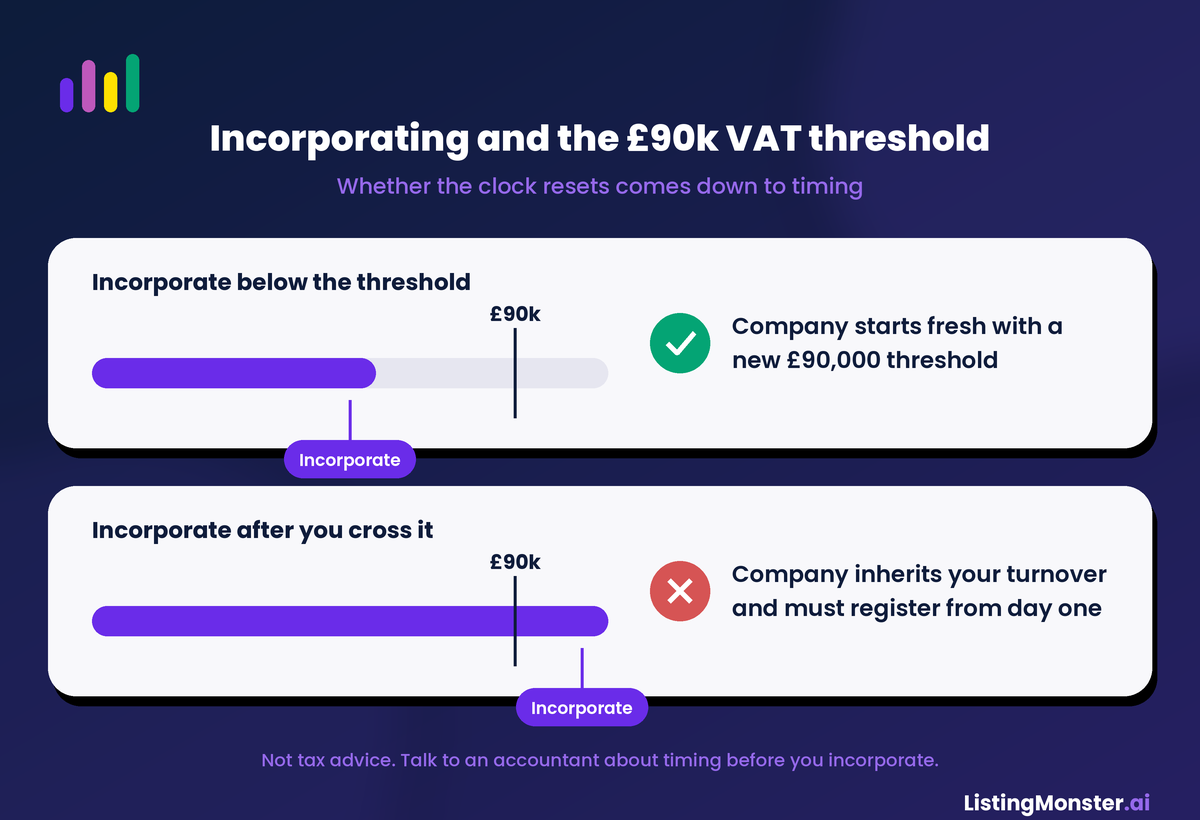
When you incorporate, you are transferring your business from one legal person (you) to another (the company). That is a Transfer of a Going Concern. Under the rules, the company only starts with a clean threshold if, at the moment of transfer, you were not yet a taxable person, meaning you had not crossed £90,000 and were not already registered. Incorporate while you are comfortably below the threshold, and the reset is genuine.
Leave it too late and it fails. If you run right up to £90,000 as a sole trader first, you have already become liable to register. The company then inherits your turnover history and has to register from day one. No reset. The timing is the whole point: you incorporate before you hit the threshold, not when you reach it.
Two more things to know. This is a one-off tactical delay, not a loophole you can run on repeat. Repeatedly changing structure to duck the threshold is exactly what HMRC's disaggregation rules exist to catch, and they can force registration and backdate the bill. And for secondhand resellers the margin scheme already reduces the VAT hit, so incorporating purely to dodge VAT is often solving a smaller problem than it looks.
Get the timing right and it is a legitimate planning point. Get it wrong and it backfires. This is precisely the kind of decision to make with an accountant, not off the back of a forum post.
There is no magic number, but there are clear signals. Consider incorporating when:
What should not drive the decision is the idea that a company looks more professional to buyers. On the marketplaces, buyers care about your feedback and your listings, not your legal structure.
Start as a sole trader. It is the right call for the overwhelming majority of resellers, and you can change your mind. Register with HMRC, keep clean records of what you buy and sell, and get on with sourcing and listing. Revisit the limited company question when your profit is consistently high, when you are reinvesting heavily, or when liability becomes a real concern. When you do, run the numbers with an accountant rather than a rule of thumb.
Whichever structure you choose, the day-to-day is the same: sourcing stock, listing it, and keeping records straight. Our UK Reseller Handbook walks through setting up cleanly from the start, so the admin side does not become the thing that holds your growth back.
Do I need a limited company to sell on eBay or Vinted?No. You can sell on eBay, Vinted, Depop and every other UK marketplace as a sole trader. Once you are buying stock to resell for profit and pass the £1,000 trading allowance, you must register as a business with HMRC, but sole trader is the simplest and most common structure for resellers.
When should a reseller switch from sole trader to limited company?There is no fixed threshold. Most resellers should consider it when profit is consistently high, when they are reinvesting profit into stock rather than drawing it all, or when liability becomes a real risk. Model your own figures with an accountant, especially after the April 2026 dividend tax rise.
Is a limited company more tax-efficient for resellers?Sometimes. At modest profit a sole trader is often no worse off and far simpler. A company can be more efficient at higher profit, particularly if you leave money in the business to buy more stock. The 2026 dividend tax increase has narrowed the advantage, so it depends on your numbers.
Do I have to register as a business to use Vinted Pro?Yes. Vinted Pro is for business sellers, and you register as either a sole trader or a limited company. A limited company must show its company name and registration number on its profile, while a sole trader can keep those details private.
Does incorporating reset my VAT threshold?Only if you incorporate before you become liable to register, meaning before your turnover crosses £90,000. Incorporate while comfortably below the threshold and the company can start fresh. Leave it too late and the company inherits your turnover and must register immediately. Take advice on the timing.
.svg)

.png)
