.png)

Ordering from a vintage wholesaler goes wrong in a handful of predictable ways: no relationship with the supplier, no vetting before committing to a full pallet, misreading grade terminology, ignoring the true landed cost per item, buying more volume than you can process, and relying on a single source for all your stock. These are the vintage wholesale mistakes to avoid if you want your first few orders to turn a profit instead of a write-off.
If you're buying vintage wholesale for the first time, or you've been burned once already, this covers the six mistakes that cost resellers the most money and the fixes that actually work.
New buyers treat wholesale ordering like a one-off transaction. Place the order, get the boxes, move on. That's a missed opportunity in a category where familiarity between buyer and supplier tends to pay off over time.
Order consistently from the same supplier, and you typically start seeing the benefits that a one-off order won't get you: earlier notice on fresh drops, better pricing at volume, and payment terms instead of paying upfront. That's not favouritism, it's how most supplier relationships work. The more a wholesaler understands what you buy and how you buy it, the easier it is for both of you.
The fix. Treat your first few orders as a trial for both sides. Communicate clearly about what you actually sell and what condition and category you want more of. Ask directly what it takes to build a stronger working relationship, whether that's more consistent grades, earlier notice on new stock, or better terms. Suppliers respond to buyers who make their job easier, not just buyers who pay on time.
Committing to a full pallet or a bulk order from a supplier you've never used is the single most expensive mistake on this list. No reviews, no clear return policy, and no sample option before a full order are three separate red flags, and any one of them should stop you.
I learned this one the hard way early on. I ordered blind from a wholesaler with no vetting, no sample, nothing. Close to 95% of what showed up was fake, damaged, or simply not sellable. On a separate order I bought 10 vintage Stone Island jumpers from a supplier I hadn't checked out properly. Nine of the ten were counterfeit. That's not a grading problem, that's a trust problem, and it's exactly what proper vetting is meant to catch before your money leaves your account.
The fix.
Grading is not standardised across the industry. One supplier's grade A is another supplier's grade B. Some grade purely on damage. Others grade on damage, era, and brand mix together. "Vintage" itself gets used loosely, some sellers mean genuinely aged stock in wearable condition, others mean anything old regardless of whether it's sellable.
I've bought 600 sweatshirts sold to me as grade A. 80% of them had holes, stains, or both. On paper it was a premium lot. In the box it was mostly stock I couldn't list as described. That gap between what "grade A" means on the invoice and what it means when you're holding the item is the most common way buyers end up disappointed with stock that technically matched what was agreed.
The fix. Before your first order with any new supplier, ask them to define their own grades in writing. What does grade A actually mean to them: percentage with damage, era range, brand mix, cleanliness. Get this in writing or a screenshot, not just a verbal assurance, so you have something to point back to if a shipment doesn't match. Never assume grading definitions carry over between suppliers, even ones in the same country.
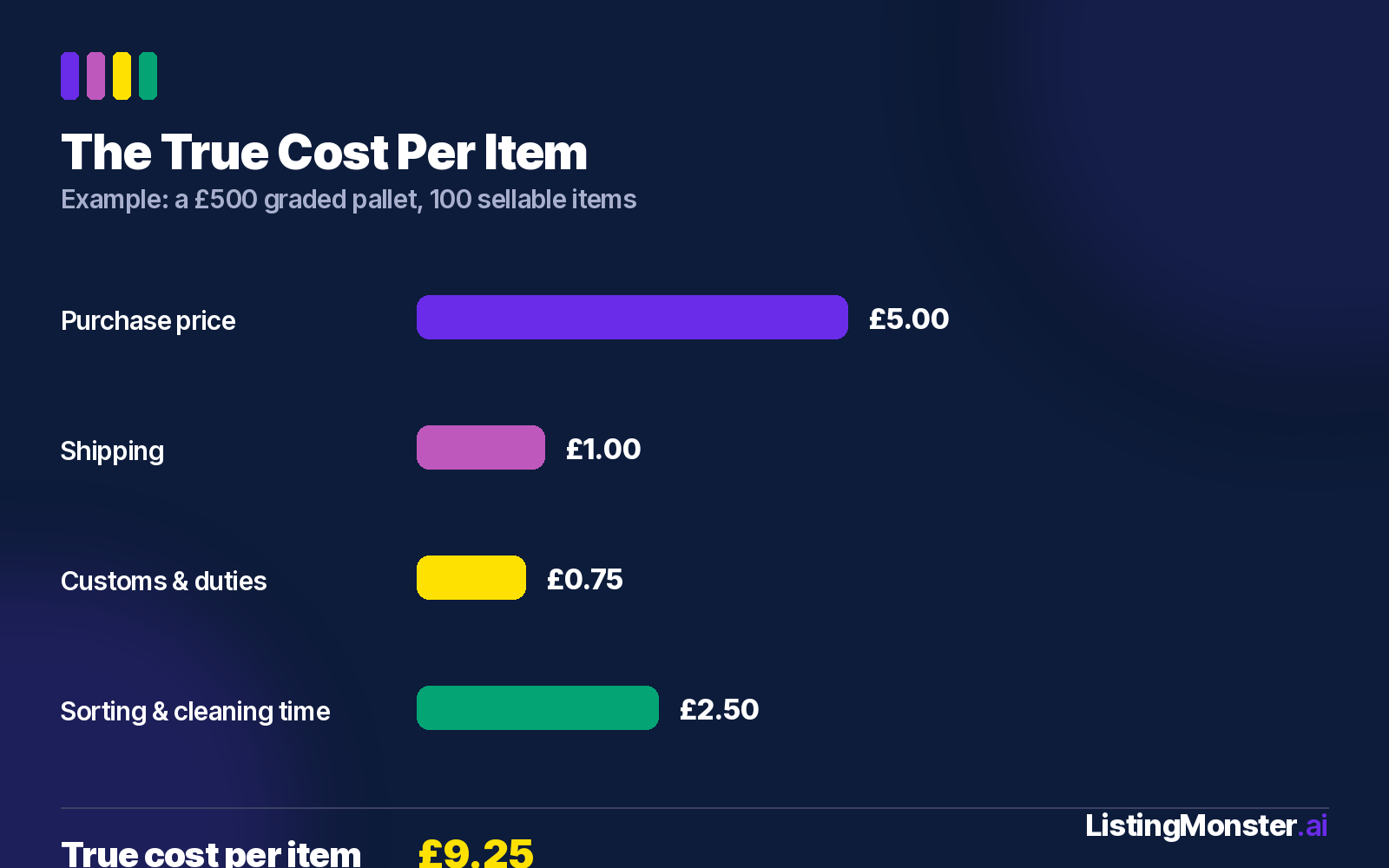
The price per kilo or per piece is the headline number. It's rarely the real number. Shipping, customs and duties on cross-border orders, and the hours spent sorting and cleaning stock before it's sellable all sit on top of the purchase price, and most resellers don't calculate them until after the order lands.
A £500 pallet that takes hours to sort, clean, and separate from filler isn't a £500 pallet. Once you add shipping, customs and duties on a cross-border order, and sorting and cleaning time valued at what your hour is actually worth, a £5.00 per-item purchase price can land closer to £9 once everything is accounted for.
The fix. Before ordering, estimate all four cost components: purchase price, shipping, customs and duties if it's crossing a border, and sorting and cleaning time valued at what your hour is actually worth. Divide that total by the realistic number of sellable items in the lot, not the total item count, since not everything in a grade A pallet is grade A. That's your true cost per item. Compare it to what similar stock actually sells for on your marketplace before you commit.
If you're importing into the US, note that the duty-free exemption that used to cover low-value shipments has been suspended, so cross-border orders that once cleared without any charge now have duties assessed regardless of declared value. Check current thresholds and rules through U.S. Customs and Border Protection before you commit to an overseas supplier.
The volume discount on a larger order is tempting, especially the first time you order from a new supplier or try a new stock category. The math looks better per kilo. What it ignores is your processing capacity.
Stock that arrives faster than you can sort, photograph, and list it doesn't sit as inventory, it sits as a backlog. That backlog is cash tied up, storage space used, and a task you start avoiding, which only compounds the problem. A good rule of thumb, whether it's wholesale stock or any other sourcing channel, is not to buy more than two to three weeks of processing capacity at a time.
The fix. Start smaller than the discount tempts you to. Time how long it actually takes you to process a sample batch from that category, sort, clean, photograph, list, before you order at scale. Once you know your real minutes-per-item for that stock type, size future orders to match what you can clear in two to three weeks, not what gets you the best per-kilo price.
Relying on one wholesaler for all your stock feels efficient right up until that wholesaler changes their pricing, tightens their grading, runs out of your category, or just becomes unreliable. Resellers who've built their whole sourcing model around a single supplier have no fallback when that happens, and it usually happens without warning.
The fix. Once you've found a supplier that works, keep testing one or two others in parallel with smaller trial orders. You don't need to split volume evenly. You need a second and third option already vetted and ready to scale up if your main supplier's terms or quality shift. Suppliers who know you have other options also tend to treat you better on price and priority.
Once the pallet lands, the real time sink starts: sorting, photographing, and writing up every item. That's exactly the gap Listing Monster AI fills, we turn photos into fully optimised listings in seconds. For a deeper look at pricing sourced stock, vetting suppliers, and listing vintage efficiently, our 2026 Reseller Handbook covers all three in detail.
There's no industry standard. Grade A can mean anything from "no visible damage" to a specific mix of era, brand, and condition depending on the supplier. Always get a written definition from your specific wholesaler before ordering, since the same label can mean very different stock quality between suppliers.
Yes, always, especially with a new supplier. A small sample order or recent batch photos let you check real condition and grading accuracy against the price before you commit to a full pallet or bulk grade. A supplier unwilling to provide this is a warning sign.
It varies by country and product category. In the US specifically, the exemption that used to let low-value shipments clear duty-free has been suspended, so imports now have duties assessed regardless of declared value. Check your destination country's customs authority for current thresholds and rates before ordering.
If your stock is arriving faster than you can sort, photograph, and list it, you're over-ordering. A practical guide is to keep no more than two to three weeks of unprocessed stock on hand at any time, regardless of how good the per-unit discount looks.
.svg)
.png)
.png)