
Most avoidable eBay returns come down to one thing: the item didn't match the listing. The way to reduce returns on eBay is to make your listings accurate before the sale, with honest photos, a precise condition description, complete item specifics, and measurements a buyer can trust. Get that right and you cut the returns that hurt most: "item not as described", the kind you can't refuse and the kind that quietly damages your seller account.
This guide is for UK sellers who source to resell. It covers the returns you can actually prevent, the ones you can't, and how to handle the rest so a single unhappy buyer doesn't drag down your metrics.
A return isn't just a reversed sale. You lose the item's sell-through, the postage both ways, your time, and often the item's condition when it comes back. For a reseller shifting volume on thin margins, a run of returns eats a weekend's profit.
The bigger cost is your seller account. eBay evaluates you on the 20th of each month against its seller performance standards, and two thresholds matter: a transaction defect rate no higher than 2%, and no more than 2 cases closed without seller resolution (or 0.3% of transactions). Miss them and you drop to Below Standard, which throttles your visibility.
Then there are Service Metrics, where eBay compares your "item not as described" and "item not received" rates against sellers like you. If your "item not as described" rate is rated Very High for a category, eBay can charge you up to 4% extra on final value fees for that category. Returns aren't just a nuisance. Priced across every sale, they're a tax on sloppy listings.
Not all returns are equal, and the advice for each is different.
Item not as described (INAD). The buyer says what arrived doesn't match what you listed: wrong size, undisclosed flaw, colour off, missing part. These are the returns you generally have to accept and pay return postage on, and they're the ones that count against your Service Metrics. Nearly all of them are preventable, because the cause sits in your listing, not the buyer.
Change of mind (buyer's remorse). The buyer simply doesn't want it. As a UK business seller selling at a distance, you're covered by the Consumer Contracts Regulations 2013, which give consumers a 14-day right to cancel an online order for any reason. These returns are governed by law and your own returns policy, not by listing accuracy. You can't eliminate them, but you can reduce and manage them.
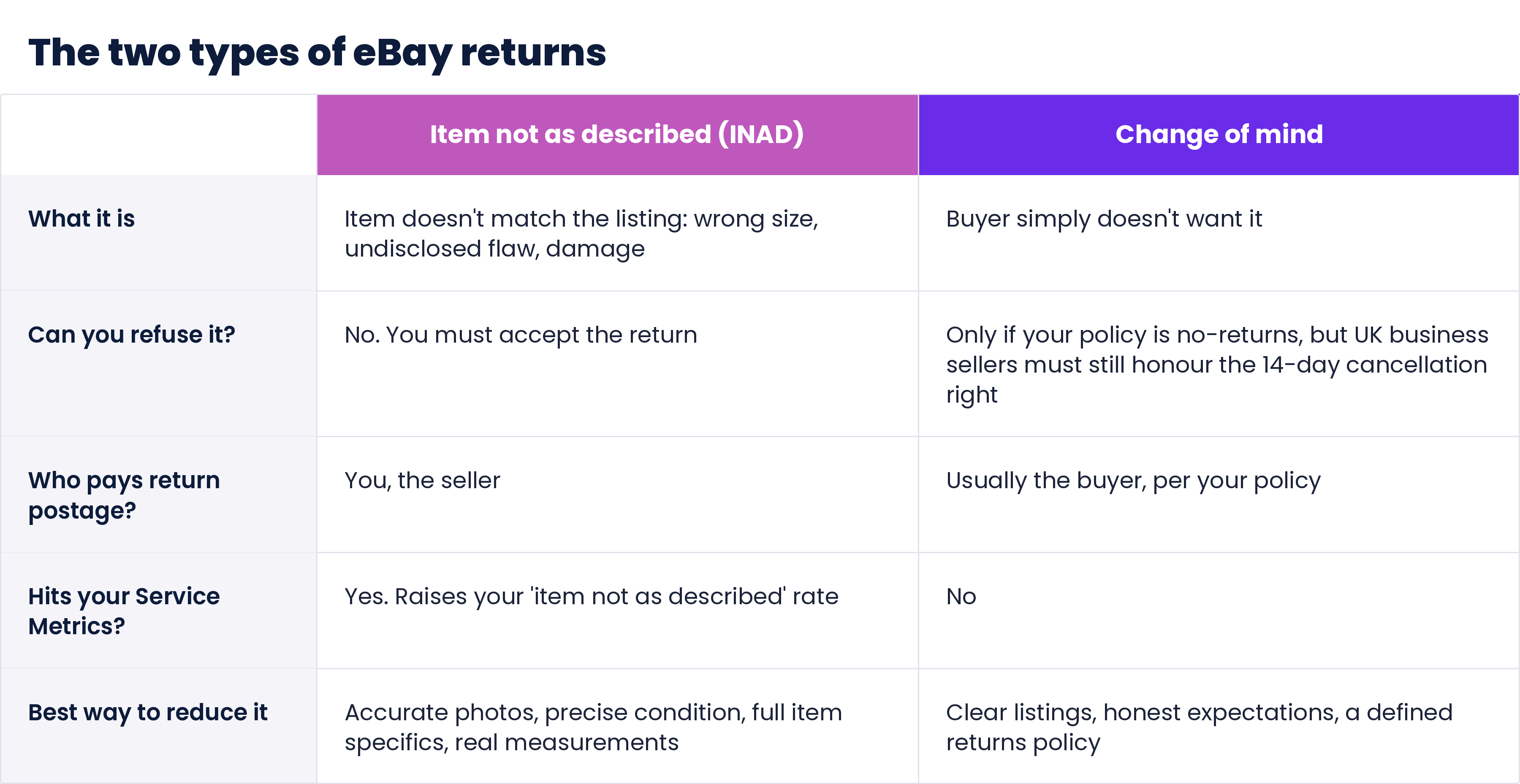
The rest of this guide leans hard on the first type, because that's where the effort pays back most.
Accurate eBay listings are the single biggest lever on returns. The goal is simple: the buyer should open the parcel and find exactly what they expected. No surprises, no disappointment, no case opened.
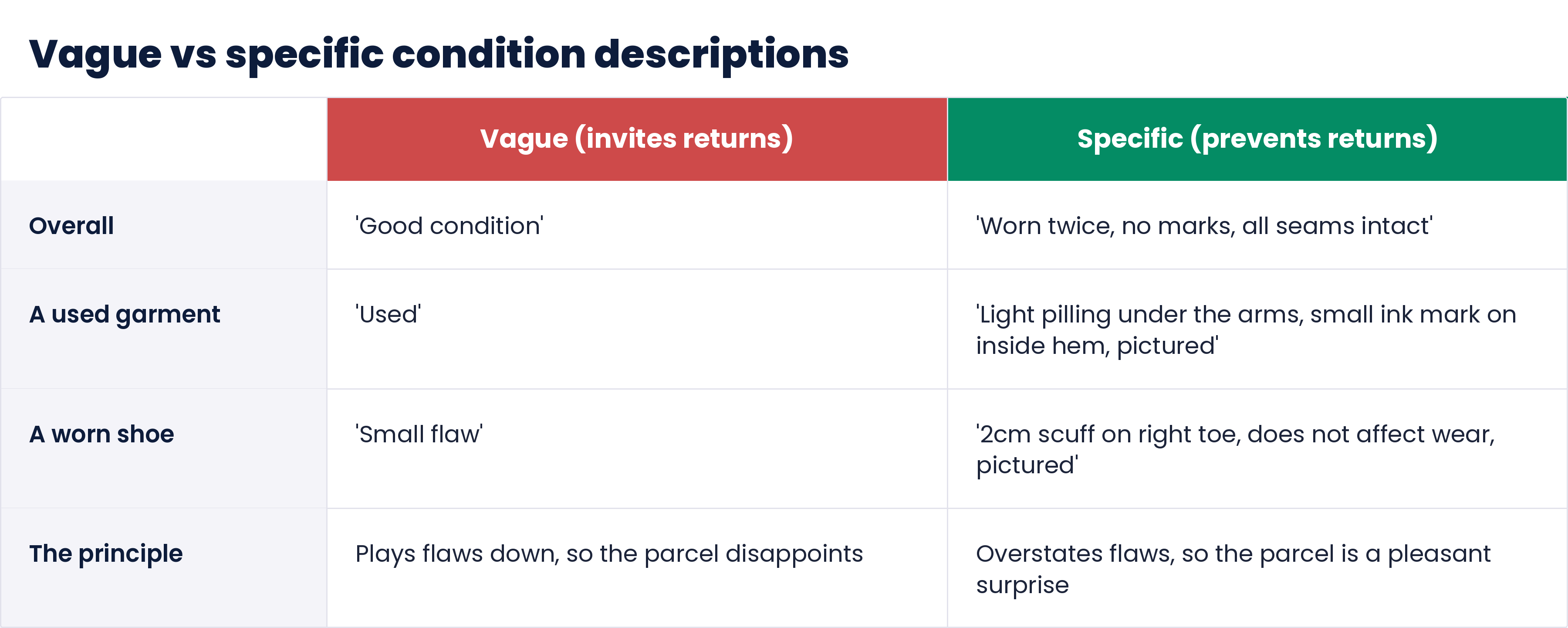
There's a rule experienced resellers learn the hard way, and it runs against instinct: when in doubt, overstate the flaws. People buying second-hand aren't expecting perfect. They'll happily wash a jumper, steam out a crease, or glue a loose sole. What they won't forgive is a flaw that was played down or left out. An over-described item arrives as a pleasant surprise. An under-described one arrives as an "item not as described" case. Every time you're unsure how to phrase a mark or a bit of wear, err toward too much.
Buyers return items when reality is worse than the photos. So show reality. Photograph the item in good, even light against a plain background, then take deliberate close-ups of every flaw: the scuff, the bobbling, the chip, the missing button. A photographed flaw is a flaw the buyer accepted at checkout. A hidden one is a return waiting to happen. For used goods especially, over-showing beats under-showing every time.
"Good condition" means nothing. Two sellers use it for wildly different items. Be specific, and lean toward the unflattering: "Worn twice, no marks, all seams intact" or "Light pilling under the arms, small ink mark on inside hem, pictured." A buyer who knows exactly what they're getting, flaws and all, rarely feels misled. And "the buyer feels misled" is the root of most INAD claims.
Item specifics (brand, size, colour, material, style, model) do two jobs. They put your listing in front of the right buyers through eBay's filters, and they set precise expectations so the wrong buyers don't buy. A listing missing its size or material invites the guesswork that leads to returns. Complete specifics are both a search-visibility win and a returns-prevention win.
Fit is the number one reason clothing comes back. Sizing is inconsistent across brands, decades, and countries, so a label size alone isn't enough. Measure the garment flat and list the key numbers: chest or bust, waist, length, sleeve, inseam. A buyer who checks the measurements against a garment they own is a buyer who keeps the item. This one habit removes a huge share of used-fashion returns. For a wider UK reselling playbook, download the UK Reseller Handbook 2026.
Your eBay returns policy shapes both how many returns you get and how much they cost you. Counterintuitively, a clear, reasonable policy usually means fewer disputes, not more.
Start with the law. As a business seller, you must honour the 14-day cancellation right under the Consumer Contracts Regulations, and if you don't tell buyers about it, that window can extend to 12 months. State your policy plainly in every listing so buyers self-select before they buy, rather than opening a case after.
A few settings genuinely help:
One useful right to know: if a buyer returns an item in worse condition than you sent it, and you offer free returns and aren't Below Standard, eBay lets you deduct up to 50% from their refund to recover the lost value.
Some returns are created after the sale, in the parcel. An item that leaves you perfect and arrives cracked is still an INAD claim on your record.
Pack for the journey, not the shelf: rigid protection for anything fragile, waterproofing for anything absorbent, and enough padding that the item can't move. Use a tracked service, whether that's Royal Mail or Evri, and upload the tracking promptly. Tracking is your evidence against "item not received" claims and it reassures the buyer while they wait. Late and lost parcels convert into returns and defects just as fast as bad descriptions do.
You can't prevent every return, so handle the ones you get cleanly. Speed and politeness resolve most issues before they become cases.
Refund within 2 business days of the item coming back. If a buyer files an "item not as described" claim that you know is false, for instance they've changed their mind but chosen INAD to dodge your policy, you can report the buyer. If eBay agrees, the case is removed from your "not as described" rate and you may get help with the return postage.
It's also worth knowing the protection floor. eBay generally won't apply Service Metrics consequences while your rate in a category is under 1%, or while you've had fewer than 10 requests from unique buyers. A single bad month won't sink you. A pattern will, which is exactly why prevention beats damage control.
None of the above is complicated. The difficulty is consistency. Photographing flaws, grading condition precisely, filling out every item specific, and measuring each garment is straightforward for 5 listings. Across 50, 200, or 600 a month, it's the first thing that slips when you're tired, and the slip is exactly where returns come from.
This is the gap Listing Monster was built to close. It fills out item specifics and writes accurate, descriptive condition descriptions for each item, so the detail that prevents returns is there on every listing, not just the ones you had energy for. You can build custom templates for the things you repeat, like dispatch times and standard condition disclaimers for used clothing, so they appear consistently without retyping. And it speeds up the measurement step so buyers get the fit information that keeps clothing sold. You can book a demo to see how it builds a listing.
The point isn't listing faster for its own sake. It's that better, more complete listings sell for more and come back less. As Listing Monster seller Tom Grimshaw put it: "The listing quality is better than what I was doing manually. Buyers comment on the listing quality."
You can refuse change-of-mind returns if your policy is no-returns, though UK business sellers must still honour the 14-day cancellation right under consumer law. You cannot refuse a genuine "item not as described" return: if the item is faulty, damaged, or doesn't match your listing, you're required to accept it and cover return postage.
Yes. "Item not as described" returns feed your Service Metrics and can raise your transaction defect rate. If your defect rate passes 2%, you risk dropping to Below Standard. A category rated Very High for "item not as described" can also be charged up to 4% extra in final value fees, so returns carry a direct financial cost.
Make the listing match the item exactly. Photograph every flaw, describe condition in specific terms rather than "good", fill out all item specifics, and list real measurements for clothing. Most INAD returns happen because the buyer expected something the listing implied but the item didn't deliver. Remove the gap and you remove the return.
For many resellers, yes. Free returns can unlock Top Rated Plus benefits and fee discounts, and they let you deduct up to 50% from a refund if an item comes back in worse condition. The trade-off is absorbing postage on change-of-mind returns, so weigh it against your margins and average order value.
.svg)