Best US Reselling Platforms 2026: The Top 5 Ranked
.png)
The best US reselling platforms in 2026 are eBay, Mercari, Depop, Poshmark, and Facebook Marketplace, but they are not interchangeable. eBay is the foundation for any serious US reseller, because it pairs around 135 million active buyers with free sold-price data and the only toolset built to handle real volume. Mercari is the strongest low-fee, hands-off complement, Depop wins for vintage and streetwear, Poshmark suits premium fashion, and Facebook Marketplace is for bulky local clearance.
There is no shortage of advice on where US resellers should sell. Most of it is written by the platforms themselves, or by sellers who built a following on one platform and have an obvious reason to recommend it. This is neither.
I have sold at volume across all five platforms below. The scores here reflect what works when you are doing this seriously, not what the platforms say about themselves. And I scored one thing almost nobody talks about honestly: how much daily engagement a platform demands just to keep your listings visible. For anyone weighing up Poshmark, that question matters more than the headline fee.
The US resale market is the largest in the world, and there is no single dominant platform. The right answer genuinely depends on what you sell, and getting it wrong costs you both time and margin.
How I scored each US reselling platform
I scored every platform out of 10 across the five things that decide whether it is worth your time, then totalled them out of 50. On all five, higher is better.
- Buyer demand and sale speed: the size of the active buyer base, how fast stock shifts, and whether buyers actually pay or only hunt for bargains.
- Fees and margin impact: what the platform really takes, including the less obvious costs.
- Scalability: whether the seller tools and listing workflow hold up when you are listing at real volume.
- Seller protection: how disputes are handled, and who the process tends to favor.
- Hands-off selling: how little daily engagement the platform needs to keep your listings visible. A high score means you can list and leave.
eBay: the serious US reseller's foundation
.png)
No other platform on this list takes reselling as seriously as eBay does. The domestic buyer pool is enormous, international shipping is well supported, and the seller tools are mature in a way no competitor has matched.
eBay reported around 135 million active buyers globally, with the US as its largest single market. The auction format gives you access to buyers who are specifically hunting for something, not casually scrolling a feed. Combined with international reach, no other platform here comes close.
I saw this first-hand when I sold a vintage Dragon Ball Z T-shirt to a US buyer for $350 on eBay. It was the kind of item that needed the right buyer, not just a quick local audience. eBay's reach meant it could find someone who understood the value and would pay properly for it.
Fees run about 13.25% plus $0.30 per order in most categories. Higher than Mercari and Depop, lower than Poshmark. The fee stings less when you factor in what you get: a buyer pool and a set of business tools no other US resale platform matches. For domestic orders, postage still eats into your margin, so it pays to match each parcel to the best US shipping options for marketplace sellers.
Scalability is eBay's defining advantage. Business seller accounts, bulk listing tools, Seller Hub analytics, promoted listings, and API access for third-party tools. If you are building a real resale operation, eBay is the only platform here that treats you like a business.
When I was listing at higher volume, eBay took more setup than the simpler apps because the item specifics and category choices mattered. But that extra work usually paid back, because the listings had a longer shelf life and kept finding buyers without constant relisting or daily attention.
That is also why eBay scores so well on hands-off selling. Once a listing is live, it sits there and works. You do not need to share it four times a day to stay visible. For high-volume sellers who want a passive listing workflow, this is a bigger deal than people realize, especially if you have spent time on Poshmark.
Poshmark: fashion community at the highest fee

Poshmark is one of the most talked-about US resale platform. It has the biggest fashion community, the strongest brand recognition among buyers, and a culture of engagement no competitor has replicated. All of that is real and earned. What most Poshmark guides will not tell you clearly is that it also charges the highest fee of any major US resale platform, plus a visibility model that effectively bills you in time as well as commission.
Sellers consistently report spending one to two hours a day on sharing and engagement beyond listing and shipping. The algorithm rewards recency and activity, not just keyword relevance, so listings that do not get shared sink down the feed. Posh Parties, follower counts, and daily sharing are not optional extras if you want consistent sales. They are part of the job.
Here is the number most Poshmark content buries: 20% commission on every sale over $15, and a flat $2.95 on sales under $15. That is the highest fee of any major US resale platform.

Across 100 items at an average of $50, that is a $773 gap between Poshmark and Depop in fees alone. The question is whether Poshmark's community quality and buyer intent justify the premium for your specific inventory. For high-end fashion brands, often yes. For general secondhand clothing, probably not. For most people doing this at scale, Poshmark works best as one channel in a multi-platform mix rather than the primary one.
Mercari: low fees and zero daily upkeep
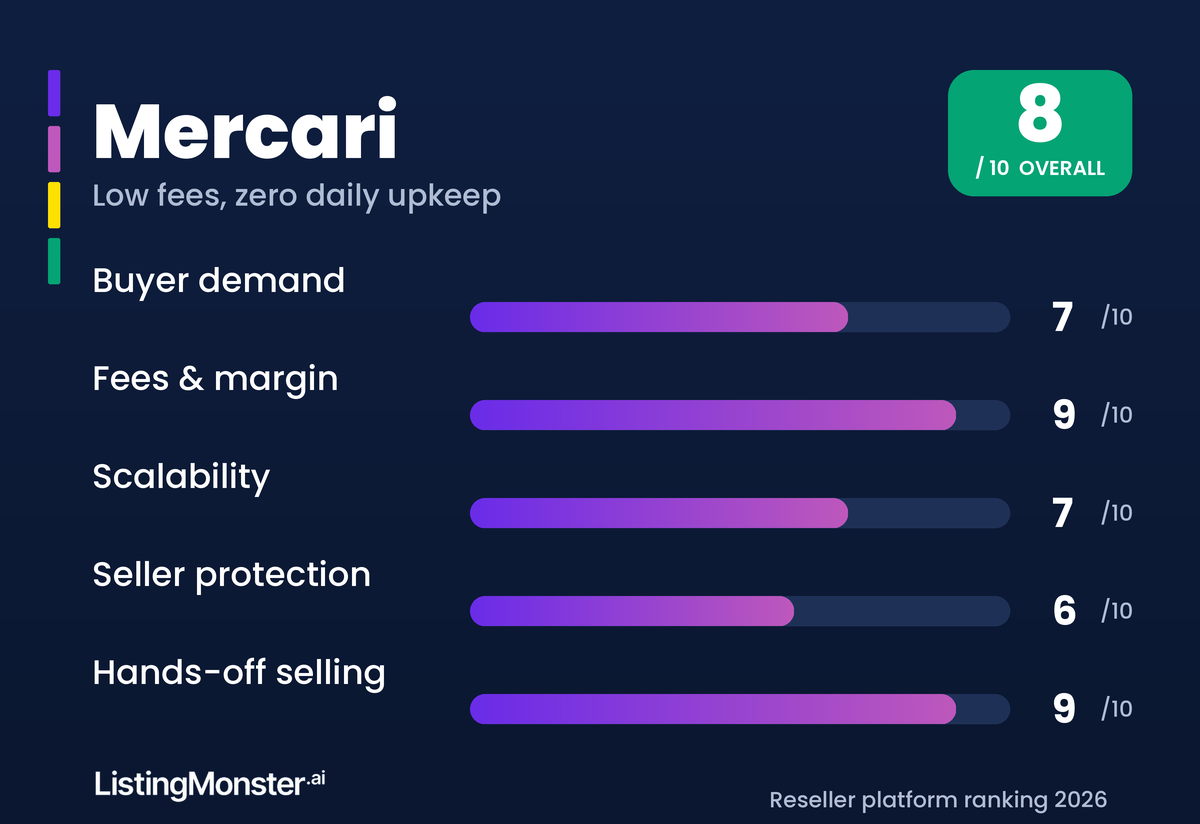
Almost every US reseller guide focuses on eBay and Poshmark, treats Depop as a niche mention, and ignores Mercari almost completely. That is a mistake.
Mercari's US operation reported its first ever full-year profit in fiscal 2025, after years of losses since launching in 2014. US gross merchandise value grew 12% year on year to roughly $196 million in a recent quarter, with growth accelerating since, even as active user numbers slipped slightly. In other words, existing buyers are spending more. The platform charges a flat 10% seller fee, and listings are static, with no daily sharing required.
List it, leave it. No Posh Parties, no sharing loops. If you list a good item at the right price, it sits there and attracts buyers without ongoing work from you. For high-volume sellers who cannot afford two hours a day on platform engagement, that matters a lot.
The buyer base is smaller and more price-sensitive than eBay or Poshmark, so a flat 10% on a $50 item costs you about $5, versus $10 on Poshmark. Sellers who try Mercari tend to stick around, partly for that reason. Most serious US resellers with mixed or non-fashion inventory are leaving money on the table by not being here.
Depop: still the home of vintage and streetwear
.png)
Depop was the fastest-growing US online apparel marketplace in 2024, generating a record $788 million in gross merchandise sales and reaching 43.5 million registered users worldwide by year end, up from 35 million in 2023. For a platform often written off as a Gen Z niche app, those are serious numbers. The US momentum has only built since, with US buyer GMS up around 60% year on year in late 2025, and in early 2026 eBay agreed to buy Depop from Etsy for $1.2 billion, a clear vote of confidence in its trajectory.
Depop worked best for me when an item had a strong visual identity. Vintage branded pieces, graphic T-shirts, Y2K styles, anything that looked good in a clean photo setup, had a much better chance of moving. It was less about the biggest audience and more about matching the right item to a buyer who cared about style and presentation.
On fees, Depop is the cheapest here. US sellers pay no seller commission, only a payment processing fee of about 3.3% plus $0.45 per transaction. On a $50 item that is roughly $2.27, versus Poshmark's $10. The gap is not subtle.
The buyer base skews heavily young, with the majority under 26, highly specific, deeply engaged, and willing to spend on the right items. That cuts both ways. If your inventory is what they want, conversion is strong. If it is not, you are listing into a void. For vintage denim, Jordan 1s, or Y2K pieces with strong visual presentation, Depop is compelling. For general or mixed-category stock, the audience simply is not there for what you are selling.
Facebook Marketplace: local clearance for bulky items

US reselling platform comparison: eBay vs the rest
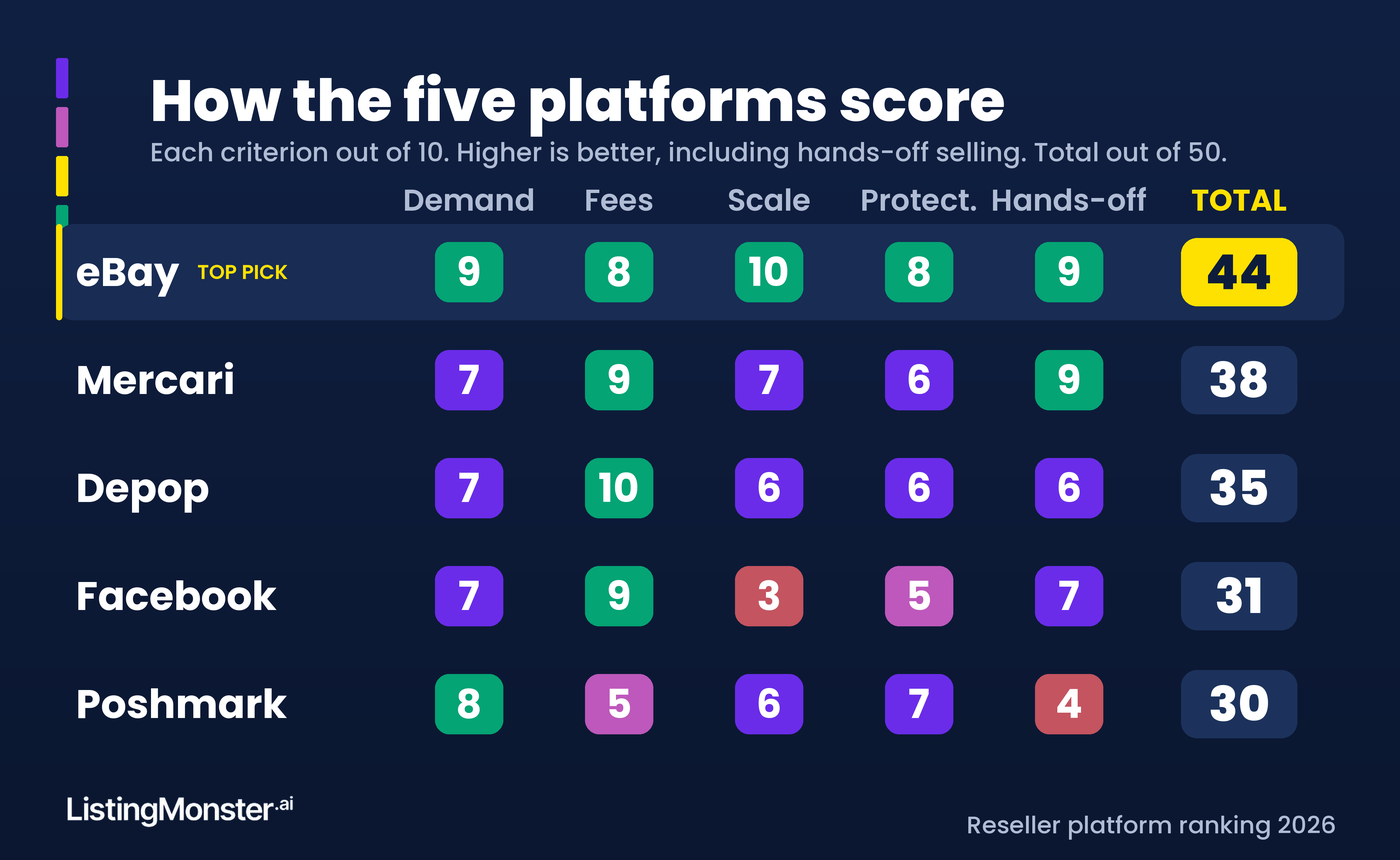
eBay tops the table at 44 out of 50 and is the clear foundation for a serious operation. Mercari follows on 38, winning on low fees and a hands-off workflow. Depop, Facebook Marketplace, and Poshmark sit a tier below for general volume reselling, each strong only for the specific inventory their audience wants.
Which US reselling platform should you actually use?
If you are building a serious US resale operation, eBay is your foundation. The buyer pool, the international reach, and the business seller tools mean nothing else here comes close for treating reselling as a business.
Use Mercari as a low-fee, hands-off complement to eBay. For mixed or non-fashion inventory, it is the easiest second channel to run, because there is no daily engagement to keep up.
Add Poshmark if you sell the fashion its buyers are specifically looking for, such as Lululemon, designer handbags, premium streetwear, and luxury brands. The community quality and buyer intent are genuinely different for that inventory. Just be honest about whether 20% plus an hour or two of daily engagement is sustainable as you grow.
Add Depop if vintage and streetwear is your niche. The zero-seller-fee model is hard to ignore, the growth story is real, and if your stock is what the under-26 buyer base wants, you will find buyers.
Use Facebook Marketplace for local clearance of items that are not worth shipping. Not a primary channel, not scalable, but the right tool for large items where the shipping math does not work.
Where to start based on what you sell
Selling fashion. Start with eBay and Poshmark together. eBay for volume and reach, Poshmark for the fashion community and buyer intent.
Mixed inventory. eBay as your foundation, Mercari as a low-fee, hands-off complement. If you want the fundamentals right from day one, the Reseller Handbook 2026 walks through sourcing, pricing, and platform setup step by step.
Vintage or streetwear niche. eBay plus Depop. The zero-seller-fee model on Depop is hard to ignore if your inventory matches the audience.
Clearing bulky, heavy items. Add Facebook Marketplace as a secondary outlet. Not scalable, but the right tool for items that cannot be shipped.
The more volume you do on eBay and Depop, the more listing time becomes the bottleneck. A well-structured eBay listing with the right item specifics, an optimized title, and accurate condition notes takes real time. Multiply that across 50, 100, or 200 items a week and it is where most of your hours go.
That is the problem Listing Monster was built around: getting your week's listings done without the grind that usually caps how much you can sell. One reseller, GDT Trading, put it like this: "Listing Monster is now the push forward to go each Sunday to source more stuff, that's no longer the bottleneck."
If listing time is what is holding your volume back, book a Listing Monster demo and buy your time back.
Frequently asked questions
What is the best reselling platform in the US?
For most US resellers, eBay is the best platform to build on, because it pairs around 135 million active buyers with free sold-price data and tools built for volume. Mercari is the strongest low-fee, hands-off second channel. Serious sellers usually run eBay as the core and add others by category.
Which US resale platform has the lowest fees?
Depop has the lowest fees for US sellers, charging no seller commission, only a payment processing fee of about 3.3% plus $0.45. On a $50 item that is roughly $2.27, versus $5 on Mercari and $10 on Poshmark. Local Facebook Marketplace sales are effectively free.
Is eBay or Poshmark better for resellers?
It depends on your stock. eBay reaches the widest audience, scales best, and needs almost no daily upkeep, which suits sellers building income across categories. Poshmark has a strong fashion community but charges 20% and rewards one to two hours of daily sharing. Most serious sellers run eBay first and add Poshmark for premium fashion.
Which reselling platform requires the least daily work?
Mercari and eBay require the least. Both let you list an item and leave it, with no sharing or community activity needed to stay visible. Poshmark requires the most, with active sellers spending one to two hours a day sharing listings, sending offers, and joining Posh Parties just to keep sales steady.
Where should beginner resellers start in the US?
Start with eBay and Mercari together. Learn eBay properly, because it has the highest ceiling and the best data, and use Mercari for low-fee, hands-off sales across mixed categories. Add Depop or Poshmark later, only when your stock genuinely fits a fashion-focused audience.