Manual Listing vs AI Listing: How Much Time Do You Actually Save?
Quick answer: When you weigh up manual listing vs AI listing, AI-assisted listing usually cuts the time it takes to create a listing by 2 to 5x. The catch is that the number depends on two things most guides skip: what you sell and how much you sell. AI compresses the writing and admin part of a listing, not the prep. So the honest answer to "does AI listing save time" is yes, a lot, but a book saves you far more than a games console does.
Most articles on this topic are really tool ads. They lead with a big number, 60% faster, 10x, whatever, then point you at the thing they're selling. This one does the less exciting but more useful thing. We break the listing process into its actual steps, time each one by hand and with AI, and tell you where the savings are real and where they aren't. According to ThredUp's 2026 resale report, the US secondhand market grew nearly 4 times faster than the broader retail clothing market in 2025, so the sellers who can list more keep winning more. The question is what "more" costs you in hours.
How long does it take to list an item on eBay manually?
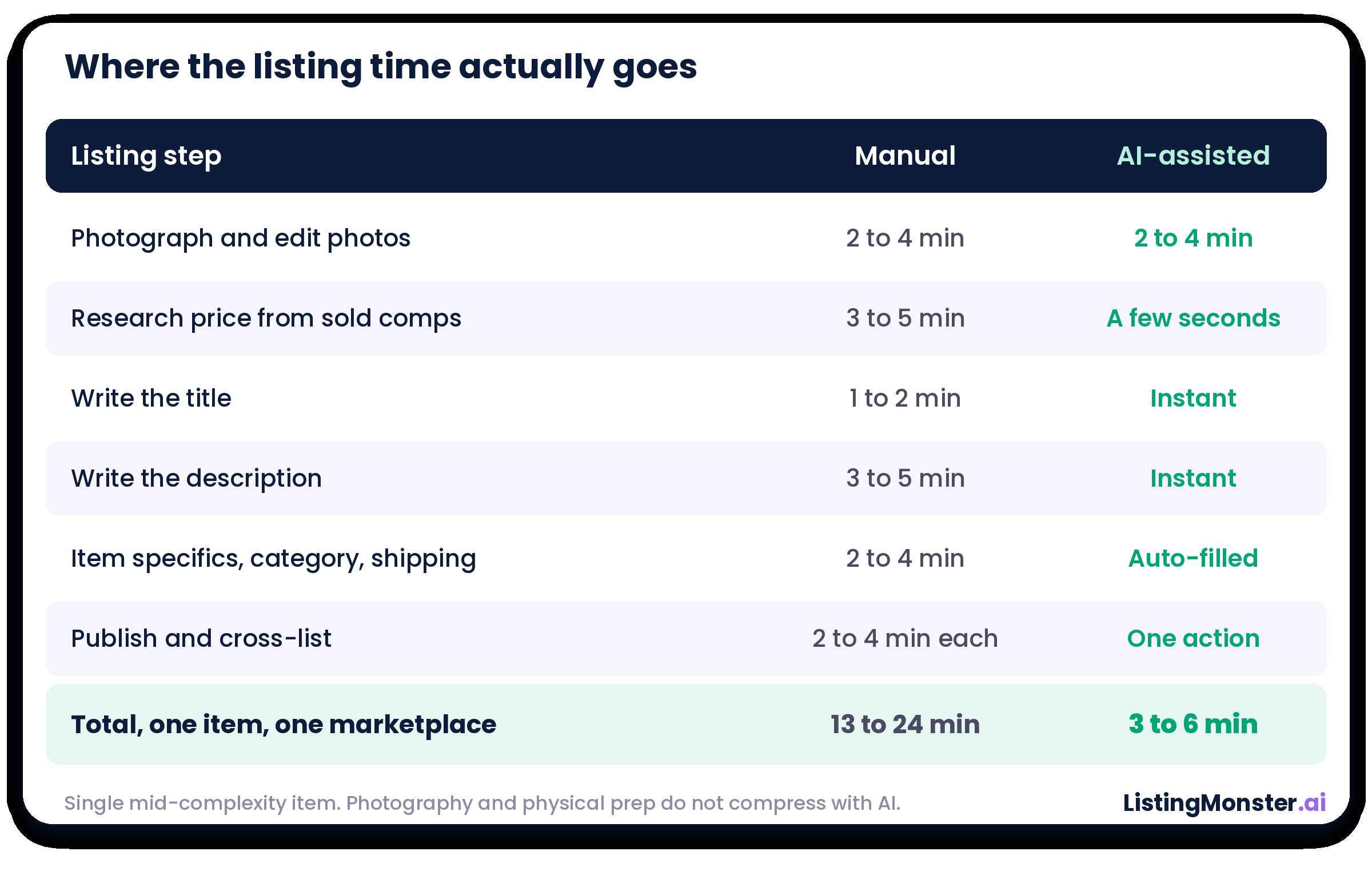
Ask 10 resellers and you'll get 10 answers, but the honest range for a single item is roughly 5 to 20 minutes once you count everything, not just the typing. Here's where a typical mid-complexity item on one marketplace actually goes:
- Photograph the item and clean up the shots: 2 to 4 minutes
- Research a price from sold comps: 3 to 5 minutes
- Write a title that carries the right keywords: 1 to 2 minutes
- Write the description: 3 to 5 minutes
- Fill in item specifics, category, condition, and shipping: 2 to 4 minutes
- Publish, then repeat for each extra marketplace you cross-list to: 2 to 4 minutes per platform
That is roughly 13 to 24 minutes for one item on one marketplace, before you cross-list anywhere. eBay's own guide to creating a listing walks through describing the item, adding photos, setting item specifics and condition, choosing a format and price, then shipping and returns. Each of those is a small decision, and they add up. Do it 50 times a month and listing quietly becomes a part-time job on top of your part-time job. One reseller told us she could manage only 1 to 2 items an hour, and had to block out half a day to make any real dent in her pile.
What AI-assisted listing actually does, and what it doesn't
Being specific here matters, because the vague version of this ("AI does your listings") is why people are skeptical.
An AI listing tool reads your photos and drafts the title, description, item specifics, category, and a suggested price. You review, tweak anything that's off, and publish. With a whole-workflow tool you can batch-upload photos of several items from your phone at once, and the drafts are waiting by the time you finish shooting.
What it does not do is take the photos for you, clean or test the item, or guarantee the price is right. Treat the suggested price as a starting point and check it against real sold comps, especially on anything valuable. The reseller JRG Selection told us that after about 20 listings, they were completing one start to finish in around 1 to 1.5 minutes.
So how much time does AI listing save?
Averaged across categories, expect listing creation to drop by 2 to 5x. But the average hides the real story, which is where the time goes. The savings pile up in the writing and admin steps, not the physical ones.
Notice what happens. Photography barely moves, because a camera still needs a human. But the title, description, and item specifics collapse from 6 to 11 minutes down to under a minute. That's the 2 to 5x. On the writing and admin alone, it's closer to 8 to 10x.
Why some categories save far more than others
This is the part almost no one tells you, and it's the difference between a realistic expectation and a disappointed one.
AI compresses the create step. It cannot compress the prep step. So the more prep a category needs before you can even start a listing, the smaller your percentage saving, even though the tool is doing exactly the same work.
Books and media sit at the easy end. You snap the cover or scan the barcode, there's nothing to clean or test, and the specifics are minimal. Manual might be 5 to 8 minutes, AI-assisted 1 to 2. Huge multiple.
Electronics sit at the hard end. You still clean the item, test that it powers on and does what it should, note any faults, and measure and weigh it for shipping. That's 10 to 20 minutes of hands-on work before AI writes a single word, and none of it goes away. The copy is still instant, so you still save real time, but the percentage is smaller because the fixed prep cost is bigger.
Roughly, from most time saved to least:
- Books, media, sealed or new-in-box goods
- Clothing, shoes, accessories, homeware
- Tested electronics, worn or complex items, high-value authenticated goods
So next time someone quotes you a single "X times faster" figure, the useful question is: for what category?
The real payoff isn't the minutes, it's the throughput
Here's the thing the stopwatch misses. Saving 10 minutes an item is nice, but it's not why resellers say a tool changed their business. The bigger effect is the ceiling coming off.
Before, listing is the bottleneck. It's the backlog you never clear, the reason you ration your sourcing because you know you can't keep up. When listing stops being the constraint, everything downstream loosens.
In our own business, we ran a team of 3 before we moved to AI-assisted listing. One person left right as we made the switch. As a team of 2 with AI listing, we were putting out considerably more than we ever managed with 3. Same shop, one fewer pair of hands, more output. That's not a 10-minutes-per-item story. That's a capacity story.
You'll feel it differently depending on where you are. If reselling is your side hustle, it looks like getting a week's worth of listings done in a single evening and getting your weekends back. If you're full-time, it looks like adding volume without adding hours, and finally clearing the pile that's been sitting in the corner. As the reseller GDT Trading put it, sourcing more stock each week is now the goal, because listing is no longer the thing holding them back. And it isn't only about scale. One seller, Lady GKS, told us she'd been meaning to start selling on eBay for two or three years, and doesn't think she would have without a tool doing the heavy lifting.
Where manual listing still makes sense
An honest comparison has to include the cases where AI isn't worth it.
If you list fewer than about 50 items a month, manual is perfectly manageable and a paid tool is hard to justify on time saved alone. If you're selling one-off, high-value, or highly bespoke pieces where every word of the description is part of the sale, hand-crafting still has an edge. And if an item has no brand or model for the AI to recognize, a plain unbranded something, the tool has little to work with and you'll do more of the writing yourself anyway.
Above that volume, and across most everyday categories, the math tips the other way fast.
AI listing tools for resellers: what to actually compare
Not all "AI listing" is the same thing, and the label hides a big gap.
Single-step help, using ChatGPT to write a description, or a tool that only generates copy, saves you on one step of a many-step job. Useful, but the item still has to be priced, have its specifics filled, get published, cross-listed, and then relisted and repriced over its life to actually sell.
Whole-workflow tools carry the item from photo to published listing across your marketplaces, then keep it selling with automated repricing and relisting. That's where the time saved compounds, instead of stopping at the description. Quality tends to go up too, not just speed: the reseller Grimshaw Findings told us his AI-assisted listings were better than what he wrote by hand, and that buyers actually comment on the quality.
On cost, the math is simple. At roughly $0.65 a listing, if you value your time at more than $15 an hour, the tool has paid for itself the moment it saves you 10 minutes. For a step-by-step framework on building a listing workflow that scales, our Reseller Handbook 2026 walks through it end to end.
Frequently asked questions
Does AI listing save time?
Yes. AI-assisted listing typically cuts listing-creation time by 2 to 5x, and closer to 8 to 10x on the writing and admin steps alone. The savings are largest on low-prep categories like books and smallest on high-prep categories like electronics, where cleaning and testing still take manual time.
How long does it take to list an item on eBay?
Manually, a single mid-complexity item takes roughly 13 to 24 minutes on one marketplace once you include photos, pricing, the title, the description, item specifics, and publishing. With AI-assisted listing, the same item usually takes 3 to 6 minutes, most of which is the photography that AI can't do for you.
Is AI listing worth it for small sellers?
Below about 50 listings a month, manual listing is still manageable and the cost is hard to justify on time alone. Above that, or if listing is the thing capping how much you can sell, AI listing usually pays for itself quickly at roughly $0.65 a listing against your hourly rate.
Does AI listing lower listing quality?
It doesn't have to, and it often raises it. A good tool fills more item specifics and writes more keyword-rich titles than most people manage by hand, which helps search placement. You should still review each draft, correct anything wrong, and verify the suggested price before publishing.
Which categories save the most time with AI listing?
Low-prep categories save the most: books, media, and sealed or new-in-box goods, where there's nothing to clean or test. Clothing and accessories are in the middle. Electronics and high-value authenticated items save the least in percentage terms, because the hands-on prep AI can't touch is a bigger share of the total.

.png)