
eBay gives sellers four core marketing tools inside Seller Hub: Promoted Listings, Store newsletters, Coupons and sale events, and Send Offers to Buyers. Together, these are the eBay marketing tools most likely to move the needle for a full-time reseller, since Promoted Listings gets a buyer to click while the other three convert that click into a sale or bring the buyer back without paying for another one. This guide walks through exactly how to set up each tool, then how experienced full-time resellers combine them for results a single tool can't produce alone.
This guide applies to both eBay US and eBay UK. The Seller Hub steps below are identical on both marketplaces, with one naming difference: eBay UK calls the subscription a "Shop" rather than a "Store." Where fees or access differ meaningfully between the two, it's called out.
All four tools live in Seller Hub, under the Marketing and Advertising tabs. Promoted Listings and Priority Strategy require setup decisions around budget. Newsletters, Coupons, sale events and Buyer Groups require an active Store (Shop, on eBay UK) subscription. Send Offers to Buyers is free to any seller with Buy It Now listings.
The point of stacking them: Promoted Listings gets a buyer to click. Everything else on this list is designed to convert that click, or bring the buyer back without paying for another one.
.png)
Promoted Listings has two strategies. Start with General Strategy if you've never used either.
Setting up a General Strategy campaign:
.png)
Moving to Priority Strategy requires an active Store (Shop) subscription. It's a cost-per-click, keyword-bid model where you pay for every click regardless of outcome. On both eBay US and eBay UK, Priority Strategy is only accessible through an eBay-authorised partner rather than self-serve in Seller Hub. Only use this once you've identified specific high-margin items where top search placement is worth paying for even without a guaranteed sale.
A margin check before you promote anything: take your sale price, subtract item cost, eBay's final value fee, payment processing where applicable, and your proposed ad rate. On eBay US this fee runs around 13 percent in most categories. On eBay UK, business sellers pay roughly 6.9 to 12.9 percent plus 20 percent VAT, plus a small per-order and regulatory fee, so your effective rate is usually in a similar 10 to 15 percent range once VAT is accounted for. If what's left doesn't cover your time and risk, don't promote that item. This is the same Profit per Hour math covered in the Know Your Numbers chapter of the Reseller Handbook 2026.
The attribution change to know before you start: eBay widened its attribution model so a fee can apply if any buyer clicks your ad and a different buyer purchases the same item within 30 days, not just the original clicker. This change reached eBay UK first; eBay US followed on January 13, 2026. If you're already selling on eBay UK, you've likely adjusted for this. If you're on eBay US, build it into your monthly campaign review now.
.png)
These require an active Store (Shop) subscription and are managed from Seller Hub Discounts.
The mistake to avoid: discounting your whole store at once. Target items with high watcher counts and no sales first. That's a clear signal of price resistance, not lack of interest.
This is free and works on any Buy It Now listing with Best Offer enabled, on both eBay US and eBay UK.
.png)
The combination worth knowing: if you have a Store (Shop) subscription, you can attach a coupon to an offer once it's been accepted or has expired, extending a discount to your wider store rather than just the one item the buyer was already interested in.
Requires an active Store (Shop, on eBay UK) subscription. eBay doesn't let you directly ask buyers to subscribe. Buyers opt in by following your store or using the signup link on your storefront.
.png)
Buyers can only receive one newsletter from you every 14 days, so relevance matters more than frequency. The strongest use for a full-time reseller is pairing a send with an active discount, targeted at a specific segment, rather than a generic weekly update.
eBay's own reporting gives a useful anchor here rather than a vague promise. Across January to March 2026, sellers running General Strategy campaigns saw average impressions more than double compared to identical non-promoted listings, according to eBay's own data shared with sellers. On the promotions side, eBay's own marketing guidance sets a rough benchmark for a healthy sale event or coupon: a well-run promotion should lift sales by roughly 20 to 30 percent, and a lift of only around 5 percent is eBay's own signal that the promotion needs adjusting.
.png)
These are eBay's platform-wide averages, not numbers specific to solo resellers. Treat them as a planning benchmark, not a guarantee.
This is where most sellers stop short of what's possible. Each combination below assumes you've already set up the individual tools using the steps above.
Use this when a listing has watchers but no sales, rather than increasing your Promoted Listings ad rate on it.
.png)
Oli Brown, Listing Monster's co-founder, hit this exact problem early on: his listings sat untouched at the same price for months, and his 90-day sell-through was under 50 percent. Switching to a fixed rule, discount every two weeks and refresh at 60 days, took his sell-through to 75 percent and lifted weekly sales by close to 50 percent, even with a slightly lower average price. A scheduled sale event is a faster, less manual way to apply that same discipline to individual listings rather than waiting for stock to go stale.
Use this when a Priority Strategy campaign is winning clicks but not converting.
.png)
Use this to turn a single-item negotiation into a wider store visit.
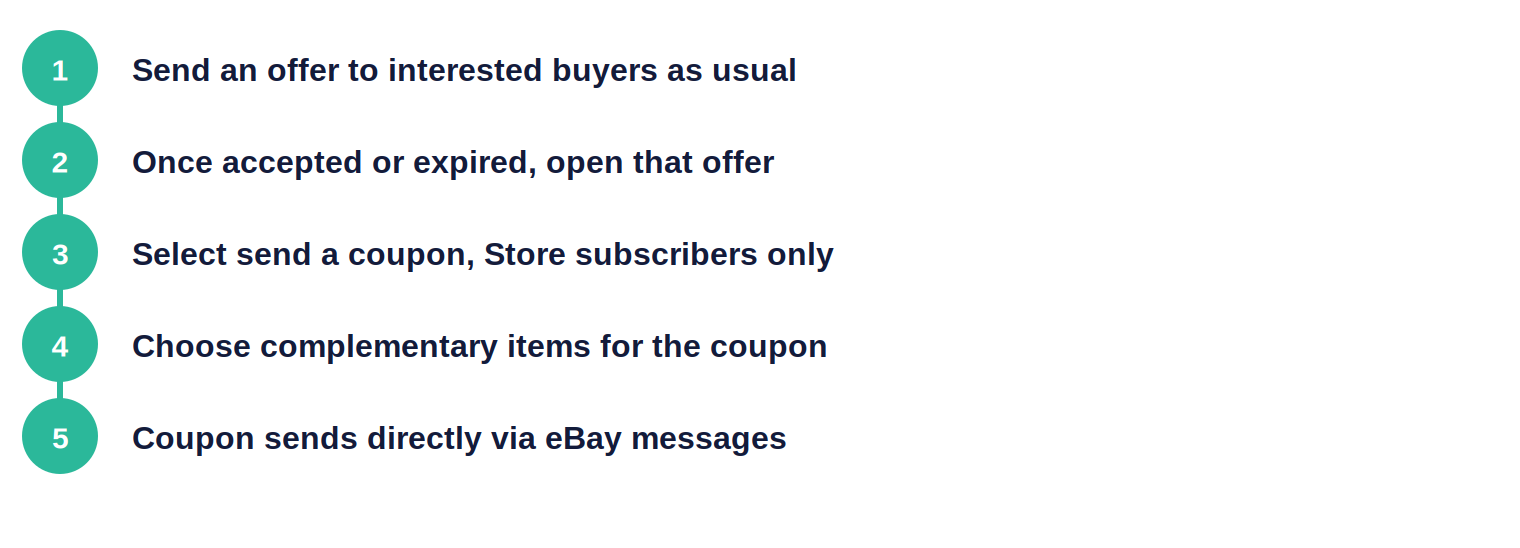
Use this to reach buyers who've already purchased from you, at no per-send cost.
.png)
None of this replaces solid listing fundamentals. A weak title or incomplete item specifics undercuts every tool on this list, since you're paying to make a poorly optimized listing more visible rather than fixing the real problem. Get the listing right first, then layer these tools on top. The Reseller Handbook 2026's Sell-through chapter covers the full set of levers, including repricing schedules and crosslisting, for anyone wanting to go deeper on this before moving to marketing tools.
Do I need an eBay Store to use coupons and newsletters?
Yes. Seller Hub Discounts (coupons, sale events, volume pricing) and Store newsletters both require an active Store (Shop, on eBay UK) subscription. Send Offers to Buyers does not.
What's the difference between General Strategy and Priority Strategy promoted listings?
General Strategy charges a percentage of the sale price and only bills you if the item sells. Priority Strategy charges per click on a keyword bid regardless of purchase, and requires a Store subscription plus access through an eBay-authorised partner.
How often can I send a newsletter to eBay buyers?
Buyers can receive one newsletter from you every 14 days, regardless of how many campaigns you have active.
Can I combine a coupon with an offer I've sent a buyer?
Yes, if you have a Store subscription. You can attach a coupon to an offer once it's been accepted or has expired, extending the discount to other items in your store.
.svg)

.png)
