Best reselling platform UK 2026: where serious resellers should sell
.png)
For UK resellers building real income, the best reselling platform to build on is eBay, because it has 135 million active buyers worldwide, free sold-price data, and the infrastructure to handle real volume. Vinted is the best place to start for clothing, since it charges sellers no fees. Most serious resellers run eBay as their core channel with Vinted alongside it, and only add Depop, Facebook Marketplace, or Etsy when their stock genuinely fits.
Most platform comparison guides land on the same answer: it depends on your category. That is true, but it is not useful. You already know the platforms are different. What you actually need to know is where to put your time, and where not to.
I have sold at volume on all 5 platforms below. The scores here are based on what works when you are doing this seriously, not on what the platforms say about themselves.
How I scored each reselling platform
I scored every platform out of 10 across the 5 things that decide whether it is worth your time, then totalled them out of 50:
- Buyer demand and sale speed: the size of the active buyer base, how quickly stock shifts, and whether buyers actually pay or just hunt for bargains.
- Fees and margin impact: what the platform really takes, including the less obvious costs.
- Listing ease: how long a single listing takes to create properly.
- Scalability: whether the platform holds up when you are listing at real volume.
- Seller protection: how disputes are handled, and who the process tends to favour.
eBay: the best reselling platform for serious UK sellers

eBay has a real learning curve. The item specifics alone trip up most people starting out. Even using "sell similar" to speed things up, you still have to check and update specifics on every listing. Skip them and your visibility takes a hit.
But once you understand it, eBay operates in a different league to everything else on this list. At the end of 2025 it reported 135 million active buyers worldwide, with the UK as one of its largest markets outside the US. Items that get zero interest at home will often sell to a buyer in Germany, Australia, or the US, and eBay's Global Shipping Programme handles customs and logistics once you have packed and dropped off. For domestic orders, postage still eats into your margin, so it pays to match each parcel to the best UK courier for marketplace sellers.
eBay's sold listings search is one of the most underused free tools in reselling. You can see what items have actually sold for, not asking prices, but what buyers paid. Checking sell-through rate before you commit to a source is how you stop making expensive sourcing mistakes.
Fees are real, typically around 12.8% for most categories and higher in a few. But high buyer intent makes fees matter less than they look on paper. Seller Hub gives you views, conversion rate, traffic sources, and pricing data by category. If you want to build something that scales, eBay is the only platform here that gives you the data to do it.
The trade-off is listing time. A structured eBay listing with accurate item specifics, an optimised title, and correct condition notes takes real time at scale. That is the honest cost of eBay at volume, and it is worth knowing going in. However, AI listing tools such as Listing Monster have made this easier than ever, removing the need to list manually.
Vinted: the easiest UK platform to start on

Vinted's numbers are hard to ignore. It reached 17 million UK users in 2025, which puts it second only to Primark and Next by UK customer numbers. No seller fees is its biggest differentiator: buyers pay a small protection fee, and sellers keep the full sale price.
The listing experience is the most frictionless on this list. No item specifics, and shipping labels built in. If you are just starting out, Vinted removes a lot of barriers.
What Vinted's marketing does not cover: the buyer base is heavily bargain focused. You can move volume, but protecting margin takes more discipline than the fee structure alone suggests.
The bigger issue for commercial sellers is account risk. Vinted's automated moderation has become far more aggressive toward sellers who look commercial, and its enforcement against relisting hardened through late 2025 and early 2026. Under Vinted's own rules on commercial selling, it can hide listings and suspend accounts for patterns like high-volume listing, repeated relisting of the same item, regular stock replenishment, or batches of identical new-with-tags items. The pattern I hear most often from resellers who have moved away: their account got suspended without a clear warning.
That is not a reason to avoid Vinted. It is a reason to manage your behaviour and not keep all your eggs in one basket. Keep relisting under control, do not upload large batches of the same item, and do not use it as your primary channel if you are building toward real volume.
Depop: still strong for niche fashion, weaker for volume

I have sold over 40,000 items on Depop, and I have watched it change a lot. In the UK its pull has cooled since the pandemic peak. Depop's UK app downloads hit roughly 245,000 in June 2020 and had fallen to around 91,000 by early 2023.
What Depop still does well is niche fashion. If your stock is curated vintage, Y2K, streetwear, or hype brands, there is a real audience that understands what it is looking at and will pay for it. Depop buyers arrive with an aesthetic. They are not purely bargain hunting.
But if you are selling general secondhand clothing at volume in the UK, Depop is increasingly hard to justify as a primary channel and you should look to Vinted.
However, don't write Depop off just yet. It was announced in febuary 2026 that eBay will acquire Depop from Etsy for $1.2bn, a comeback may be on the cards.
Worth knowing: Depop is still growing globally, driven mainly by the US, so this is a UK-specific cooling rather than a platform in decline everywhere.
Facebook Marketplace: a clearance channel for bulky items

Facebook Marketplace has one clear use case: large or heavy items that make no sense to post. No seller fees on local sales, strong local reach, and a fast turnaround when it works.
Where it falls down is everything else. More no-shows, more lowball offers, and more time-wasters than any other platform here. Scams are a documented problem too. Fake payment confirmation emails, overpayment cons, and collection scams are common enough that you need to know how these scams work before you sell anything valuable.
Use Facebook as a clearance channel for stock that cannot be shipped, not as a foundation.
Etsy: curated vintage only

Etsy had around 86.5 million active buyers globally at the end of 2025, down from about 96 million in early 2024. The audience is highly specific: handmade, vintage, personalised, and niche items. If your stock does not fit that, the traffic will not convert no matter how well you list.
Where Etsy earns its place is properly curated vintage. Etsy buyers will pay more for the same piece than Vinted or even eBay buyers will. For general volume resellers, it is the wrong platform.
Reselling platform comparison: eBay vs Vinted vs the rest
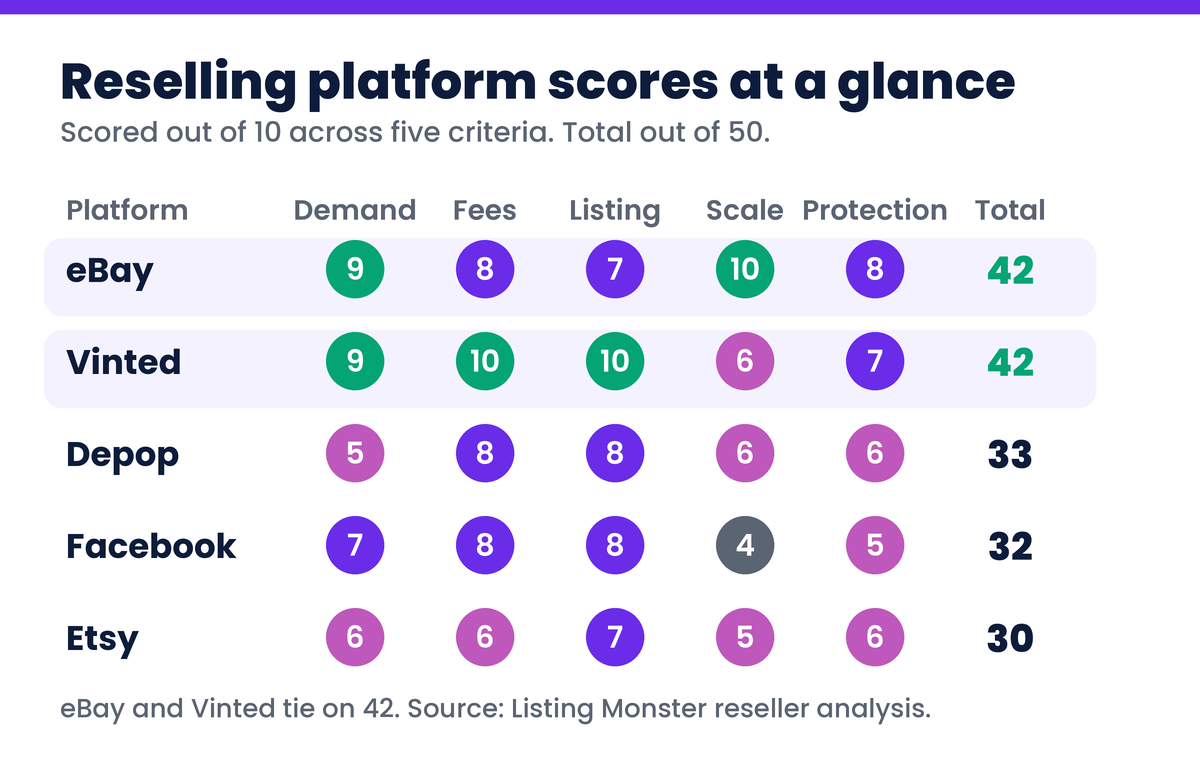
eBay and Vinted tie at the top on 42 out of 50, but they get there in opposite ways. eBay wins on reach and scalability. Vinted wins on cost and listing speed. Depop, Facebook Marketplace, and Etsy all sit a clear tier below for general volume reselling.
Which reselling platform should you actually use?
The direct answer: if you are building something serious, meaning full-time income, consistent monthly revenue, and a business you can grow, eBay should be your foundation. Not because it is perfect, but because it is the only platform here that genuinely supports growth, through seller data, international reach, buyer intent, and the infrastructure to manage volume.
For most resellers that means eBay as the core channel, with Vinted running alongside it for the right stock. Depop if your inventory suits it. Facebook for the bulky items that cannot ship. Etsy if and when your stock evolves in that direction.
What does not work is spreading thin across all 5 from the start.
Where to start based on where you are
Just starting out
Start with eBay and Vinted together. Learn eBay properly, because it has the highest ceiling. Use Vinted for clothing where your buy cost is low. If you want to get the fundamentals right from day one, the Reseller Handbook 2026 walks through sourcing, pricing, and platform setup step by step.
Ready to scale
Make eBay your foundation. Treat Vinted as a complementary channel. Be honest about whether Depop's audience still matches your stock.
Specific inventory
Bulky items that cannot ship go on Facebook. Curated vintage or handmade go on Etsy. Everything else starts on eBay.
The more volume you do, the more listing time becomes the real bottleneck. A properly structured eBay listing, with an accurate title, correct item specifics, and solid condition notes, takes time. Multiply that across 50, 100, or 200 items a week and it is where most of your hours go.
That is the problem Listing Monster was built around: getting your week's listings done without the grind that usually caps how much you can sell. One reseller, JRG Selection, described the shift like this: "About 20 listings into using the platform, I completed one start-to-finish in about 1 to 1.5 minutes."
If listing time is what is holding your volume back, book a Listing Monster demo and buy your time back.
Frequently asked questions
What is the best platform to resell on in the UK?
For most UK resellers, eBay is the best platform to build on, because it has 135 million buyers, sold-price data, and the tools to handle volume. Vinted is the easiest place to start with clothing, since sellers pay no fees. Serious sellers usually run both together.
Is eBay or Vinted better for resellers?
It depends on your stock and goals. eBay reaches the widest audience and scales best, which suits resellers building real income across many categories. Vinted is cheaper and faster to list on for everyday clothing, but it limits commercial sellers. Most experienced resellers use eBay as the core channel and Vinted alongside it.
Which reselling platform has the lowest fees?
Vinted has the lowest seller fees, because sellers pay nothing and buyers cover the protection fee instead. Local sales on Facebook Marketplace are also effectively free. eBay charges roughly 12.8% in most categories, which is higher, but its buyer demand often makes the larger fee worth paying on the right items.
Can you get banned from Vinted for reselling?
Yes. Vinted is built for private individuals clearing their wardrobes, and its automated systems increasingly suspend accounts that look commercial, such as high-volume listings, repeated relisting, or batches of identical new items. You can still resell on Vinted, but keep relisting under control and do not rely on it as your main channel.
Where should beginners start reselling?
Start with eBay and Vinted together. Learn eBay properly, because it has the highest ceiling and the best data. Use Vinted for clothing where your buy cost is low and you want fast, fee-free sales. Add Depop, Facebook Marketplace, or Etsy later, only when your stock genuinely fits those audiences.

.png)