eBay vs Vinted 2026: Which Should UK Resellers Actually Use?
There is no single winner in the eBay vs Vinted debate, and 2026 has made the answer more situational, not less. Vinted still wins on cost and speed for everyday fashion. eBay still wins on scale, higher-value items, and building something that looks like a real business rather than a wardrobe clear-out. The right call depends on what you are selling, how much of it, and where you want this to go.
This guide breaks down the real 2026 numbers on both platforms, where each one actually wins, and why the old "Vinted for clothes, eBay for everything else" rule of thumb is already out of date.
eBay and Vinted: what each platform is actually built for
eBay is a general marketplace. Founded in 1995, it covers almost every category you can legally sell, from clothing to electronics to collectibles to car parts. You can list at a fixed price or run an auction, and it has the deepest toolset of any UK reselling platform: Seller Hub for managing orders and performance, Promoted Listings for visibility, and sold-listing research so you can price with actual market data.
Vinted is a peer-to-peer resale app that started as a fashion swap site in Lithuania in 2008 and has grown into one of the UK's most-used resale apps. Its whole model is built around speed: photograph an item, set a price, and it is live. There is no auction format and, until recently, virtually no categories outside fashion.
If eBay and Vinted don't feel like the full picture, the best UK reselling platforms covers the wider field, including the marketplaces that suit more specialist categories.
eBay vs Vinted fees compared (2026)
This is where most comparisons go stale fastest, so here is what each platform actually charges UK sellers right now.
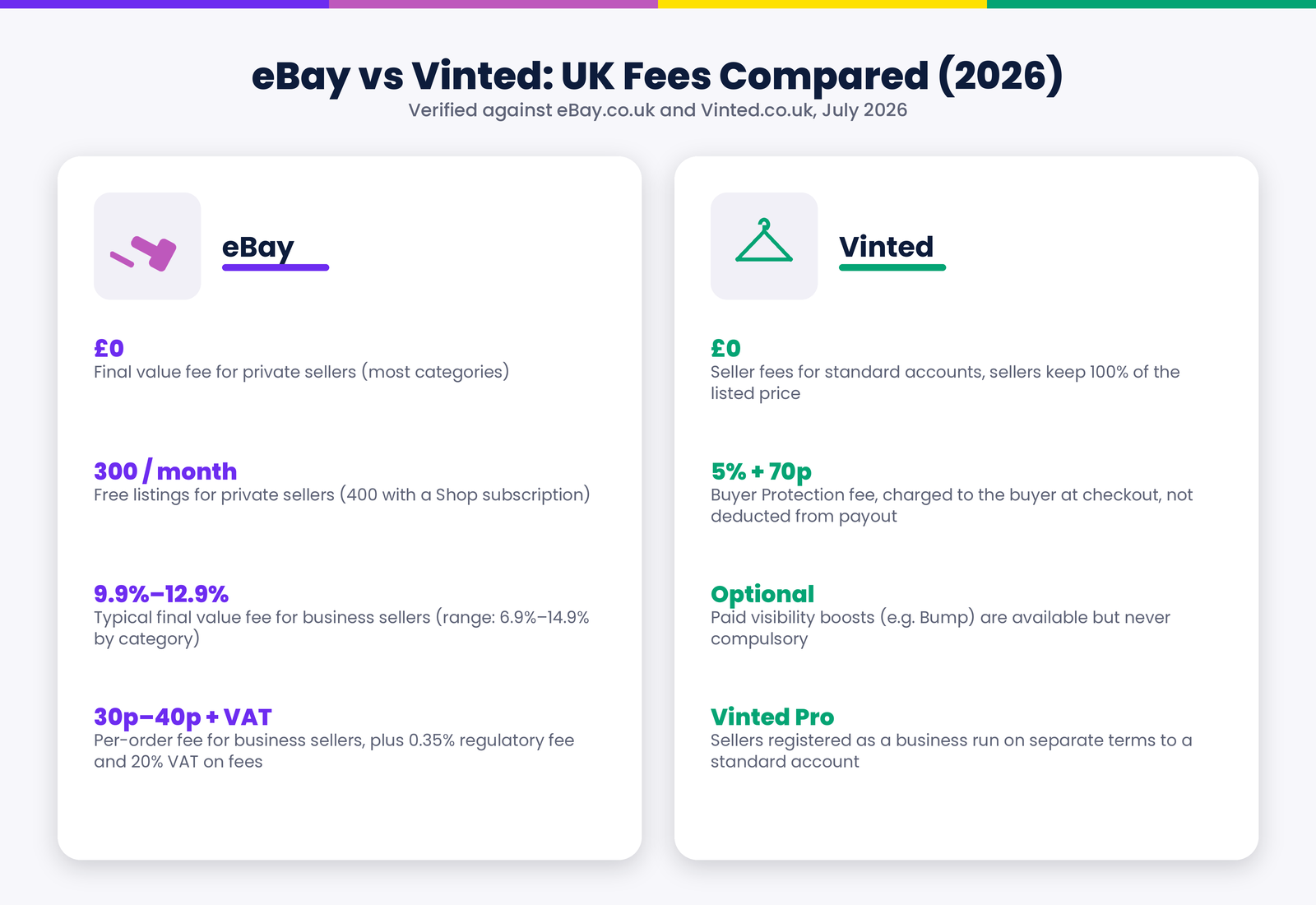
eBay UK fees
- Private sellers pay £0 in final value fees for most categories (Motors is the exception). You get 300 free listings a month (400 with an eBay Shop subscription), then 35p per listing after that.
- Business sellers pay a Final Value Fee of roughly 6.9% to 14.9% depending on category (most fall between 9.9% and 12.9%), plus a per-order fee of 30p (orders of £10 or under) or 40p (orders over £10), plus a 0.35% Regulatory Operating Fee, plus 20% VAT on top of all of that. All in, most business sellers land somewhere around 10% to 15% of the sale.
- An eBay Shop subscription does not reduce your percentage fee in the UK (unlike the US). What it buys you is a bigger free listing allowance and access to Promotions Manager.
Vinted UK fees
- Standard sellers pay £0. No listing fee, no commission, no final value fee. Whatever you list the item for is what you get paid.
- The cost sits with the buyer instead: Vinted charges a Buyer Protection fee of 5% of the item price plus 70p, shown at checkout, not deducted from your payout.
- Optional paid extras exist if you want more visibility (a "Bump" to push a listing up the feed), but nothing is compulsory.
- Vinted Pro accounts, for sellers registered as a business, run on different terms to a standard personal account.
Bottom line on fees: if you are a casual seller clearing a wardrobe, Vinted is cheaper because you keep 100% of your price. If you are a business seller who has crossed HMRC's £1,000 trading allowance, the comparison gets closer, since both platforms now report seller activity to HMRC once you pass around 30 sales or £1,700 in a year, and both come with real running costs once you are trading properly rather than just decluttering.
eBay vs Vinted for selling clothes
For straightforward, everyday fashion, this is the closest call and the one most UK sellers actually face.
Vinted has the built-in audience for it. Buyers open the app specifically to browse clothes, and listing is genuinely fast: photo, price, done. The tradeoff is that Vinted buyers are price-sensitive. They are there for a bargain, and if your price looks high next to similar listings, it either sits unsold or gets low-balled with offers.
eBay reaches a wider, less fashion-specific audience, and its auction format still does something Vinted's fixed-price-only model cannot: let scarcity and demand push a rare or desirable piece well above what a fixed price would have captured. For designer pieces, vintage, or anything with genuine collector interest, that matters. For a five-year-old fast fashion top, it usually does not.
A real example: vintage Woolrich shirts. The same vintage flannel shirt sits on Vinted for £2 to £5, and regularly sells on eBay for £15 to £30. The item is not the variable, the audience is. Vinted skews younger and bargain-focused, while eBay pulls in an older, more established buyer with a genuine appetite (and budget) for vintage workwear. Same shirt, same condition, a completely different outcome depending on where you list it.
Rule of thumb: everyday, on-trend fashion tends to move faster and with less friction on Vinted. Designer, vintage, or anything you'd want a bidding war over tends to do better on eBay, partly because of format and partly because of exactly this kind of audience gap.
Where eBay pulls ahead: scaling a real reselling business
This is the part most eBay vs Vinted comparisons skip, and it is the part that matters most once you are past the "clearing out my wardrobe" stage.
eBay is built for sellers who want to run this as an actual operation:
- Seller Hub gives you order management, performance data, and sales reporting in one place, not scattered across app notifications.
- Promoted Listings let you pay for visibility on specific items, which Vinted's Bump feature only partially replicates.
- Sold listing data lets you price against what has actually sold recently, not guesswork.
- Category breadth means one account can carry your fashion, your electronics, your collectibles, and your general household finds, rather than needing a separate platform for each.
- Higher price ceilings are more culturally normal on eBay. Buyers expect to pay proper money for electronics, tools, or graded collectibles there in a way Vinted's bargain-hunting culture doesn't yet support at the same scale.
Vinted, by contrast, is still built primarily around casual, personal-account selling. It actively discourages commercial-scale patterns on a standard account, and if your selling looks like a business, you will be asked to register as a Vinted Pro seller with different terms. That is not a flaw, it is just a different design goal: Vinted optimises for fast, low-friction fashion turnover, not for running a multi-category reselling business.
Why this comparison won't stay still in 2026
Here's the bit that most "eBay vs Vinted" guides miss, or that is already out of date by the time you read them: Vinted is not staying in its fashion lane.
Vinted added an Electronics category in 2024, covering items like games consoles, music players, and wearables, and it has kept expanding since. By 2026, its category list includes home goods, entertainment, hobbies and collectibles, sports equipment, and even a collectables category covering things like stamps, coins, and trading cards. Vinted's own leadership has spoken publicly this year about continuing that expansion beyond fashion as part of the platform's next stage of growth, alongside a reported valuation north of $9 billion.
What this means practically: the old advice of "Vinted for clothes, eBay for absolutely everything else" is thinner ground than it used to be. For a handful of categories, mainly small electronics and collectables, you now have a genuine choice between the two platforms where a couple of years ago you didn't. Whether Vinted's buyer base for those categories matches eBay's depth yet is a separate question. But the boundary between the two platforms is moving, and it is worth checking which category your item actually sells better in before assuming the old rule still applies.
Which should you use: eBay, Vinted, or both?
There is not one right answer here, so use this as a quick sense check rather than a rulebook:
- Selling occasional, everyday fashion? Start with Vinted. Zero fees and a built-in fashion audience make it the lowest-friction option.
- Selling designer, vintage, or anything with collector demand? eBay's auction format and older, more established buyer base tend to capture more value, exactly like the Woolrich example above.
- Selling electronics, homeware, or collectables? Worth testing both, since Vinted's reach here is newer and still building relative to eBay's established audience.
- Listing 50 or more items a month, across more than one category? eBay's tools (Seller Hub, Promoted Listings, sold data) are built for that volume in a way Vinted currently is not.
- Not sure yet? Most experienced UK resellers end up running both, and pick per item rather than per platform.
Selling on eBay and Vinted without doubling your admin
The most common outcome for anyone reselling seriously is not "eBay or Vinted." It is both, split by category and item type, because the two audiences genuinely do not fully overlap.
The catch is obvious the moment you try it: listing the same item twice means writing it up twice, photographing it twice, and remembering to take it down everywhere else the moment it sells on one platform. That admin overhead is usually the real reason sellers end up sticking to just one marketplace, even when splitting across both would earn them more.
For a fuller breakdown of pricing, packaging, and platform-specific selling tips beyond just these two, our full Reseller Handbook 2026 is worth the download.
FAQs
Is eBay or Vinted better for selling clothes in the UK?
Vinted tends to work better for everyday, on-trend fashion because listing is fast and its audience is fashion-first. eBay tends to work better for designer, vintage, or rarer pieces, where its auction format can push the price above what a fixed listing on Vinted would capture.
Does Vinted charge seller fees in the UK?
No. Standard Vinted sellers pay £0 in listing or selling fees and keep 100% of their listed price. Vinted charges the buyer instead, through a Buyer Protection fee of 5% of the item price plus 70p, added at checkout.
Can I sell electronics on Vinted now?
Yes. Vinted added a dedicated Electronics category in 2024, covering items such as games consoles, music players, e-readers, and wearables, and has continued expanding into home goods and collectables since.
Do I need a business account to sell regularly on eBay or Vinted?
If you are buying items specifically to resell them, both eBay and HMRC expect you to register as a business seller once you're trading regularly, generally past the £1,000 trading allowance. Both platforms now report seller data to HMRC once you cross around 30 sales or £1,700 in a year.
Can I list the same item on eBay and Vinted at the same time?
Yes, and many experienced resellers do exactly this to reach both audiences. The main risk is forgetting to delist it everywhere else the moment it sells on one platform, which is the main admin cost of running both.
.png)

.png)