.png)
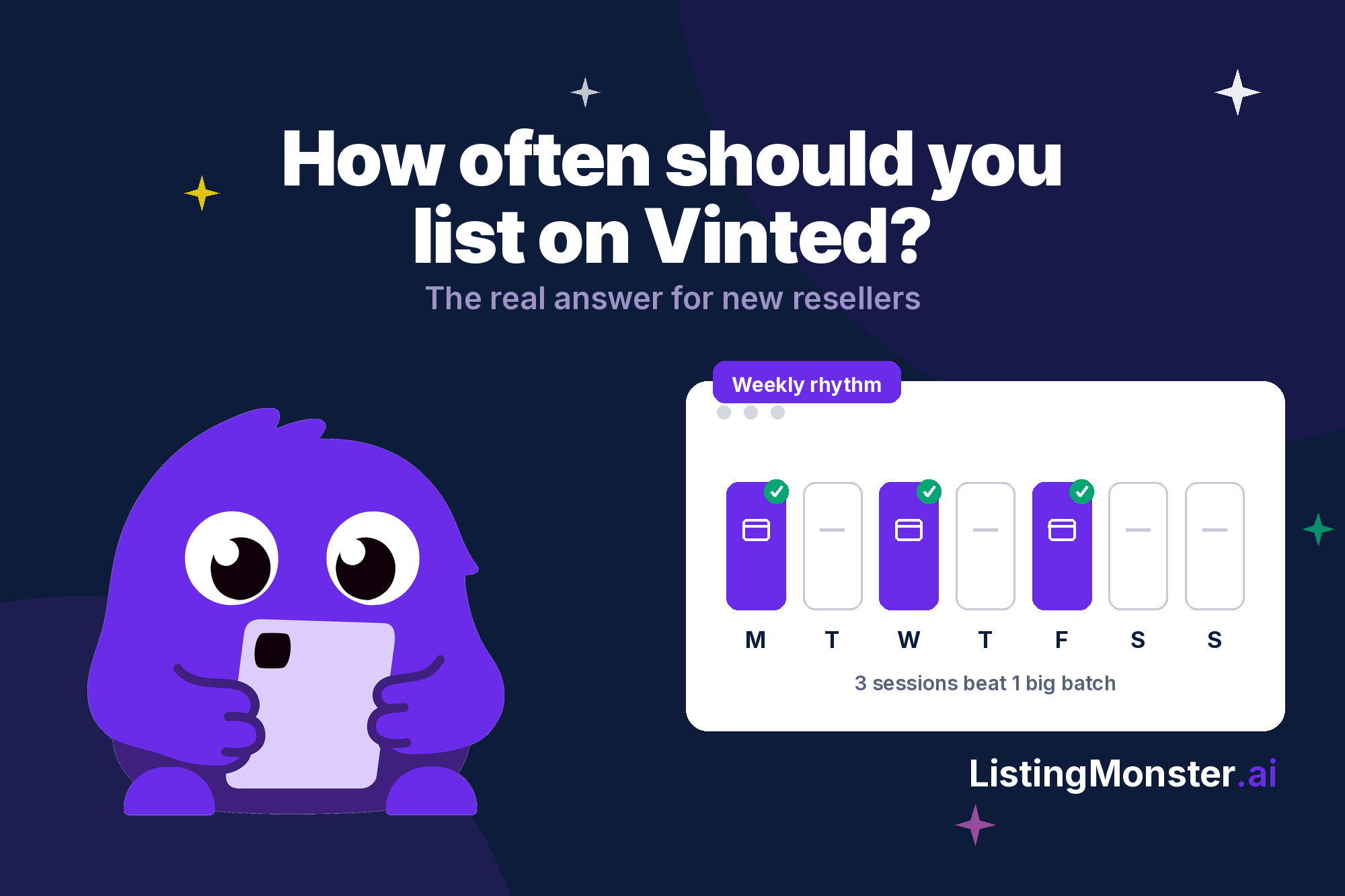
Short answer: For most new Vinted resellers, 2 to 3 listing sessions a week is enough. Vinted confirms that listing age and listing frequency are both parameters its systems use, but it doesn't publish a daily-listing requirement. Consistency matters more for keeping stock moving through your business than for gaming the algorithm.
You'll find ten different opinions on how often should you list on Vinted: daily, every 3 days, twice a week. Most of it is guesswork dressed up as certainty. This guide sticks to what Vinted and eBay actually disclose about their own ranking systems, then makes the case for why a routine matters more as a business habit than as an algorithm hack.
Vinted publishes more of this than most reseller blogs let on. Its help centre confirms its recommender systems use a defined set of parameters to rank and recommend listings, including:
Time since upload is a real ranking parameter. Listing age can affect how an item is ranked or recommended. Listing frequency is disclosed separately: uploading several items within a short window changes how Vinted shows them to buyers, though Vinted doesn't spell out the mechanics beyond "proportionate."
What Vinted does not say anywhere is that your shop as a whole loses ranking because you go quiet for a few weeks, or that editing an existing listing resets its recency. Those are different claims, and reseller blogs regularly collapse them into one. You'll see the term "freshness boost" all over reseller content. Vinted doesn't use that language itself.
See Vinted's own explanation of how recommendations work for the full parameter list.
Because Vinted explicitly names listing frequency as a parameter used when a member uploads multiple items within a short period, there's a reasonable case for spreading a large batch across several sessions instead of publishing it all at once. Vinted says this shows those listings to buyers in a proportionate way. It doesn't publish enough detail to say exactly how one batch of 30 compares with three batches of 10, so don't treat this as a guaranteed sales advantage. It's simply one disclosed reason spacing uploads out can make sense, not a guess dressed up as a rule.
The platform benefit above is real but modest. The bigger reason to build a listing routine is what happens to your business when you don't.
New resellers often list in bursts. Photograph a backlog after a car boot haul, upload it all in one sitting, feel great about it, then life happens and nothing goes up for two or three weeks. Sourced stock piles up in bags in the corner of a room. Coming back to a backlog feels heavier than it should, so it gets put off again. That's the cycle that turns listing into something to dread rather than a habit, and it has nothing to do with what the algorithm is or isn't doing.
The value of routine isn't unique to listing. Listing Monster co-founder Oli Brown saw the same effect when he introduced a fixed repricing and relisting schedule:
"When I started reselling I left listings untouched at the same price for months. My 90-day sell-through was below 50%. I switched to a simple rule that I stuck to no matter what: discount every two weeks, refresh (delete and relist) at 60 days. Sell-through hit 75%. My weekly sales were up nearly 50% even with a slight drop in ASP."
The point isn't that repricing proves anything about Vinted's listing algorithm. It doesn't. It's that repeatable systems stop inventory management becoming something you only do when motivation strikes. The Reseller Handbook 2026 walks through Oli's full pricing and relisting system, along with the sourcing and dispatch routines that go with it.
eBay uses a different ranking system (Best Match), and it's specific about what feeds into it. eBay's own guidance lists query relevance, item popularity, price, listing quality and completeness, selling terms (returns policy, handling time), and seller track record as the factors that decide where a listing appears in search.
eBay's Best Match guidance doesn't give sellers a target for how often to create new listings. Its broader User Agreement does say search placement can consider a seller's history, including "listing practices," alongside Detailed Seller Ratings, policy compliance, feedback and defect rate. eBay doesn't define listing practices as a requirement to list daily, or even consistently, and its own advice to sellers focuses on complete, accurate listings, competitive pricing and shipping, and good customer service, rather than upload frequency.
So if you're asking how often should you list on eBay, there's no specific number to chase. Set a frequency that keeps stock moving through your business and your account in good standing, and treat consistency as a business decision rather than a ranking hack.
There's no official threshold from either platform, so this is a recommendation, not a rule, and it scales with how much stock you're moving:
If you've got 30 items ready, publishing 10 on Monday, 10 on Wednesday and 10 on Friday beats feeling obligated to create listings from scratch every single day, and it lines up with the listing frequency point above.
The practical way to hit any of these tiers without burning out is separating two jobs. Batch the slow work, photography, measurements, research, writing descriptions, into one sitting when you've got a free block of time. Then publish the prepared listings across several sessions instead of all at once. You get the time-efficiency of batching and the small, disclosed advantage from spreading uploads, without listing from scratch every day.
If you have no new stock ready in a session, use the time to review older stock instead: improve a weak photo, tighten a description, reconsider the price, or decide whether an item's worth relisting.
No. Vinted confirms that time since upload and listing frequency are both parameters its systems use, but there's no published requirement to add items every day. A routine of 2 to 3 sessions a week is a realistic starting point for most beginners, scaling up as your stock volume grows.
Yes. Deleting and reposting a listing removes any likes and interaction history built up on it, which is worth knowing before you relist. Vinted hasn't published anything confirming that editing a listing's photo, price or description gives it a fresh recency boost, so treat editing as a way to improve the listing itself, not as a guaranteed ranking reset.
There's no official eBay listing-frequency target. Best Match considers query relevance, price, listing quality, completeness, popularity, selling terms and seller track record, and eBay's User Agreement notes that a seller's listing practices can factor into search placement, without defining that as a daily requirement. Set a frequency that keeps inventory moving without sacrificing listing quality.
Vinted doesn't disclose any ranking penalty simply for not uploading for a few weeks. Your existing listings stay live, but they're ageing while new competing items continue entering the marketplace from other sellers. When you're ready to start listing again, just resume at whatever pace you can sustain. There's no published penalty or recovery period to work around.
It can be, if that's genuinely the routine you'll stick to. A single monthly batch beats an unrealistic daily target you abandon after a week. The advantage of spreading listings out instead is that Vinted's listing frequency parameter treats a large batch differently to several smaller ones, so more frequent batches can make sense if you can sustain them, not because a single batch is penalised.
.svg)
.png)
.png)