
Every time a buyer types something into eBay's search bar, a system called Cassini decides which listings get seen and in what order. Most guides explain Cassini in the context of a dropshipper with 10,000 identical products. This one is written for resellers working with unique, secondhand stock, which is a meaningfully different problem.
Cassini is eBay's internal search engine, introduced in 2013. Its job is to predict which listing is most likely to lead to a completed, satisfactory transaction. Not just which listing is most relevant, but which one is most likely to sell.
That distinction matters. Cassini isn't optimizing for clicks. It's optimizing for purchases. A listing that gets lots of views but no sales will actively hurt your ranking over time. A listing that converts well, even with modest traffic, gets rewarded.
Cassini doesn't publish its weighting, but eBay's own seller guidelines and a decade of observed results point to a clear hierarchy.
1. Title keywords — and their order
The single strongest relevance signal. If a buyer searches "Nike Air Max 90 US 9 black" and those words aren't in your title, you don't rank, regardless of everything else. Cassini can't read your description. It reads your title.
Beyond including the right keywords, order matters too. Lead with the most critical terms for your product type, because a title that mirrors how a buyer actually searches scores higher than one with the same words in a different sequence. In fashion, that means brand, model, type, size upfront:
"Levi's 501 Jeans 32x30 Medium Wash" will outrank "Medium Wash Denim Jeans Levi's 501 32x30" — identical keywords, different result.
Use all 80 characters.
2. Item specifics
When a buyer filters results by brand, size, color, or condition, eBay only surfaces listings with those specifics filled in. Leave them blank and you're invisible to every filtered search.
Importantly, item specifics also help drive external traffic (i.e off-eBay) to your listings. Item specifics represent the ‘structured data’ used by external search engines and AI chatbots to find your products on eBay. By filling out item specifics your products will turn up in fast growing sources of traffic such as Google Shopping and ChatGPT.
Fill every field eBay offers for your category (a good job to outsource to AI), not just the required ones. A few examples of what gets missed:
Item specifics don’t just affect your visibility when buyers use eBay’s filters, they also act as an additional keywords beyond the title that can show up when a buyer uses the general ebay search bar. Titles are limited to 80 characters, if you fill out item specifics you can push your searchable keywords up to 150-200 characters.
“Item specific fill out has been a major focus of eBay’s recent seller clinics, with up to a 4x improvement in traffic quoted”
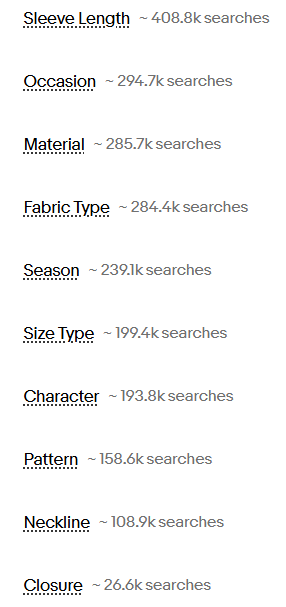
Every keyword brings with it an associated amount of search volume (albeit with different levels of intent). eBay actually give you this data on the listing page. The more relevant, high-intent keywords specific to your product you can add to your title and item specifics, the most search impressions you will generate per listing. If your click through rate and conversion rate hold steady, then more search impressions = more views = more buyers.
3. Click-through rate, engagement and conversion rate
Cassini tracks whether buyers click your listing, whether they add to their watchlist, and whether they then buy. Listings that convert well get surfaced more. Listings with high impressions and no action get quietly deprioritized.
This is why photos matter beyond just trust. A weak lead photo kills click-through rate, which drags down ranking over time even if the title was perfect. eBay's data points to 10-12 photos as a meaningful threshold — the platform average sits around 8. For listings where you're jostling for position with similar items, those extra photos can be the difference.
4. Seller performance
Cassini gives a visibility boost to Top Rated sellers and suppresses Below Standard accounts across their entire inventory, not just individual problem listings. One run of late shipments or an unresolved defect case doesn't just hurt that transaction. It quiets the whole store in search.
5. Listing consistency
If you have 70 items ready to publish, spreading them across 7 days at 10 per day will serve you better than publishing all 70 at once. Consistent daily activity signals an active, healthy store. A single spike followed by silence doesn't.
6. Listing freshness
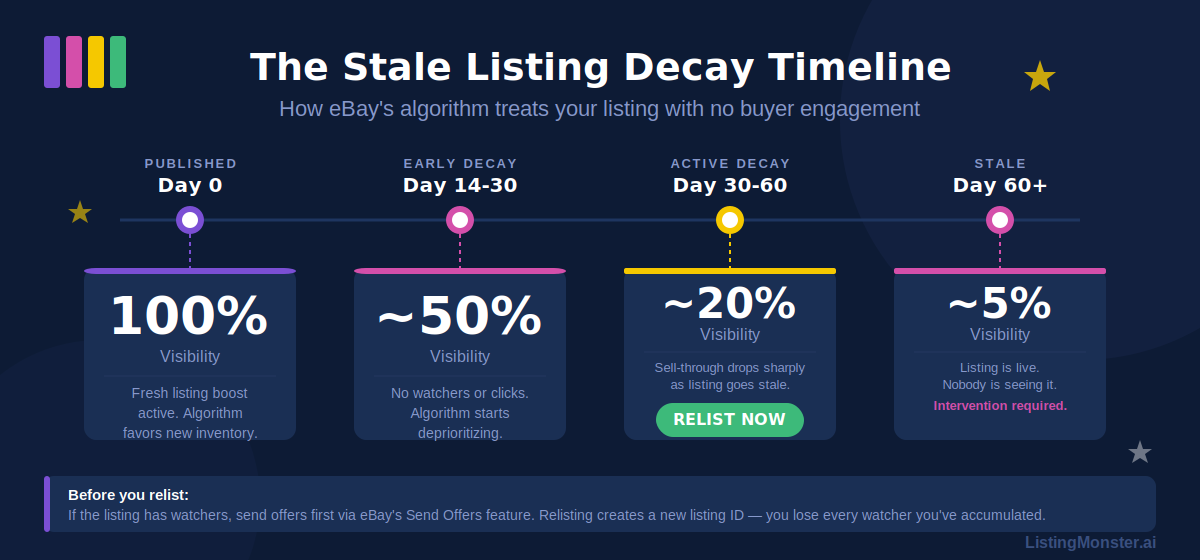
Cassini treats freshness as a demand signal. A listing that hasn't had meaningful engagement — clicks, watchers, offers — in the past 14 to 30 days starts losing rank. By day 90, the algorithm has effectively written it off. How to diagnose it, and what to do about it, is covered in full in the next section.
This is the one that quietly eats most resellers' stores alive.
eBay's Good Till Cancelled listings auto-renew every 30 days. Most sellers assume that means the listing stays visible. It stays active. It doesn't stay visible.
Based on patterns from our seller community and customer base, here's roughly how the decay plays out:
The fix is relisting: ending the listing and recreating it, or using Sell Similar. Both generate a new listing ID and give the item a fresh-start boost. But there's a nuance here that most guides miss entirely.
If a listing has watchers, don't just relist it.
When you relist, you create a brand new listing in the eyes of the algorithm. You lose every watcher you've accumulated. For a listing with no traction, that's no loss. For a listing sitting at 8 watchers with no sale, relisting without attempting a sale first is leaving money on the table.
The right sequence:
For listings with no watchers and no engagement? Just relist. There's nothing to lose.
Everything above applies to all eBay sellers. But secondhand resellers face a version of this problem that new-goods sellers don't.
A dropshipper lists 10,000 units of the same product. Keyword research is done once. The item specifics template copies across every listing. The title is written once and tested over time.
You list a thrift haul of 40 completely different items from a Saturday garage sale run. Every title is written from scratch, for an item that might have 5 sold comps on eBay if you're lucky. Every set of item specifics is assessed individually. And because your items are one-of-a-kind, you don't get the benefit of a listing building sales history over time. Every item starts at zero.
That's why listing quality matters more for secondhand resellers than the generic guides acknowledge. You only get one shot per item. A weak title or incomplete specifics on a unique piece means that item may never surface for the right buyer. There's no version 2 of the same SKU.
For a deeper look at how to build a listing system that handles this at volume, the Listing Monster Reseller Handbook 2026 covers sourcing-to-sale workflow in full.
Most of this isn't news. The resellers who win on eBay search are usually not the ones who know more — they're the ones who actually execute consistently. In practice that means:
The algorithm isn't complicated. It rewards sellers whose listings look like things buyers want to buy. The job is making sure yours send that signal clearly, and keep sending it.
Earlier than most sellers expect. Based on seller community data and reseller feedback, listings with no buyer engagement signals start losing algorithm favor somewhere between day 14 and 30. By day 90, a listing is truly stale and statistically unlikely to sell without being relisted. Auto-renewal every 30 days keeps the listing active, but it doesn't reset its position in search.
Yes, but with an important caveat. Relisting or using Sell Similar creates a new listing ID, which gives the item a fresh-start boost in Cassini. For listings with no traction, relist without hesitation. For listings that have accumulated watchers, send offers to those watchers first via eBay's Send Offers feature. When you relist, you lose every watcher. That's a missed sale opportunity if you haven't tried to convert them first.
Cassini is eBay's internal search algorithm, in place since 2013. It determines which listings appear in search results and in what order. It ranks listings based on how likely they are to result in a completed sale, factoring in title keyword relevance, item specifics, seller performance, engagement signals like clicks and watchers, and listing freshness.
It feeds positive signals into your store's overall health. More importantly, spreading your listings across multiple days outperforms bulk publishing. If you have 70 items to list, 10 a day for 7 days will serve you better than a single upload. Consistent daily activity signals an active, well-managed store. One large batch followed by nothing doesn't.
.svg)

.png)