Reselling Tax UK: What You Actually Owe HMRC
.png)
If you buy stock to resell on eBay or Vinted, you owe Income Tax and possibly National Insurance on your profit once your trading income passes £1,000 in a tax year. Selling your own unwanted clothes and gadgets is a different story and usually isn't taxable at all. The rules didn't change with the "side hustle tax" headlines. What changed is that HMRC now gets sent your sales data directly from the platforms.
This guide covers exactly where the line sits, what you owe once you're over it, and what actually changed with platform reporting from January 2024.
Selling your old stuff vs running a business
HMRC doesn't care that you're using Vinted instead of a car boot. What it cares about is whether you're trading. Clearing your wardrobe of things you bought for yourself, at a loss or for roughly what you paid, isn't trading. Buying stock with the intention of reselling it at a profit is.
HMRC uses a set of indicators known as the "badges of trade" to work this out, including:
- How often you sell (a one-off clearout vs weekly listings)
- Whether you buy specifically to resell, rather than sell things you already owned
- Whether you're organised about it (sourcing trips, a system, repeat suppliers)
- Whether your intention is to make a profit
If most of these apply to you, you're trading. Most people reading this are, whether they've thought of it that way or not.
The £1,000 trading allowance
Every UK trader gets a £1,000 tax-free trading allowance each year. This is based on gross income before any expenses, not profit. The Low Incomes Tax Reform Group's guide to the trading allowance covers the full detail if your situation is more complex.
If your total trading income across all platforms is £1,000 or less in a tax year, you don't owe tax and you don't need to tell HMRC.
If it's more than £1,000, you need to register for Self Assessment and declare it, even if you don't end up owing anything once your expenses are deducted. Once you're over the threshold, you choose one of two ways to work out your taxable profit:
- Deduct the £1,000 allowance from your gross income, or
- Deduct your actual expenses (stock cost, postage, fees, and so on)
You can't do both. Use whichever gives you the lower taxable profit.
Worked example: you sell £3,400 worth of stock across the year. Your stock cost, eBay and Vinted fees, and postage add up to £1,900. Deducting actual expenses gives you £1,500 taxable profit. Deducting the £1,000 allowance instead would leave £2,400 taxable. Claim the expenses.
The £1,000 allowance is shared across every platform
This is where most resellers get caught out. The £1,000 allowance isn't per platform. It's a single allowance across everything you sell, whether that's eBay, Vinted, Depop, or Facebook Marketplace combined.
Worked example: you make £600 profit reselling trainers on eBay and £550 profit on vintage clothing on Vinted. Neither figure alone looks close to £1,000, but added together that's £1,150. You're over the threshold and need to register for Self Assessment.
What actually changed on 1 January 2024
The "side hustle tax" isn't a new tax. Income Tax on trading profit has worked the same way for years. What changed is reporting.
From 1 January 2024, under rules the UK adopted from the OECD, digital platforms including eBay, Vinted, Etsy, and Depop were legally required to start collecting detailed data on sellers who cross certain thresholds. Platforms began sending this data to HMRC from January 2025 onward, covering sales made from 1 January 2024.
A platform has to report you if, within a calendar year, you:
- Make more than 30 sales, or
- Earn more than €2,000 (roughly £1,735) in total sales
Two things worth being clear on:
- This threshold is about when the platform must report you. It has nothing to do with when you owe tax. That line is still £1,000 profit, and it can catch you long before you hit 30 sales.
- Falling below the reporting threshold doesn't mean you're off the hook. If you're trading and over £1,000, you still need to declare it yourself, reported or not.
HMRC has been using this data to send "nudge letters" to sellers whose declared income doesn't match what platforms have reported. Getting ahead of your filing is considerably less stressful than responding to one of these.
What you actually owe once you're over the threshold
Once you're registered and declaring, you pay Income Tax and, usually, Class 4 National Insurance on your profit, alongside anything you earn from a job or elsewhere.
- Income Tax: your first £12,570 of total income each year is tax-free (your Personal Allowance). Above that, profit is taxed at 20% up to £50,270, then 40% above that. Full current bands are on GOV.UK's Income Tax rates page. If you already use up your Personal Allowance through a main job, your reselling profit is taxed from the first pound.
- Class 4 National Insurance: due once profit passes £12,570, at 6% up to £50,270 and 2% above. See GOV.UK's self-employed National Insurance rates for the current figures.
- Class 2 National Insurance: no longer compulsory, but paying it voluntarily at £3.65 a week protects your State Pension record if your profit is under £7,105.
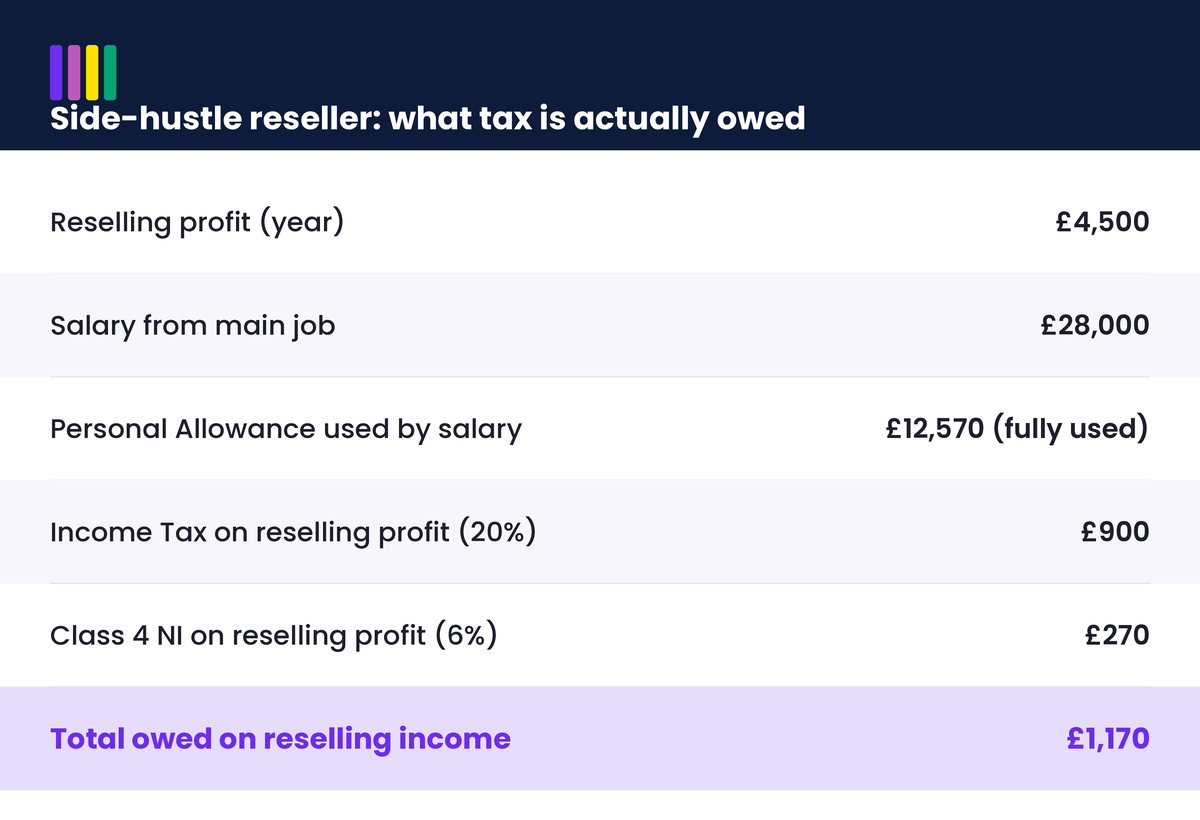
Worked example — a side-hustle reseller: £174,720 might be the full-time dream, but most side hustlers are working with far smaller numbers. Say your reselling profit for the year is £4,500, on top of a £28,000 salary from your main job. Your Personal Allowance is already used up by your salary, so the full £4,500 is taxed at 20% (£900), plus Class 4 NI at 6% (£270). You owe HMRC roughly £1,170 on top of what your employer already deducts.
Show Image
If you're scaling toward VAT
Most side hustlers won't get near this, but it's worth understanding the ceiling. Once your total taxable turnover (not profit) passes £90,000 in a rolling 12-month period, you must register for VAT, regardless of how thin your margins are.
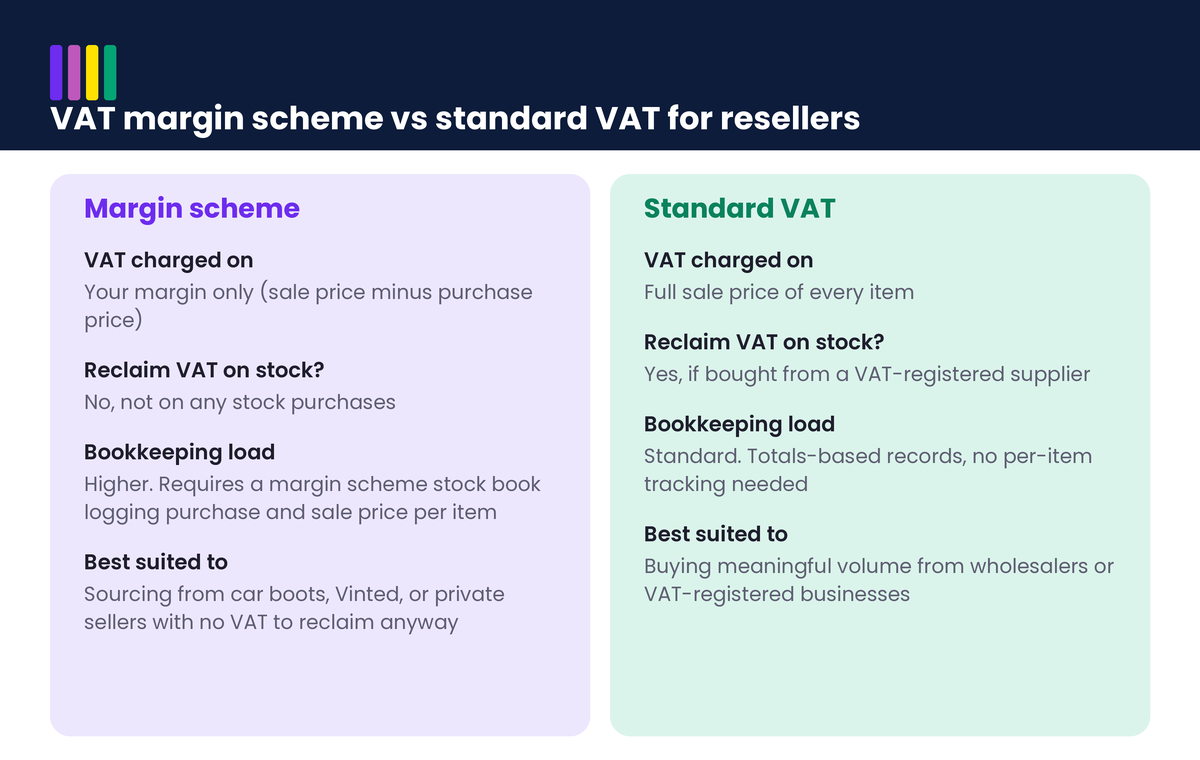
If you're reselling second-hand goods, the VAT margin scheme is worth understanding properly before you register. It exists to stop second-hand goods being taxed twice: once when the original owner bought them new (VAT already paid), and again in full when you resell them. Instead of charging VAT on your full sale price, the margin scheme lets you charge VAT only on your margin, the difference between what you paid and what you sold it for.
A few things to weigh up before choosing it:
- You can't reclaim VAT on stock purchases under the margin scheme. If you're sourcing from car boots, Vinted, or private sellers who aren't VAT-registered, this rarely matters since there's no VAT to reclaim in the first place. But if you're buying meaningful volume from wholesalers or VAT-registered businesses, this is a real trade-off to run the numbers on.
- It comes with more bookkeeping, not less. You need to keep a proper margin scheme stock book, tracking the purchase and sale price of each item individually, rather than the simpler totals-based records that suit standard VAT accounting.
- It's not automatically the right call. I've run reselling businesses under both the margin scheme and the flat rate scheme, and the honest answer is that it depends entirely on your sourcing mix and volume. Do the maths on your actual purchase sources before assuming the margin scheme is the obvious choice for a reseller. If you do decide to go this route, find an accountant who's specifically worked with margin
- scheme clients before, since it's a fiddlier setup than standard VAT and not every accountant handles it well.
Keeping records that actually hold up
Whatever you decide to claim, HMRC expects evidence. At minimum, keep:
- What you paid for stock and where (receipts, bank statements, or a simple spreadsheet)
- Platform and payment fees
- Postage and packaging costs
- Total sales income, by platform and in total
Making Tax Digital for Income Tax is being phased in for higher-earning sole traders, and digital record-keeping is where things are heading for everyone. Building the habit now, even as a side hustler, means you're not reconstructing a year of receipts in January.
For a fuller picture of what your reselling business actually earns once tax, fees, and time are factored in, the Reseller Handbook 2026 UK walks through profit-per-hour modelling across different levels of commitment.
Tax is just one part of running a reselling business properly. If you'd rather talk it through with people who've actually done this, our team is made up of experienced resellers who are always happy to share what's worked for them. You can book a demo and get advice alongside a look at the platform.
FAQ's
Do I have to pay tax on Vinted sales?
Only if you're trading, meaning you buy items to resell at a profit rather than clear out your own wardrobe. If your trading profit across all platforms is £1,000 or less in a tax year, you don't owe tax or need to tell HMRC.
What is the 30 item rule for eBay and Vinted?
There's no such rule. Platforms must report sellers who exceed 30 sales or €2,000 in a calendar year, but that's a reporting threshold for the platform, not the point at which you start owing tax. That threshold is £1,000 profit.
Does the £1,000 trading allowance apply per platform?
No. It's one allowance covering your total trading income across every platform you sell on. Combine your eBay, Vinted, and Depop profit before checking whether you're under or over £1,000.
What happens if HMRC finds undeclared income from eBay or Vinted?
HMRC cross-checks platform data against Self Assessment records and may send a "nudge letter" asking you to review your position. Ignoring it can lead to penalties and interest. Declaring proactively is always the better route.
Do I pay tax on selling my own personal items?
Usually not. Selling clothes, gadgets, or furniture you originally bought for yourself, for the same or less than you paid, isn't trading. The exception is a single item sold for £6,000 or more, which can trigger Capital Gains Tax.