.png)
To handle a difficult buyer, stay calm, keep every message on the platform, and respond using facts rather than emotion. eBay, Depop and Vinted don't handle disputes the same way, so knowing the process on each platform before you reply saves time, money and unnecessary back-and-forth.
Before getting into the difficult cases, it's worth keeping some perspective. If you're selling regularly, the vast majority of buyers are completely straightforward. It's easy to remember the handful who cause problems and forget the hundreds who don't. A difficult buyer occasionally appearing isn't a sign you're doing anything wrong. It's simply one of the realities of selling at volume.
The three marketplaces handle buyer problems differently.
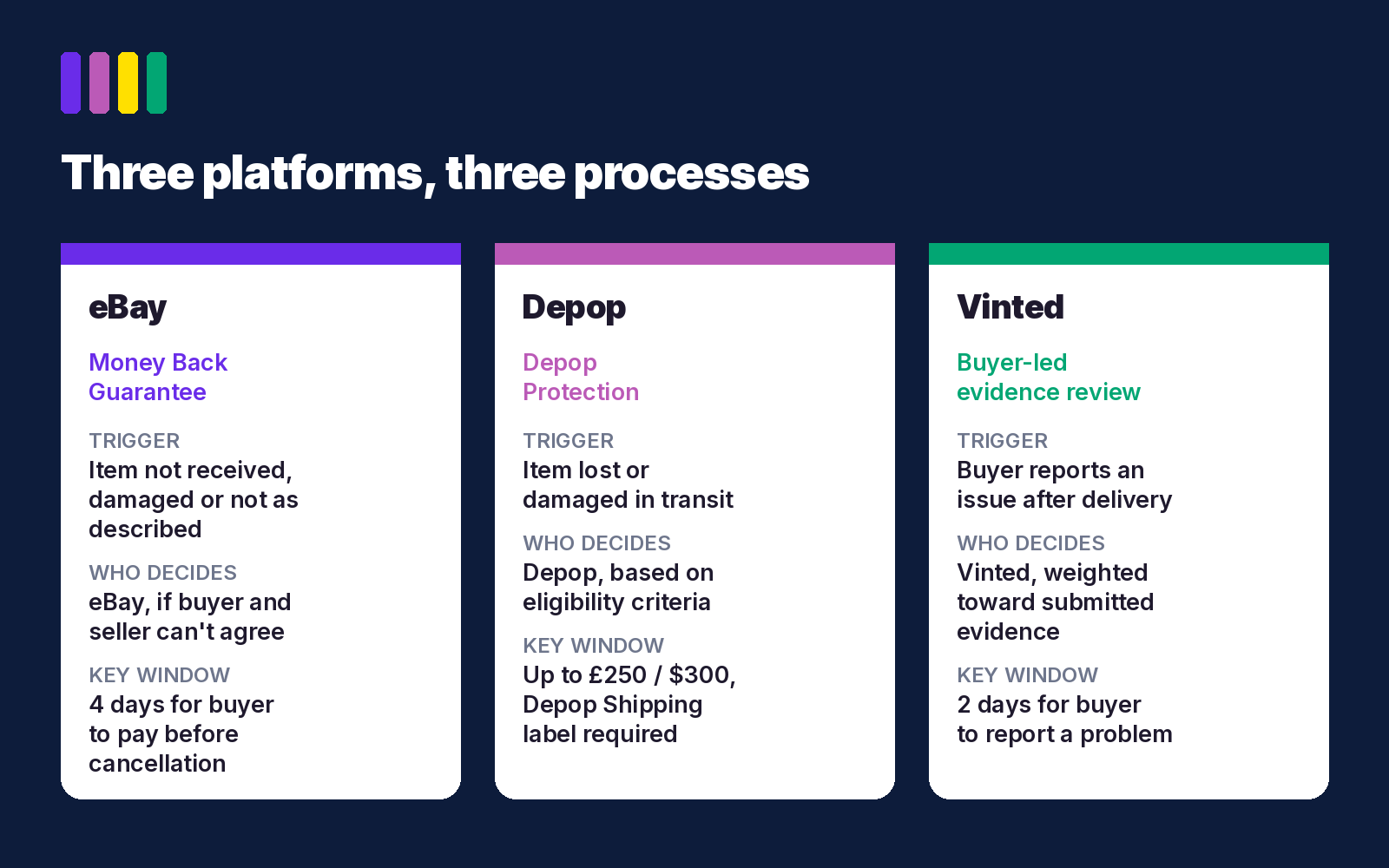
eBay uses its Money Back Guarantee process for problems including items not arriving, arriving damaged or not matching the listing. Depop has Depop Protection for eligible sellers in the UK and US using Depop Shipping, with specific eligibility requirements and protection limits, so don't assume every transaction is automatically covered. Vinted gives buyers a limited period after delivery to report an issue, and once one is raised, the transaction is suspended while it's resolved.
Whatever platform you're using, your listing, photographs, tracking information and messages can become important evidence. That means handling disputes properly really starts before you've even sold the item.
Three common eBay problems are item-not-as-described claims, buyers who don't pay, and buyers asking for partial refunds while keeping the item.
If a buyer says the item isn't as described, don't immediately get defensive. First, check your own listing. Look at the photographs, description, measurements and condition notes. If you missed something, deal with it fairly. If you believe the listing was accurate, calmly reference what was shown and direct the buyer towards the proper return process.
For example: "Sorry to hear that. The listing photos show [specific detail], and I also mentioned [specific detail] in the description. If you're unhappy with it, I'm happy to resolve it through the eBay return process."
For genuine not-as-described cases covered by eBay's Money Back Guarantee, sellers may be required to accept the return even if their normal policy says they don't accept returns.
Don't spend days chasing somebody for payment. eBay already sends payment reminders. Buyers must pay for items they purchase within 4 calendar days. If the buyer still hasn't paid after this period, the seller can cancel the order and select "Buyer hasn't paid," which records an unpaid cancellation on the buyer's account. You can also configure eBay to automatically cancel certain unpaid orders. Use eBay's actual cancellation process rather than repeatedly messaging the buyer.
One of the more frustrating situations is: "There's a problem with it. Can you refund me £20 and I'll keep it?"
Sometimes a partial refund genuinely makes commercial sense. A small refund might be cheaper than paying for a return and relisting the item. But you don't have to automatically agree just because the buyer asks.
If you want the item returned instead, say so: "Thanks for letting me know. I'd rather have the item returned in this case, so please open a return through eBay and I'll resolve it through there."
That keeps the resolution inside the normal process.
Common Depop disputes include "my item hasn't arrived," condition disputes, sizing disagreements, items arriving damaged, and requests for money back after delivery.
One important consideration is how you shipped the order. For eligible UK and US sellers, Depop Protection covers sales up to £250 (UK) or $300 (US), but only when the item was shipped using a Depop Shipping label within 5 days of the transaction date, and sent to the buyer's address shown on the sales receipt. If you select Depop Shipping but send the item using another method instead, you won't be covered for that transaction.
Check the tracking before replying, then give the buyer the actual information you have rather than guessing.
For example: "I've checked the tracking and it's currently showing [status], last updated on [date]. I'll keep an eye on it and if it doesn't update or deliver, we can follow the appropriate Depop process."
Don't promise a delivery date you can't control.
If somebody says the condition isn't what they expected, go back to your listing first, then ask for evidence.
For example: "The listing showed the item as [condition]. If something has arrived differently from that, could you send me a photo of the issue so I can take a look?"
This is useful for two reasons. First, you can see whether there's genuinely a problem. Second, if the dispute escalates, you've already started collecting the information needed to understand what happened.
Vinted works differently again. Once Vinted notifies the buyer that the order should have been delivered, the buyer has 2 calendar days to report a problem through the platform. If they report an issue, the transaction is suspended while it's resolved. If they don't report a problem within that window, or confirm everything is okay, the payment is released to the seller.
Because the reporting window is short, don't ignore an active dispute. Gather your evidence:
Then respond through Vinted's dispute process and follow the instructions provided for that specific case.
The bigger lesson is preventative. Your photographs and description aren't just there to sell the item. They're also your record of what you actually sold. Photograph flaws properly, describe condition accurately, include useful measurements where relevant, and use tracked shipping where appropriate. Doing that takes considerably less time than arguing about an undocumented flaw after the sale.
One more thing worth knowing: if you sell as a Vinted Pro seller, the process works differently. Buyers purchasing from Pro accounts are covered by Buyer Protection Pro, which includes a right of withdrawal under UK and EU consumer law. That means a buyer can request a return within 14 days of delivery for any reason, not just because the item arrived damaged or didn't match the listing. Return shipping falls to the buyer unless you choose to offer free returns. If you're trading as a Pro seller, factor this wider return window into how you price and describe items, since you're operating under standard consumer protection rules rather than Vinted's regular buyer-to-buyer process.
Not every difficult buyer starts out difficult. Sometimes you've got a perfectly reasonable customer reacting to a problem you didn't cause.
Shipping disruption is a good example. Over Christmas a few years ago, during one of the Royal Mail strikes, I had a steady stream of buyers asking whether their orders would arrive in time. I couldn't honestly guarantee that they would. Instead of making promises I couldn't control, I explained what was happening and moved affected shipping over to Evri so orders could keep moving.
That's generally the better approach. Tell the buyer what's actually happening, then tell them what you're doing about it. "I don't know, but here's what I'm doing" is often much better customer service than reassurance that turns out to be wrong.
After selling more than 50,000 items, the framework I'd use is fairly simple.
1. Check before you respond. Don't fire off an annoyed reply. Read the message, then check the listing, photographs and tracking information. You might be right. You might also have genuinely missed something.
2. Respond with facts. Instead of "There's absolutely nothing wrong with it," say: "I've checked the listing and the mark you're referring to is visible in photo 4 and mentioned in the condition description." Facts are much easier to defend than opinions.
3. Use the platform's normal resolution process. Returns, refunds and disputes exist for a reason. If somebody wants a solution outside the normal process, you don't automatically have to agree to it.
4. Keep communication on-platform. Keeping conversations inside eBay, Depop or Vinted creates a clear record of what both sides have said if the issue later needs platform support. It also reduces the risk of getting dragged into endless conversations through WhatsApp, text or email.
5. Keep useful evidence. For higher-value or higher-risk items especially, keep clear listing photographs, photographs of flaws, serial numbers where relevant, tracking information, proof of postage and relevant packaging photographs. The time to think about evidence is before there's a dispute, not after one starts.
There's a difference between a buyer with a legitimate problem and somebody being abusive or unreasonable. If you've already given a clear answer and explained the appropriate resolution, you don't need to keep having the same argument. If someone becomes abusive, threatens you, repeatedly demands something outside the platform process or otherwise breaches platform rules, use the relevant reporting and blocking tools where appropriate.
Your job is to resolve legitimate customer problems fairly. It isn't to win an argument.
When you're selling a handful of items, spending 30 minutes dealing with one buyer might not seem significant. At 50, 100 or 500+ orders a month, it becomes an operational problem.
That's why good resellers don't just get better at answering difficult messages. They build systems that prevent them: accurate condition descriptions, consistent photography, tracked shipping, saved response templates, clear return processes, good record keeping.
The goal isn't to make sure you never encounter a difficult buyer. It's to make sure that when you do, resolving the problem takes five minutes instead of an hour.
On eBay UK, buyers generally have 4 calendar days to pay. After that, the seller can cancel the order using "Buyer hasn't paid." Sellers can also configure preferences to automate certain unpaid-order cancellations.
Depop Protection is available to eligible sellers in the UK and US who meet the programme's requirements, including using a Depop Shipping label. Protection is subject to eligibility conditions and transaction limits of £250 (UK) or $300 (US).
Under Vinted's standard refund process, buyers generally have 2 calendar days after Vinted notifies them that the order should have been delivered to report an issue.
Only when it makes sense for you and the circumstances justify it. Sometimes a small partial refund is commercially sensible. In other situations, asking the buyer to return the item through the platform is the better option.
Generally, no. Keeping order-related communication on the marketplace gives you a clearer record if a dispute develops.
Stop arguing with them. Keep your responses factual, use the platform's reporting or dispute process where appropriate, and block the buyer when necessary.
.svg)
.png)