The best non-clothing items to resell are consumer electronics, video games and consoles, books and media, trading cards and collectibles, small kitchen appliances, tools, and baby gear. These categories pair steady buyer demand with less competition and fewer returns than apparel, which is why plenty of full-time resellers build their income around them instead. Below is what sells in each one, the margins to expect, and where to source and list it in the US.
Clothing gets all the attention for a reason. It is cheap to source, easy to find, and the resale market for it is enormous. But "easy to start" and "best place to put your hours" are not the same thing. If you have been reselling apparel for a while and the ceiling feels lower than the effort you are putting in, this is the guide to what else is worth your time.
Apparel is the biggest secondhand category by a distance. ThredUp's 2026 Resale Report puts US secondhand apparel growth at roughly 13% in 2025, close to 4 times faster than the broader clothing market, with supply, not demand, now the constraint. That growth is real. It is also why every thrift store within driving distance has 10 other resellers combing the same racks.
Here is the honest case for clothing, kept short. The pros: low entry cost, huge supply, and you can start with what is already in your closet. The cons are what send people searching for what to sell besides clothes. Margins per item are thin once fees and shipping come out. Sizing drives returns, which eat your time and your seller metrics. And because the barrier to entry is so low, you are competing with everyone. To make real money in apparel you usually have to move serious volume, which means listing all day.
Non-clothing categories flip that math. Many have narrower supply, more defined buyers, and fewer size-related returns. Some carry much higher margins per item. None of them are "better" for everyone, but each solves a problem that clothing creates.
Before the list, a quick lens. A strong resale category usually scores well on five things:
Demand and sell-through. Sell-through rate is the share of your listed items that actually sell in a given window. High sell-through means cash keeps moving instead of sitting as dead stock.
Margin per item. What you clear after purchase cost, marketplace fees, and shipping. A $60 profit is only a $60 profit if fees and postage did not quietly take half of it.
Sourcing access. How reliably you can find the item cheap, and whether you need to compete with a crowd to get it.
Shipping and handling. Small and light ships cheaply and nationwide. Big and heavy usually means local pickup only, which caps your buyer pool but removes shipping headaches.
Skill and knowledge. Some categories reward expertise more than others. That is a moat if you have the knowledge and a trap if you do not.
One more that ties them all together: profit per listing and per hour. This is the number most new resellers ignore and most full-timers obsess over. A category that returns $8 a sale can out-earn one that returns $40, if you can list and sell 10 times as many of them. Keep that in mind as you read.
Here is how the main categories stack up before we go deep on each one.
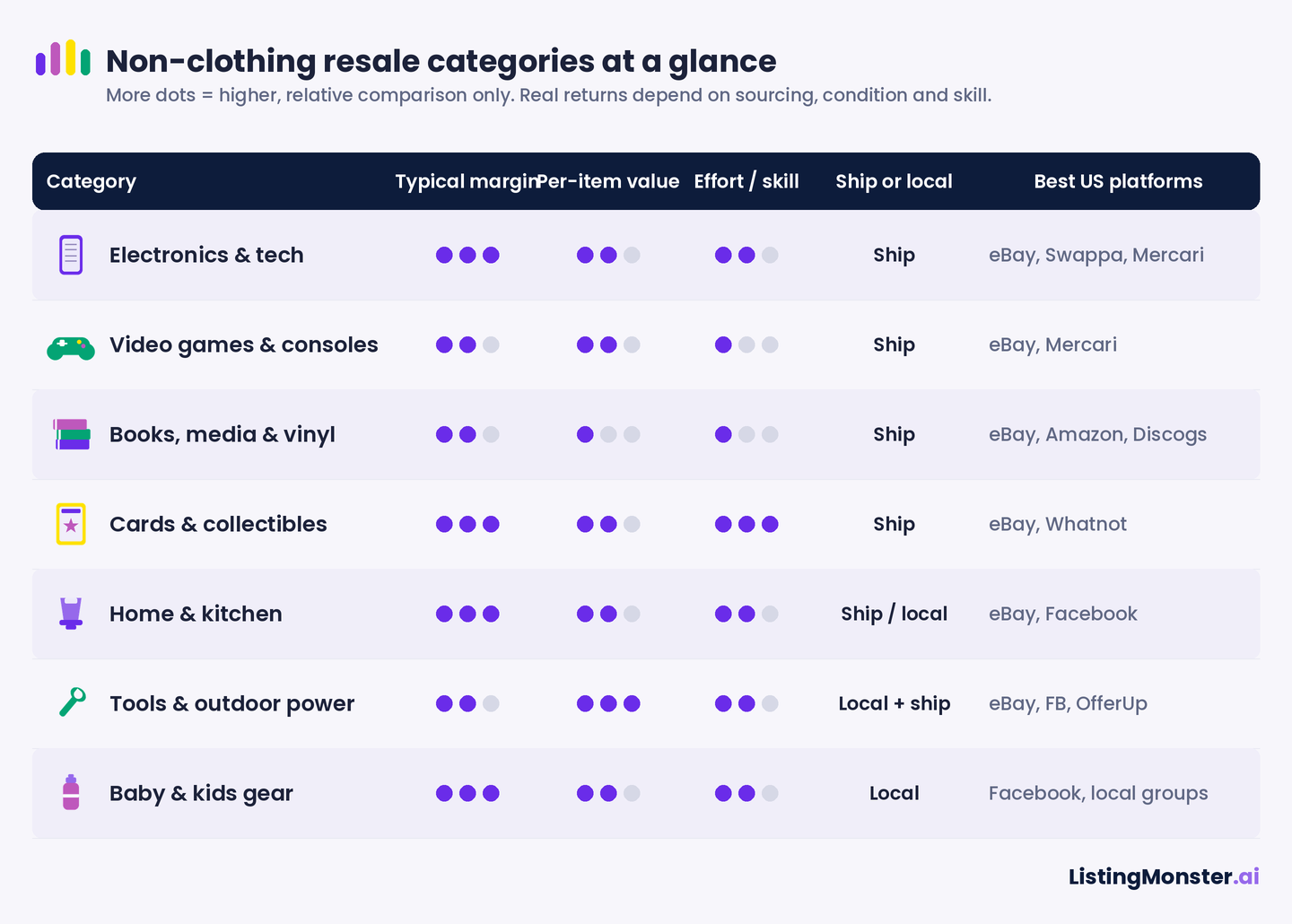
Electronics are the most reliable non-clothing category for a reason: buyers always want a working device for less than retail. Smartphones, tablets, laptops, gaming headsets, smartwatches, and name-brand accessories all hold value, and comps are easy to check on sold listings. Typical margins run about 20% to 70% depending on condition and whether you can do minor repairs or cleanups.
Source from garage sales, estate sales, thrift stores, and Facebook Marketplace, where people routinely underprice tech just to get rid of it. Sell on eBay for reach, or Swappa for phones specifically. Avoid anything iCloud or Google account locked that you cannot unlock, and test everything before you buy. Small, light, and high-demand makes this a category you can run entirely by shipping.
Games are close to a perfect flipping category. They are cheap to acquire, easy to authenticate, light to ship, and have clean comps. Retro consoles and cartridges ride steady nostalgia demand, and sought-after or complete-in-box titles can return well over 50%. Current-gen consoles and popular titles move fast too.
Look for original packaging, which lifts value noticeably, and complete sets. Source from thrift stores, garage sales, and lots on Facebook Marketplace and OfferUp. Sell on eBay and Mercari. If you play, you already have an edge here, because you know what is rare and what is landfill.
Books are the classic high-volume, low-per-item play. Individual profits are small, but they are dirt cheap to source, USPS Media Mail keeps shipping low, and a scanning app tells you a title's resale value in seconds. Textbooks, niche nonfiction, technical and professional titles, and homeschool curriculum bundles carry the steadiest demand.
Vinyl records are the higher-margin cousin. Classic rock, jazz, and rare pressings pull real money, and whole collections bought from a collector often come in at a great cost per record. They are easy to list and predictable to sell, which is what makes vinyl one of the more dependable volume plays on this list. Source books and records from library sales, estate sales, thrift stores, and yard sales, often by the box. Sell books on eBay and Amazon, and records on eBay and Discogs.
Collectibles reward knowledge more than any category on this list. Sports cards, Pokemon, Funko Pops, and retired Lego sets all have active, sometimes obsessive, buyer bases. Retired Lego sets in particular have a long history of appreciating past retail. The upside is high. So is the risk of buying something you think is valuable that is not.
Before you spend real money here, spend time in sold listings so you are pricing against reality, not hope. Source from estate sales, collections, and clearance. Sell on eBay, and consider live selling on Whatnot, which has become a strong channel for cards and collectibles specifically. Treat this as a category to grow into as your expertise deepens.
Premium kitchen brands hold their value unusually well. A KitchenAid stand mixer, a Vitamix or Ninja blender, an Instant Pot, a Breville espresso machine, or a Dyson can resell for a large share of retail, especially in a desirable color or a discontinued model. Buyers trust the brand and want the discount.
Source from estate sales, thrift stores, and clearance. Sell on eBay for shippable items and Facebook Marketplace for anything bulky or heavy. Test that everything actually works and include the accessories, because a complete unit sells faster and for more.
Tools are one of the most underrated non-clothing categories. They hold value, and the buyers know exactly what they want, so listings convert. Power drills, saws, sanders, pressure washers, lawn mowers, and leaf blowers all do well, with a seasonal lift in spring and summer. Brand and working condition are everything.
Source from estate sales, garage sales, and Facebook Marketplace. Sell on eBay for hand tools and smaller power tools, and locally on Facebook Marketplace or OfferUp for anything large or gas-powered where shipping would kill the margin. Little competition from apparel resellers means less crowded sourcing.
Parents pay for safety and convenience, and they need most gear for a short window before reselling it themselves. Premium strollers and car seats from brands like UPPAbaby, Nuna, and Doona retain a strong share of retail. High chairs, carriers, and quality toys move well too.
One firm rule: always verify that car seats are not expired or recalled before you resell them, and sell baby gear locally so the buyer can inspect it. Source from consignment sales, Facebook mom groups, and yard sales. Sell on Facebook Marketplace and local groups. This is mostly a local, pickup-based category, which keeps it simple.
Three that did not make the core list but earn their place for the right seller. Furniture, especially solid wood and mid-century modern, can clear a few hundred dollars a piece and often comes free on the curb, but it is a local-pickup, refinishing-skill game. Musical instruments, from student band instruments to vintage guitars, have devoted enthusiast demand and a clear seasonal pattern around the school year. Sporting and fitness equipment, from dumbbells to golf clubs, has steady demand but tends to be bulky and best sold locally.
Here is the thing most category guides skip. Once you have picked a category that suits your sourcing and your skills, your income stops being about what you sell and starts being about how much of it you can get listed. A $6 book and a $15 retro game only add up if you can put a lot of them live, accurately, without burning your evenings on it. That is the ceiling most resellers actually hit, and it is why the most profitable items to resell are often the ones you can list at volume, not just the ones with the fattest single margin.
Resellers who clear that bottleneck feel it immediately. As JRG Selection put it, "About 20 listings in, I completed one start-to-finish in about 1 to 1.5 minutes."
For a fuller breakdown of sourcing, pricing, and building a category into a real business, our 2026 US Reseller Handbook walks through the operational side in detail.
There is no single winner, because profitability depends on your sourcing and skill. Electronics and premium small appliances tend to offer the best margin per item for most sellers, while trading cards and collectibles have the highest ceiling if you have the knowledge to buy well. Match the category to your access and expertise.
Books and small electronics are the easiest starting points. Books have predictable pricing through scanning apps and cheap Media Mail shipping, and small electronics are light, in constant demand, and simple to comp. Both let you learn to photograph, price, and ship with very little money at risk before you scale up.
Not harder, just different. Clothing is everywhere but heavily picked over. Non-clothing categories often have less competition at the same garage sales and estate sales, because most resellers walk straight to the clothing racks. The trade-off is that some categories, like collectibles, reward knowing more than the person selling to you.
eBay is the strongest all-rounder for electronics, games, books, tools, and collectibles, thanks to its reach and sold-listing data. Facebook Marketplace and OfferUp win for bulky local items. Mercari suits general goods, and Whatnot is a strong live channel for cards. Our guide to the best US reselling platforms in 2026 compares them in full.
No. Most sellers start with $50 to $200 and flip books, small electronics, or media, then reinvest profits into higher-value inventory. Starting with items you already own costs nothing and teaches you the full process before you spend a dollar on sourcing.
.svg)
.png)
.png)
.png)