

Buying a counterfeit designer bag - even unknowingly - doesn't just cost you money. It costs you your reputation on every platform you sell on, and those are hard to rebuild.
Counterfeits are getting harder to catch. "Superfakes" - high-quality replicas engineered to fool buyers and experienced resellers alike - now circulate across every platform and price point. The authentication checks that worked five years ago aren't always enough today. No single check is sufficient. The right approach is layered: physical inspection first, documentation second, professional authentication for anything high-value or uncertain.
This guide covers six of the most counterfeited designer brands - Chanel, Louis Vuitton, Prada, Mulberry, Dior, and Versace - plus the universal rules that apply to every piece you'll ever handle. Worth remembering throughout: sometimes the person selling a fake doesn't know it's a fake themselves. Authentication isn't about doubting anyone - it's about making yourself the last line of defence, every time.
These principles apply across every luxury brand, every time.
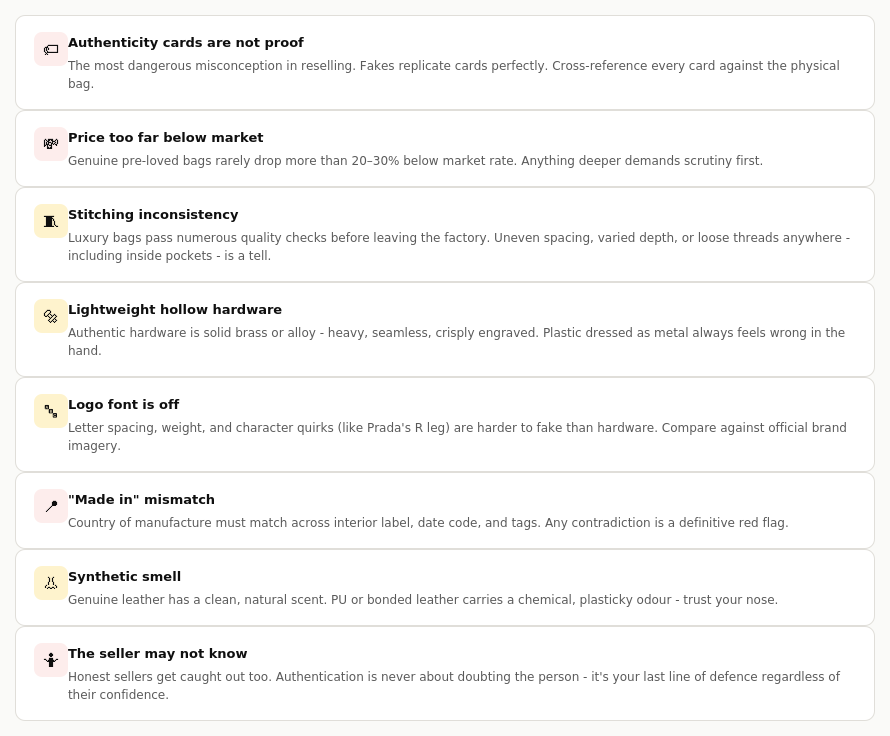
Authentic designer bags hold strong resale value even pre-loved. A genuine piece doesn't appear at a car boot sale for a fraction of its market price without a reason. Legitimate price reductions on authentic bags rarely exceed 20-30% below market rate. Anything beyond that demands scrutiny before anything else.
This is the single most dangerous misconception in reselling. Counterfeiters have become expert at replicating cards, holograms, serial numbers, and even the paper stock. A card being present means nothing in isolation. It must always be cross-referenced with the physical bag - construction quality, date codes, hardware, and materials. Never let a card alone give you confidence.
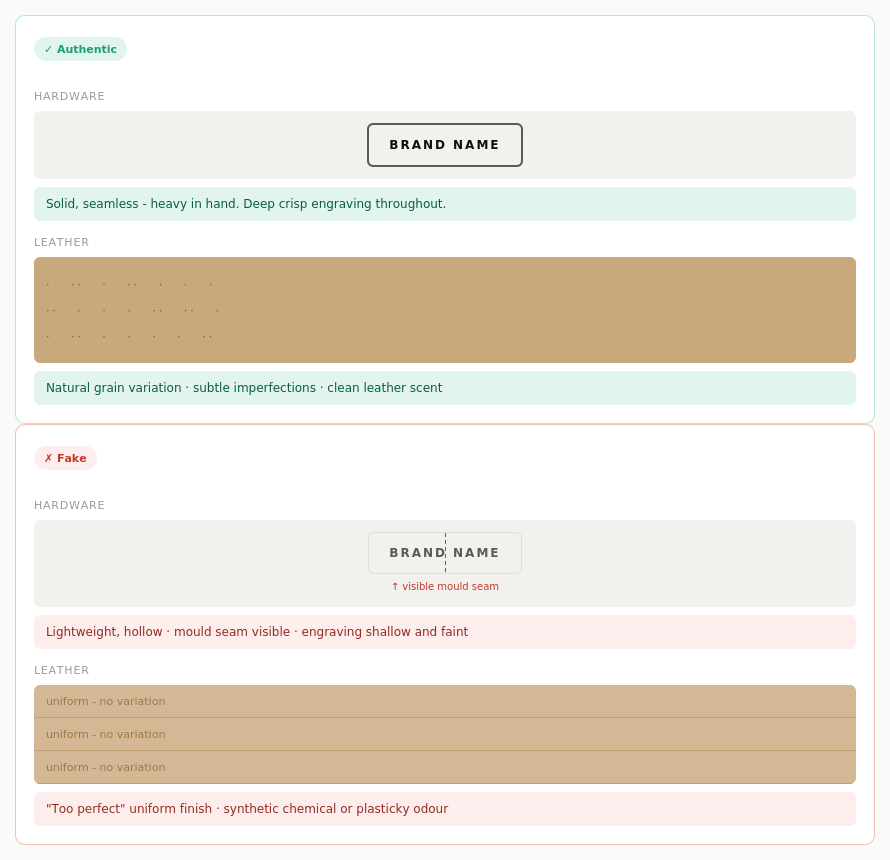
Genuine designer hardware - zippers, clasps, turn-locks - is solid brass, palladium, or quality gold-plated alloy. It feels substantial. Any brand-name engraving on hardware should be deeply and crisply etched. Counterfeit hardware is lighter, often develops visible seams where moulded pieces meet, and uses plastic components dressed up as metal. If it feels flimsy, it almost certainly is.
Counterfeiters consistently fail at replicating brand fonts precisely. Letter spacing, character weight, and the specific quirks of each brand's proprietary typeface are harder to fake than most people expect. Always compare logo details against verified imagery on the brand's official website - this takes sixty seconds and catches a surprising number of fakes.
Quality leather has a clean, natural smell. PU or bonded leather carries a synthetic, chemical odour. Beyond smell, genuine leather has natural variation - slight marks, subtle tonal differences - that fakes try to eliminate in favour of a uniform finish. That "too perfect" look is itself a warning sign.
Every major luxury brand stamps or embeds a country of manufacture. This must be consistent across the interior label, date or serial code, and any tags. Any contradiction between these - a French factory date code on a bag stamped "Made in Italy," for example - is a clear counterfeit indicator.
Online authentication services can authenticate from photos in under 48 hours. For high-value pieces, this cost is negligible against the risk. Building a relationship with a trusted authentication provider is a business decision every serious reseller should make.
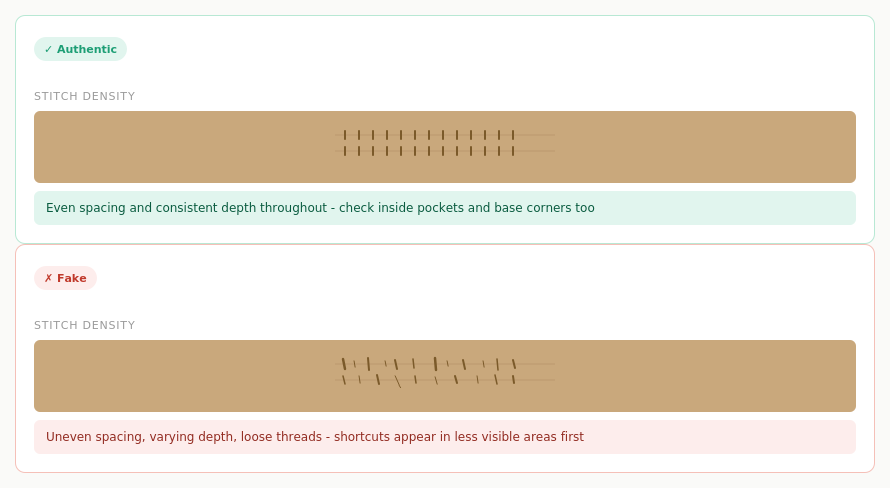
Luxury bags pass numerous quality checks before leaving the factory. The stitching on an authentic piece is consistently even across the entire bag - seams, handles, corners, and interior. Fakes often try to approximate this but lose consistency in less visible areas. Check inside pockets and base corners specifically; this is where production shortcuts show up first.

Chanel is among the most counterfeited luxury brands in the world. The Classic Flap has increased roughly 70% in retail price over six years, and superfakes targeting this model in particular are now sophisticated enough to fool casual buyers easily. Authentication requires a 360-degree approach - no single check is sufficient.
The CC Logo
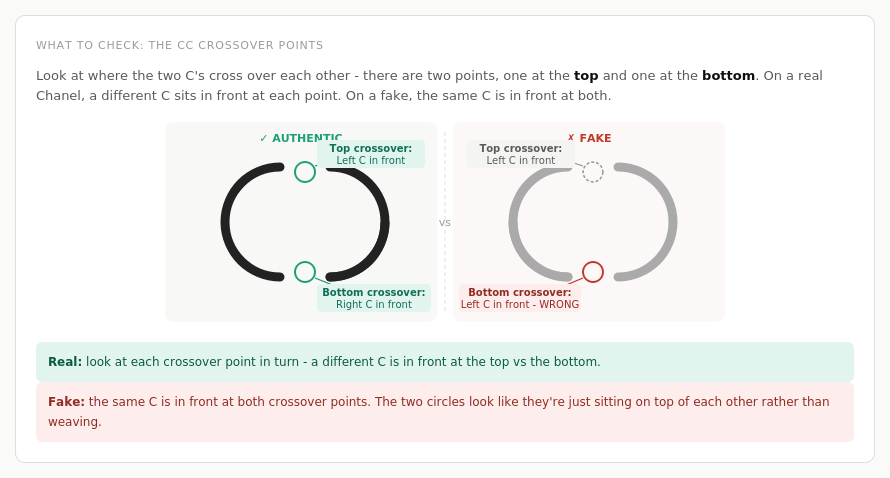
Look at where the two C's cross over each other. There are two crossover points - one at the top, one at the bottom. On a genuine Chanel, a different C sits in front at each point: the left C is in front at the top, the right C is in front at the bottom. On a fake, the same C sits in front at both. Once you know this rule, checking it takes seconds.
Quilting and Stitching
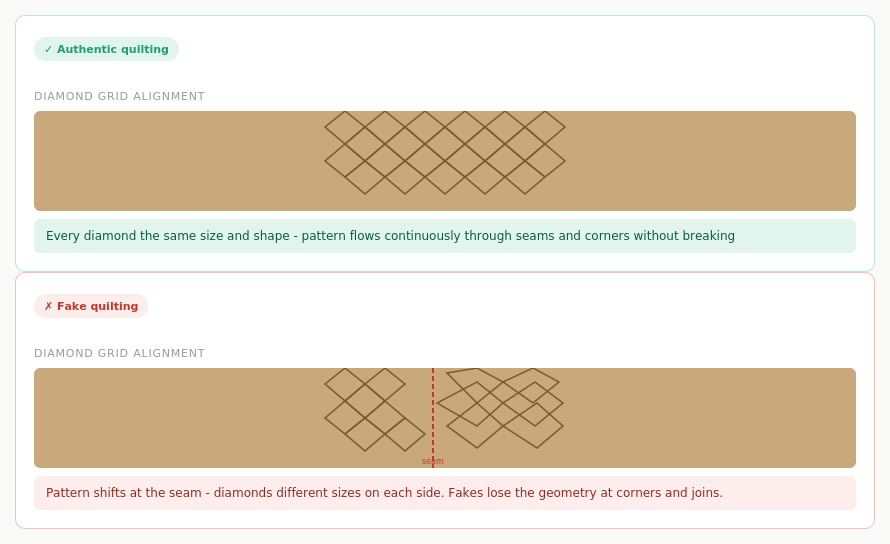
The quilted diamonds must be perfectly centred and symmetrical across the bag, and the pattern should never be interrupted awkwardly at seams or near hardware. Authentic Chanel quilted leather uses 10-12 stitches per inch - consistently throughout, including in corners and near the base. Fewer stitches and the quilting loses structure; more and it puckers. Fakes almost always show misalignment at the corners or a stitch density that varies across the bag.
Serial Numbers and Microchips
Chanel introduced serial number stickers in 1984. From the 2021 collection (21A) onwards, the brand transitioned to NFC microchips embedded in a metal plate inside the bag with an alphanumeric code. On bags from 2021 or later, look for the chip rather than a sticker. On older bags, the serial sticker should sit cleanly without peeling edges or misaligned placement.
Hardware Screws
From 2015 onwards, Chanel switched from flathead screws in its CC turn-lock hardware to proprietary star-shaped screws. A bag claiming to be post-2015 with flathead screws is a red flag.
The "Made In" Stamp
Chanel stamps the country of origin directly into the interior leather or a leather patch. The stamp colour always matches the hardware colour - gold hardware means a gold stamp, silver hardware a silver stamp. Any mismatch here is immediately suspicious.
Louis Vuitton is the single most counterfeited luxury brand globally. Authentication is therefore one of the most practised - and most attempted - skills in the resale market, which means fakes have also evolved to be more convincing than almost any other brand.

Date Codes and RFID Chips
LV bags made from the early 1980s to around 2021 carry a date code - two letters identifying the factory location followed by four numbers indicating the production week and year. From approximately 2021, LV transitioned to RFID microchips. You can detect a chip's presence using an NFC reader app, but only LV staff can decrypt its data.
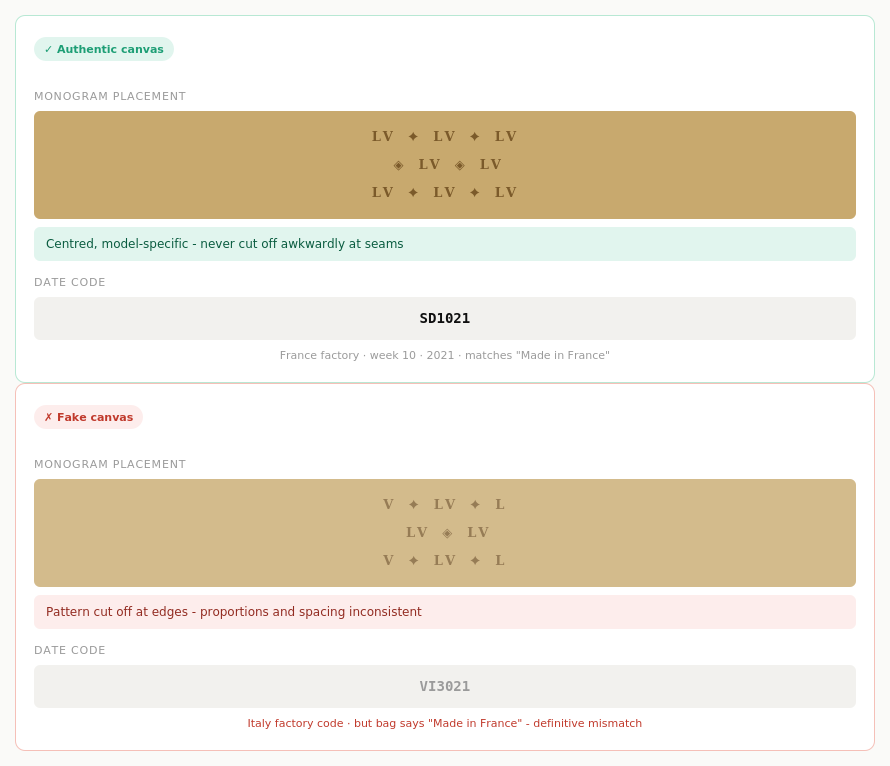
On older bags, the factory letters in the date code must match the "Made In" country label precisely. Factory codes SP, VI, and SD indicate French production - the bag must read "Made in France." A mismatch is a definitive fake indicator.
Monogram Canvas Placement
On genuine LV monogram bags, the pattern is deliberate and model-specific. It is never cut off awkwardly at seams, and the pattern placement is consistent side-to-side. Canvas proportion and alignment are details fakes consistently struggle to replicate correctly.
Interior Label
The interior leather stamp reading "Louis Vuitton Paris" should be precisely centred and deeply embossed, with consistent font weight and even letter spacing throughout. Shallow embossing, thin text, or off-balance placement are all giveaways.
Vachetta Leather Ageing
On bags with vachetta leather handles and trim, the leather ages naturally into a warm honey-coloured patina with genuine use and light exposure. Fakes use dyed or coated materials that don't age the same way, or arrive with a fake pre-applied patina that looks inconsistent or too uniform.
Prada's most commonly counterfeited styles are the Galleria bag and the nylon re-edition. The brand's hallmarks are distinctive - but one detail trips up more buyers than almost any other on the list.
The "R" in the Logo Is the Tell
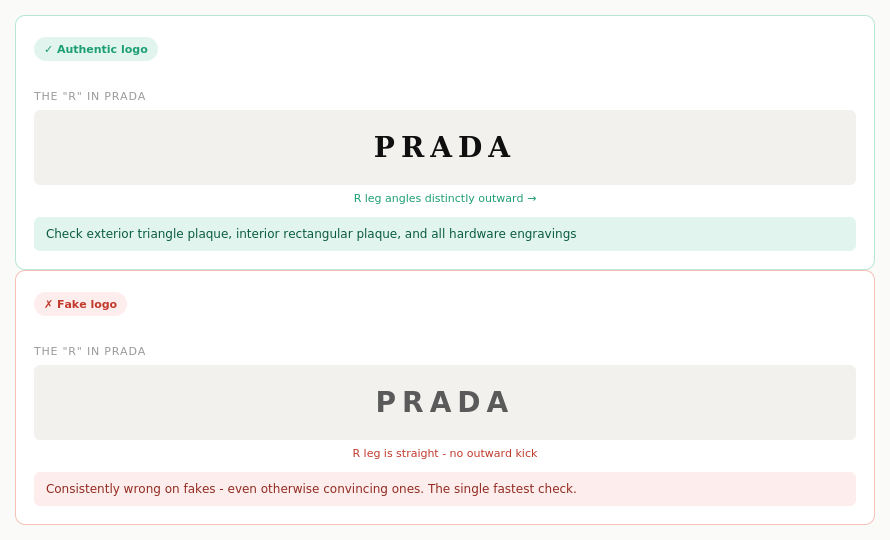
On an authentic Prada triangle plaque or any hardware engraving, the right leg of the letter "R" angles distinctly outward. This is a quirk of Prada's specific proprietary font. On fakes, this leg is almost always straight. Once you know what to look for, you'll spot it instantly - and you'll find it consistently wrong on counterfeits, even otherwise convincing ones. Check this on the exterior triangle plaque, interior rectangular plaque, and any hardware engravings.
The Triangle Plaque
The exterior inverted triangle plaque is enamel-coated, precisely equilateral, and has sharp, clean edges. It should be securely attached and perfectly straight. Any distortion in shape, rough edges, or slightly off-hue enamel is a flag.
The Interior Rectangular Plaque
Inside sits a rectangular plaque reading "PRADA MILANO" and "Made in Italy." Every letter should be the same font weight throughout - consistent thickness across the entire inscription. Counterfeits frequently produce text that's too thin, too thick, or uneven across individual characters.
Stitching Direction
Prada's topstitching is applied at an angle, not horizontally. Horizontal stitching on a Prada bag is an immediate flag.
Hardware and Zippers
Genuine Prada uses named zipper manufacturers - Lampo, YKK, Opti, Riri, Ipi - with the name marked on the zipper pull. The screw feet on the base of Prada bags are rounded, voluminous, and bright gold or silver in tone. Flat, dull, or bronze-toned feet indicate a fake.
Mulberry is a staple of the UK pre-loved market. The Bayswater, Alexa, and Lily remain consistently popular - and consistently targeted. A few specific details separate authentic pieces from convincing fakes.
The Postman's Lock Screws
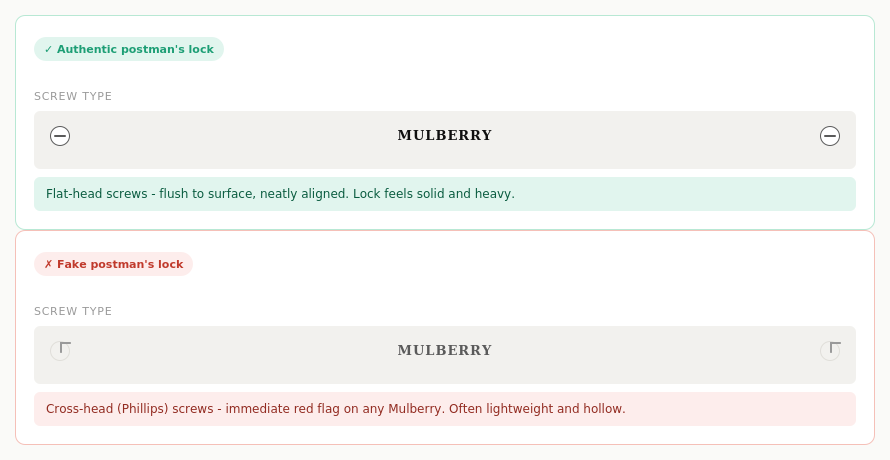
The screws on Mulberry's postman's lock are a reliable tell. On an authentic bag, these are flat-head screws, neatly aligned and sitting flush against the surface of the lock. Cross-head (Phillips) screws are a red flag. Screws that are uneven, raised, or sitting at different depths suggest a fake. Combined with the overall weight of the lock - which should feel substantial - this is one of the fastest physical checks on Bayswater and similar styles.
The Brass Disc and Serial Number
Every authentic Mulberry bag contains a brass disc inside the bag bearing the Mulberry tree logo. Beneath this disc is the serial number. The disc should feel solid and heavy - not hollow or lightweight. No disc is an immediate problem. A disc that feels thin or plasticky is equally suspicious.
Stitching Precision
Mulberry bags are made to exacting quality standards with numerous production checks before leaving the factory. Check inside pockets and base corners specifically - these are where production shortcuts show up first on fakes.
Leather Quality
Authentic Mulberry leather - whether Classic Grain, Natural Vegetable Tanned, or Silky Calf - is flexible and structured. It doesn't crease permanently or feel slick. Fake leather tends to be stiff, sticky, or lacks the natural variation of genuine hide.
A Note on "Made In"
Not all Mulberry is made in the UK. The brand also manufactures in Turkey and China for certain ranges. This is not an automatic fake indicator - cross-reference the serial number and brass disc instead.
The Lady Dior and Saddle Bag are Dior's most counterfeited models. The Lady Dior has risen from around £1,200 in 1995 to over £4,000 today - and that price trajectory has driven significant counterfeiting sophistication.
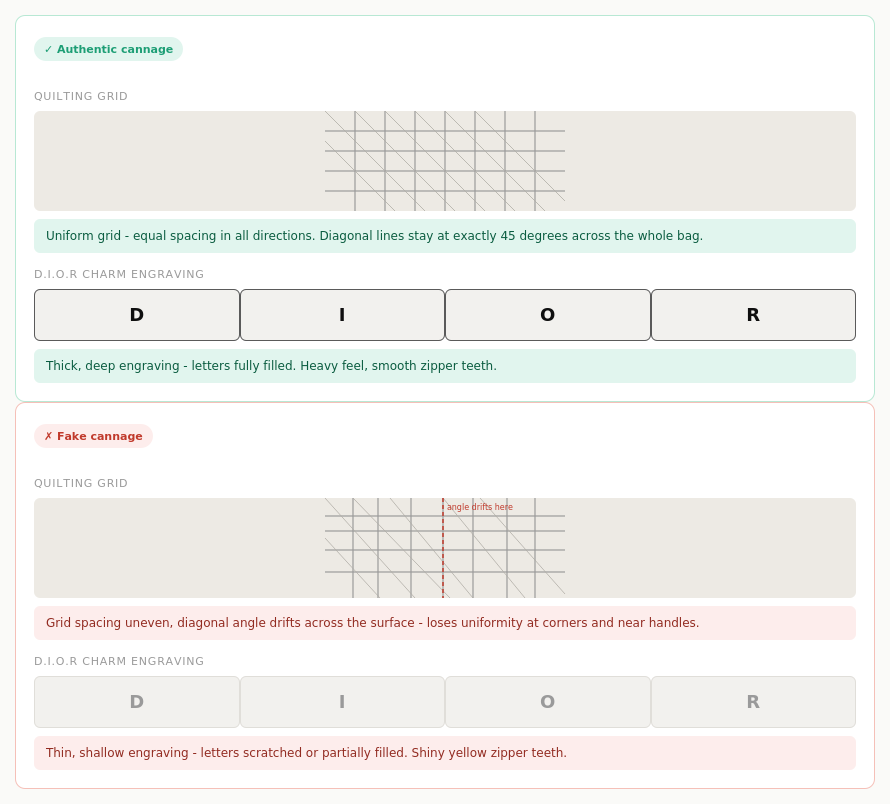
The Cannage Quilting
Dior's signature cannage pattern - the diagonal cane-woven motif - must be perfectly uniform in proportion and spacing throughout the bag. Fakes consistently lose this uniformity near corners, handles, and where panels meet. It's one of the fastest visual checks on the Lady Dior.
The "D.I.O.R." Letter Charms
The four letter charms on the Lady Dior are weighty on an authentic piece. The "CD" or brand markings etched into hardware are deeply engraved and appear visibly thick and crisp. Fakes show shallow engraving, scratched letter surfaces, or visibly thinner text. The zipper teeth on authentic bags are smooth and less reflective - fakes often show very shiny, yellow-gold teeth.
The Interior Leather Tag
Inside an authentic Dior bag sits a leather tag with "Christian Dior" and "Made in Italy" heat-stamped with consistent font weight and precise letter spacing. Uneven spacing or shallow stamping are indicators of a fake.
Hardware Magnetism
Genuine Dior hardware is typically high-quality steel alloy - and is magnetic. A quick magnet test can add a useful data point during inspection. Non-magnetic hardware on a bag claiming to be authentic Dior is worth investigating further.
The Authenticity Card
Authentic Dior bags include a grey watermarked authenticity card with "Christian Dior" in black or gold on one side, and blank fields for purchase details on the reverse. The interior label is a small square patch sewn into the zip pocket. Font weight and stitching density on this patch are precise on genuine pieces - fakes consistently get one or both wrong.
Versace offers more digital verification tools than any other brand in this guide, making authentication of modern pieces more straightforward - but vintage stock requires the same physical inspection approach as any other brand.
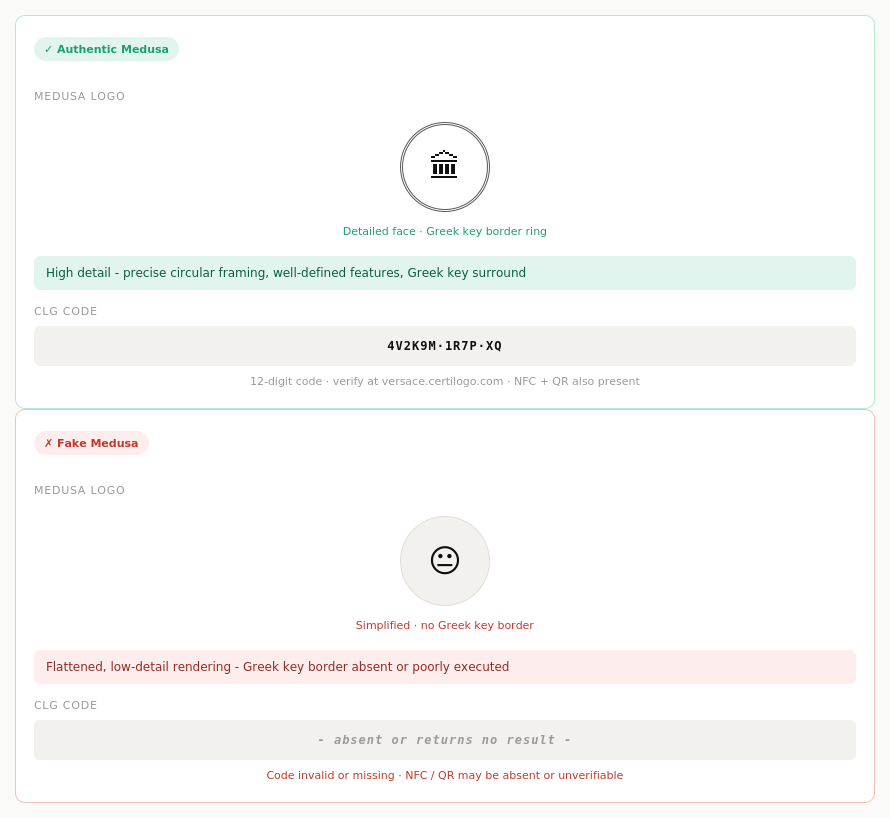
The Certilogo (CLG) Code and Digital Verification
Modern Versace bags carry three verification methods: a CLG (Certilogo) code, an NFC serial number, and a QR code. The CLG code is a 12-digit alphanumeric code that can be checked at versace.certilogo.com. All three codes must align with the certificate of authenticity. Counterfeiters are attempting to replicate these systems, so a valid code return supports authentication - it doesn't conclude it.
The Medusa Head
The Versace Medusa is a specific and detailed artistic rendering. On authentic pieces, she is surrounded by a row of Greek keys on most styles. Fakes simplify the Medusa, often losing the Greek key border entirely or producing a flattened, less detailed version. Compare any piece against Versace's official imagery before concluding it's genuine.
Hardware Weight and Seams
Authentic Versace hardware is heavy, shiny, and seamless - no visible join lines where mould parts met during manufacturing. Fakes show these seams, feel lighter in the hand, and have a less vivid finish. All hardware on a genuine piece is matching metal throughout - no plastic components.
Production Stickers
Inside an authentic Versace bag are two production stickers: one confirming manufacture in Italy, one indicating the country of sale. Both should be crisply printed with no smearing or spelling errors.
Interior Label
The interior "VERSACE" label uses the brand's specific typeface with dense, consistent stitching. Fakes show thinner stitching around the label and often slightly different letter weight or spacing.
The landscape has shifted significantly in the last five years. Superfakes - replicas engineered to pass casual and even intermediate inspection - now exist across every brand and price point in this guide. They come with convincing cards, correct-looking date codes, and even NFC chips with partial data.
No single check guarantees authentication. The right approach is always layered: physical inspection first (leather, stitching, hardware, logo details), documentation second (date codes, serial numbers, digital verification where available), and professional authentication for high-value pieces or anything you're not completely certain about.
And remember: sometimes the person selling a fake genuinely believes it's real - they may have been caught out themselves further up the chain. That's not a reason to be less rigorous. It's a reason to always be the last line of defence in your own sourcing process. For resellers operating at any meaningful volume, professional authentication is part of your margin calculation on every high-value piece - not an extra cost.
For more free expertise on reselling smarter, explore our full library of reseller guides and free downloads.
Check price first: authentic pieces rarely drop more than 20-30% below market rate. Then inspect hardware weight, logo font accuracy, stitching consistency, and "made in" label consistency across the interior tag and date code. No single check is conclusive, so layer several before deciding.
No. Counterfeiters routinely replicate cards, holograms, and serial numbers. A card only means something when cross-referenced against the physical bag itself, including construction quality, hardware, and date codes. Treat a card as one data point, never as standalone confirmation.
A superfake is a high-quality counterfeit engineered to fool casual buyers and experienced resellers alike, often featuring convincing cards, plausible date codes, and even partial NFC chip data. They've become common enough that no single authentication check can be relied on alone.
Yes, for anything high-value or uncertain. Online services can authenticate from photos in under 48 hours, and the cost is negligible against the risk of relisting a counterfeit. For resellers working at volume, this cost belongs in your margin calculation, not treated as optional.
Louis Vuitton is the most counterfeited luxury brand globally, with Chanel, Prada, Dior, Mulberry, and Versace also heavily targeted. Each brand has specific tells, from Chanel's CC crossover points to Prada's angled logo "R," making brand-specific checks essential alongside universal red flags.
Guide produced by ListingMonster.ai - your toolkit for reselling smarter.
.svg)

.png)
