What the eBay-Depop Acquisition Means for Resellers
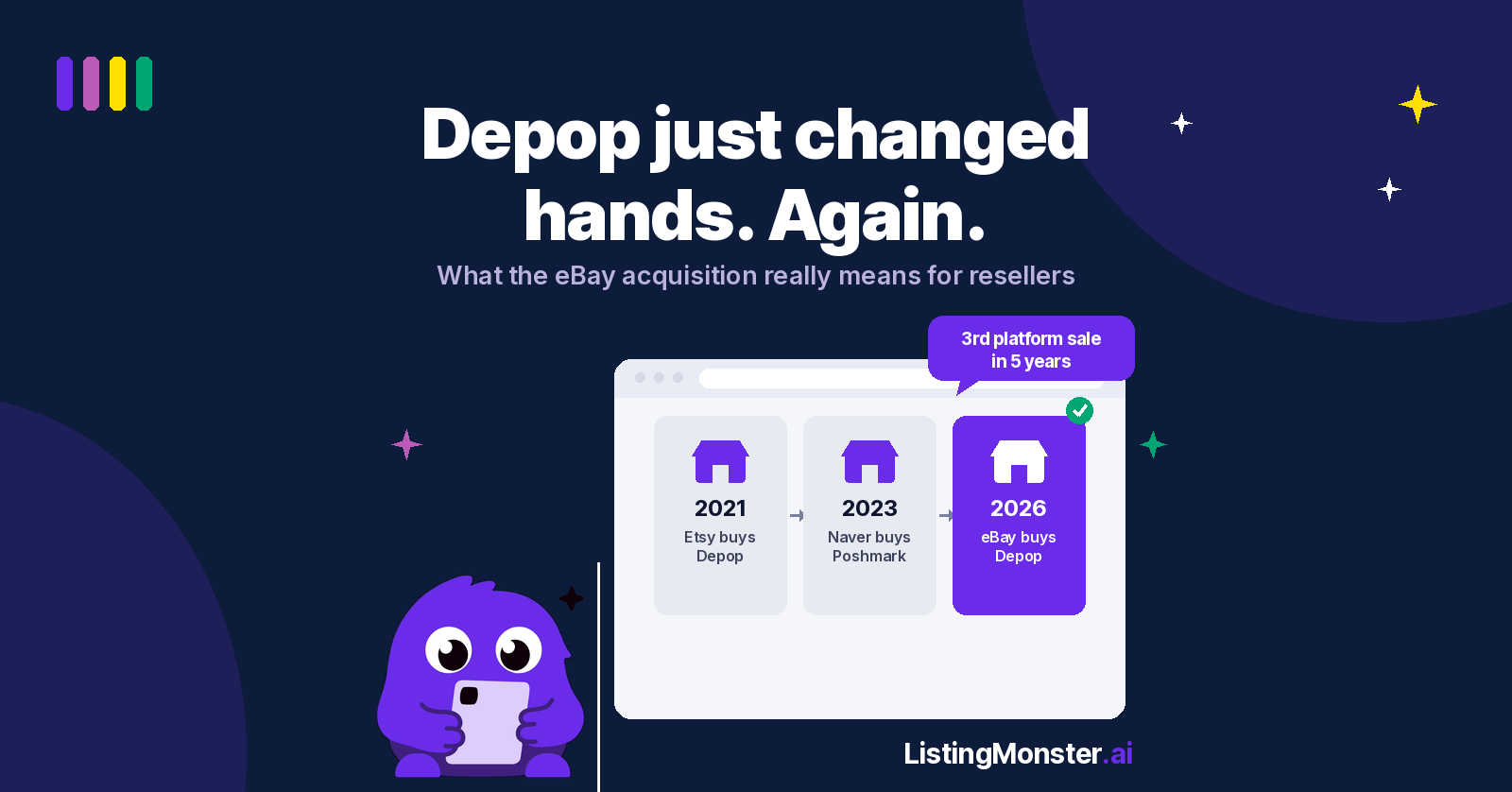
Depop has changed owners twice in five years.
That's the real story behind eBay's acquisition of Depop, not the deal itself.
eBay completed the acquisition on 30 July 2026, and eBay says nothing changes for sellers today. That's true. But history shows acquisitions rarely change marketplaces overnight. They change them slowly, over months and years, long after the announcement stops being news.
So what does the eBay-Depop acquisition mean for resellers? Not much this week. Quite a lot over the next few years, if the pattern holds.
What actually happened
eBay bought Depop from Etsy, which had owned it since 2021. The deal closed at the end of July 2026, and both companies have been clear that Depop keeps its own brand, app, and community for now. Nothing is merging. Your Depop listings will not show up on eBay, and vice versa.
What eBay gets is Depop's 7 million active buyers, most of them under 34, plus a foothold in vintage and Y2K fashion it never built organically. What Depop gets is eBay's infrastructure: payments, shipping, authentication, and the kind of operational muscle a standalone app its size struggles to fund on its own.
That's the official story. It's also, almost word for word, the same story eBay and Depop's previous owners told in 2021.
This isn't Depop's first sale, and that's the real story
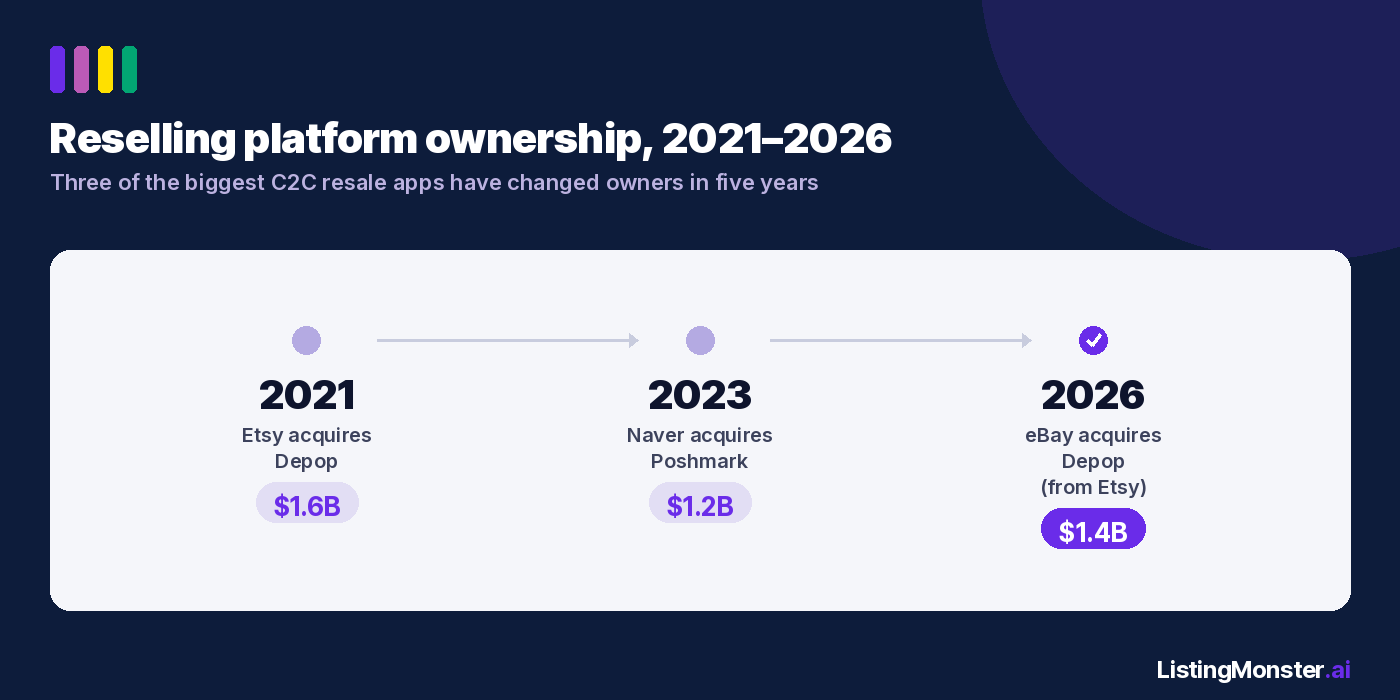
Depop was bought by Etsy in 2021 for around 1.6 billion US dollars. Five years later, eBay has bought it from Etsy for around 1.4 billion. That's not a one-off news event, it's a platform changing hands twice in half a decade, and each time the new owner has made the same promises: your brand stays, your community stays, nothing changes.
It's not just Depop. Poshmark went from a public company to a private subsidiary of the South Korean firm Naver in January 2023, in a deal worth around 1.2 billion US dollars. Same shape: new owner, promises of independence, distinct brand retained on paper.
Individually, these look like separate stories about separate apps. Looked at together, they're the same story: the standalone reselling app is becoming a rarer thing, and the platforms most of us built our businesses on are increasingly owned by companies whose priorities sit somewhere above the individual seller.
For what it's worth, I land on the optimistic side of this one. eBay has the global infrastructure, the authentication systems, and the cross-border shipping experience that Depop has never had the resources to build on its own. If that means Depop can properly invest in the US and start clawing back some of the ground it's lost to Vinted here in the UK, that's good for sellers, not bad. I'm not worried. I'm hopeful.
Why "nothing changes" doesn't mean nothing changes
Here's the thing about acquisitions like this. The seller-facing promises are always genuine in the short term and untested in the long term. eBay has said it's committed to preserving what makes Depop's marketplace unique, its brand, culture, and community, while supporting the platform's continued growth. That's a real commitment, made in good faith, by people who currently mean it.
But "for now" is doing a lot of work in that sentence. Fee structures get reviewed. Seller protections get standardised across a parent company's portfolio. Support gets centralised. None of that has been announced for Depop. All of it has happened, in some form, to sellers on other platforms that got acquired and told the same thing.
You have no vote in any of this. That's not a criticism of eBay or Depop, it's just the reality of selling on a platform you don't own. Your account, your fee structure, and your reach are all decisions made somewhere else, by people optimising for shareholders and buyer growth, not for your specific business. Being hopeful about the outcome doesn't change that fact, it just means you can watch this one with curiosity rather than dread.
What this actually means for how you run your business
The lesson here isn't "leave Depop" or "panic about fees." Nothing has changed yet, and Depop's buyer base and discovery-driven audience are still genuinely valuable if vintage, streetwear, or Y2K fashion is your thing. The lesson is about what you're building your business on top of.
If your entire income sits on one platform, you're now exposed to decisions made in a boardroom you'll never see. That was already true before this acquisition. It's just more visible now.
The resellers least affected by news like this are the ones who already treat any single marketplace as one channel among several, not as the whole business. Two platforms run properly beats five run badly, but relying on exactly one, however good it currently is, means every policy change lands on you with nowhere else to redirect that stock or that income. Our Reseller Handbook 2026's marketplace strategy guide goes into this trade-off in more depth if you're weighing up whether to expand beyond your primary platform.
This is the same logic behind cross-listing in the first place. It's not really about squeezing out a few extra sales, though it does that too. It's about not being one policy update away from a bad month.
What to actually watch for
Nothing needs doing today. But it's worth keeping an eye on a few specific things over the coming months, since this is where past acquisitions like this have actually changed seller experience:
- Fee announcements. Any change to Depop's seller fees or payment processing terms
- Cross-listing signals. Whether eBay starts offering Depop inventory visibility inside its own marketplace, which would be a bigger integration step than anything confirmed so far
- Support changes. Whether Depop's support and dispute handling stays independent or moves onto eBay's systems
- Category or policy shifts. Any tightening of what's allowed to be listed, common when a platform standardises with a larger parent
None of this is cause for alarm. It's cause for not being surprised later.
FAQs
Will my Depop listings automatically appear on eBay?
No. Depop and eBay remain separate marketplaces with separate listings, accounts, and buyers. eBay has confirmed there's no automatic cross-posting between the two platforms as part of this acquisition. If you want your items on both, you'll still need to list them separately or use a tool that does it for you.
Will Depop's seller fees change now eBay owns it?
No changes have been announced. eBay has said Depop will keep its existing brand, platform, and customer experience. Fee structures are exactly the kind of thing that tends to get reviewed once a platform is folded into a larger parent company, so it's worth keeping an eye on official Depop communications over the coming months.
Should I stop selling on Depop?
No. Depop's buyer base and discovery-driven audience haven't gone anywhere, and vintage, streetwear, and Y2K fashion still sell well there. The sensible response isn't to leave, it's to make sure Depop isn't the only place your business exists. Treat it as one strong channel among several.
Is Vinted likely to be acquired next?
There's no indication Vinted is for sale or in talks with any buyer. It remains privately owned and has grown organically rather than through acquisition. That said, the pattern across Depop, Poshmark, and now Depop again shows that platform ownership in this space keeps shifting, so it's sensible to plan your business without assuming any single platform's ownership structure stays fixed forever.