Why Buying Stock Feels Productive (But Isn't)
.png)
Buying stock feels productive. You've spent money, found something decent, and got a result you can hold in your hands. But sourcing only turns into income once an item is listed, live, and in front of a buyer. For side hustlers fitting reselling around evenings and weekends, that gap between "I bought something" and "I made money" is where most backlogs start. The long-term fix isn't sourcing less. It's making sure your listing capacity keeps pace with what you're buying. A good weekend at the car boot isn't the win. What gets listed afterwards is.
Why sourcing feels better than listing
There's a reason the charity shop rail is fun and the laptop full of photos isn't. Finding an item is a fast, certain reward. You spot it, you know it's good, you pay, done. Listing is slower and less certain: photograph it, write it up, guess a price, then wait.
A 2022 neuroscience study published in Nature Communications found that procrastination is strongly associated with how people perceive effort over time: work pushed into the future can feel less costly than the same work done today. In other words, "I'll list it tomorrow" genuinely looks easier from where you're standing right now. Some call this productive procrastination, doing something that feels like work without actually moving your business forward.
Reselling creates the perfect conditions for this. Sourcing gives you the immediate satisfaction of finding something. The repetitive work needed to turn it into a listing can always be pushed to tomorrow, so it's no surprise stock tends to grow faster than listings do.
Busy isn't the same as productive
A weekend of car boots, three charity shops and a house clearance sounds like a proper session. It can also mean you've created hours of photography, research and listing work, none of which you've actually done yet. A few signs you've drifted from busy into just accumulating:
- You can describe last weekend's sourcing trip in detail, but not what you listed from it
- The corner, shelf, or spare room keeps growing and you've stopped mentioning it
- You go back for more stock before finishing photographing the last lot
- "I'll list it properly at the weekend" has become a running excuse, not a plan
Getting choosier at the point of sourcing helps as much as anything you do afterwards. Smarter charity shop sourcing is as much about matching what you buy to what you can actually get listed as it is about spotting a bargain on the rail.
The number that tells you if you have a problem
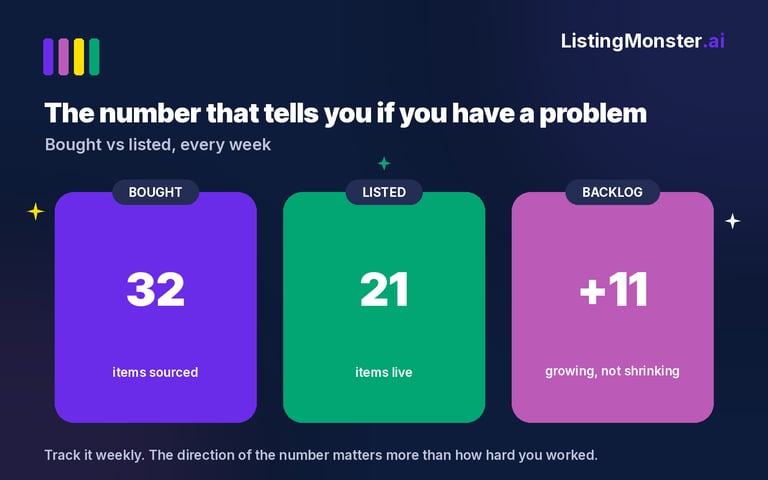
Once a week, compare two numbers: what you bought, and what you actually got live.
Do that every week and the direction of that number matters more than how hard you feel like you worked. 32 bought minus 21 listed is 11 unlisted, every single week. Keep that pace for 10 weeks and that's 110 extra items stacked on top of wherever you started. If you buy 30 and list 20 most weeks, motivation isn't the problem. The maths guarantees a growing backlog regardless of effort.
And once you're tracking what comes in against what gets listed, you can take the same idea one step further. Not every sourcing trip that feels productive is actually a good use of your time.
"Being able to track your profit per hour back to specific sourcing runs is powerful. Log every sourcing run, where you went, how long it took, how many items you came back with, and total spend. Record it against those listings. Some will surprise you. The thrift store run that feels productive might be half as profitable per hour as the clearance auction you nearly skipped. The numbers tell you where to spend your time."
— Patrick Cooper, 3x Vintage Founder
What unlisted stock is really costing you
An item sat in a bag might be inventory on paper, but it isn't doing anything for your business. You've already spent the cash, and it has zero chance of selling until it's live. Multiply that across 30 or 40 items and it's not just money sat idle, it's shelf space, it's the mental tax of walking past it every day, and it's the sales you're not making because none of it is in front of a buyer yet.
My own experience with the sourcing trap
I once had around 2,000 unlisted items and somewhere between £12,000 and £14,000 tied up in them.
I'd convinced myself I'd had a brilliant run of sourcing. In reality, none of that money was working for me. It was just bags and rails taking up a spare room, waiting for time I never seemed to find. What changed wasn't cutting sourcing out for good. It was refusing to buy anything else until I'd worked that number down to something manageable, then sticking to a much stricter rule afterwards: unlisted stock never gets to outpace what I can realistically process that week.
Once I stopped buying and focused on getting through what I already had, I was listing around 30 items a day. At that rate it took a little over two months to clear the 2,000, and every week that number dropped instead of grew was proof the rule actually worked.
How to keep sourcing without building a backlog
A simple operating rule keeps the two in step, and batching your photography and listing sessions is the backbone of it:
- Set a maximum unlisted-stock threshold for yourself
- Batch your photography immediately after a sourcing trip
- Don't source again until the previous batch is processed
- Track bought versus listed every week
- Reduce the friction in the actual listing process
The first four stop the backlog getting away from you. The fifth increases how much stock you can actually process.
Make listing easier, not sourcing less enjoyable
The other lever is simply making each listing take less time. If 40 new items means hours of repetitive titles, item specifics, categories and descriptions, it's easy to see why the backlog builds. Anything that reduces that admin makes it easier for your listing capacity to keep pace with your sourcing, which is exactly the gap tools like Listing Monster are built to close, turning a batch of photos into ready-to-edit listings instead of another batch of repetitive admin.
Want the full system for turning sourcing trips into sales, not just backlog? Download the Reseller Handbook 2026 UK for the complete framework.
FAQs
Why do I keep buying more stock than I list?
Sourcing gives you a fast, certain reward, you find something, you know it's good, you pay. Listing is slower and less certain, so your brain naturally favours the first over the second. Tracking what you buy against what you actually list each week is the quickest way to catch it before it becomes a backlog.
How much unlisted stock is too much?
There's no fixed number, but a useful test is whether you can realistically list everything you've sourced within the next week or two. If you're consistently bringing home more than that, your backlog will keep growing regardless of how motivated you feel. Match what comes in to what you can actually process.
What's the fastest way to clear an eBay or reselling backlog?
Stop the gap widening before trying to close it. Batch-photograph what you already have, work through that exact batch before sourcing again, and track bought versus listed weekly until the number turns negative. Clearing an existing pile is much easier once new stock has stopped adding to it.
Should I stop sourcing until I've listed everything?
Not necessarily, but if your bought-versus-listed number is consistently positive, pausing sourcing for a week or two while you catch up is a reasonable reset. The goal isn't to source less long-term, it's to keep the two roughly matched so a backlog never gets the chance to build.