Sourcing for Resellers: The Complete Guide to Finding Stock That Sells
.png)
Sourcing for resellers means finding stock cheap enough, and in condition good enough, to turn a reliable profit once it's listed. The best sourcing decisions aren't about finding the most interesting item. They're about finding items that move cleanly and predictably through your whole process, from purchase to sale. Get sourcing right and every later step, listing, pricing, selling, gets easier. Get it wrong and no amount of good listing copy fixes an item you overpaid for or can't move.
This guide covers where resellers actually find inventory, how to judge whether an item is worth buying before you commit, and the buying habits that separate a business that scales from one that stalls under its own stock.
Profit Is Decided Before You Buy
Most problems in reselling start at the buying stage, not the listing stage. If an item is hard to price, slow to list, risky to ship, or unlikely to sell, the mistake usually happened when it was picked up, not when it went live.
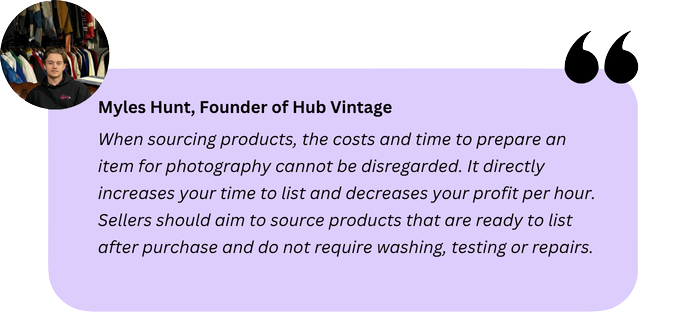
The moment you buy something, you've committed time to it. You'll handle it, list it, manage the live listing, store it, and eventually ship it. So the real goal of sourcing isn't finding valuable items. It's choosing items worth that time. Good resellers don't just ask "is this valuable?" They ask "is this worth my time?"
Margin Comes From Buying, Not Pricing
You can't fix an overpaid item later. If you buy too high, you're left with two bad options: price it high and it doesn't sell, or discount it and sell at a loss. Once the buying decision is made, pricing can only work within the ceiling that decision set.
Strong buying gives you options instead. Buy well and you can price competitively, accept offers without panicking, or move stock quickly when you need the cash flow, all without eating into margin you never had room for in the first place. This is why experienced resellers spend more energy scrutinizing the purchase than tweaking the listing afterward. The listing can only sell what the buying decision made possible.
The Three Qualities of Target Stock
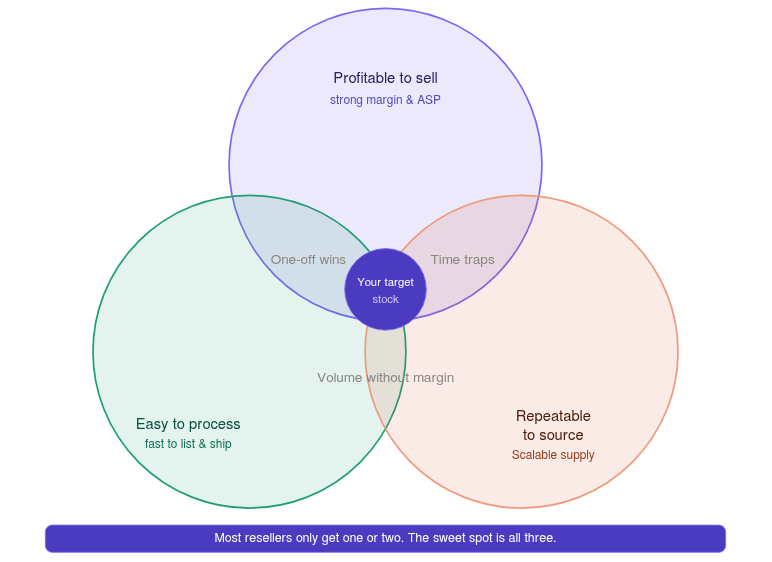
Most resellers only hit one or two of these on any given item. The sweet spot, and the goal to build your sourcing strategy around, is all three at once.
- Profitable to sell. Strong margin and a healthy average selling price (ASP) for the category.
- Easy to process. Fast to photograph, list, and ship, with no repairs, cleaning, or authentication headaches before it's sale-ready.
- Repeatable to source. You can find more of it. A one-off win that you can never restock again isn't a sourcing strategy, it's luck.
Stock that's profitable but hard to process or find again becomes a one-off win you can't scale. Stock that's easy to find but thin on margin becomes volume without profit. Neither builds a business on its own.
Three Questions at Point of Purchase
Every sourcing decision, whether it's a $2 charity shop find or a $2,000 wholesale pallet, should be answerable in seconds:
- What will it realistically sell for? Not the best example you've seen online, the normal one.
- How likely is it to sell? Regular, predictable demand beats rare potential every time.
- Will it be easy to process? Easy to list, easy to store, easy to post.
The clearer your answers, the lower your risk. And vice versa: the fuzzier any one answer is, the more that item is a gamble dressed up as a find.
Where Resellers Actually Source Inventory
There's no single best channel. Most established resellers run two or three in parallel: one low-cost, treasure-hunt source for margin, and one higher-volume source for predictable supply.
Thrift stores and charity shops
The classic entry point. Low cost of entry, huge variety, and new stock on the floor daily. The trade-off is time. You're competing with every other reseller who walks the same aisles, and finding sellable stock at volume takes practice.
Garage sales and estate sales
Often the best margins in reselling, especially on furniture, tools, collectibles, and premium small appliances, because sellers are motivated to clear a house, not maximize price. Estate sales in particular reward showing up early and buying in bulk lots from a single seller.
Online and retail arbitrage
Buying discounted or mispriced stock from retail stores or other online marketplaces to resell elsewhere. Scalable and doesn't require leaving your desk, but margins get squeezed by competition once a deal becomes well known.
Wholesale and liquidation
Buying pallets, cases, or graded lots from a wholesaler or liquidator. The path to real volume once thrifting alone can't keep up with your listing capacity, but it's also where the most expensive sourcing mistakes happen. Vetting the supplier before you commit to a full pallet, and understanding exactly what a "grade A" label means to that specific supplier, is the difference between a profitable order and a write-off.
Live-shopping platforms
Apps like Whatnot let you bid on individual items in a live auction, cheaper than blind wholesale because you see the item on camera before you buy, but slower and lower-yield per hour than a bulk buy. A solid low-risk way to source for beginners, and a useful release valve for the weakest end of any bulk purchase.
Auctions
Estate auctions, storage unit auctions, and specialty auctions can produce large single-lot wins, but demand more product knowledge to bid confidently and avoid overpaying on hope rather than realistic resale value.
Buy for Predictability, Not Hope
New resellers often chase rare items, big potential flips, and "Instagram-worthy" finds. Unpredictable items are usually time traps: harder to price, slower to list, and slower to sell, with more buyer questions along the way.
Reliable categories build real income, because they can be sourced at volume and processed quickly and consistently. You don't need every item to be amazing. You need most items to be dependable.
There's More Than One Way to Win
You are not trying to maximize profit on a single item. You are trying to maximize reliable profit across many items.
Good sourcing produces stock that generates consistent profit per hour, but there's no single formula for what that stock has to look like. Some categories are low value but easy to source and process. Others are high value but harder to find and prepare. Both can land at the same profit per hour through a different mix of average selling price, sell-through rate, margin, and processing speed.
Three valid routes, all landing at $50 profit per hour: a high-volume category like media, books, or fast fashion, moving 10 items an hour at $5 profit each. A mid-range category like collectibles, branded goods, or electronics, moving 4 items an hour at $12.60 profit each. Or a premium category like vintage or antiques, moving 2 items an hour at $25 profit each. Different stock, different pace, the same result.
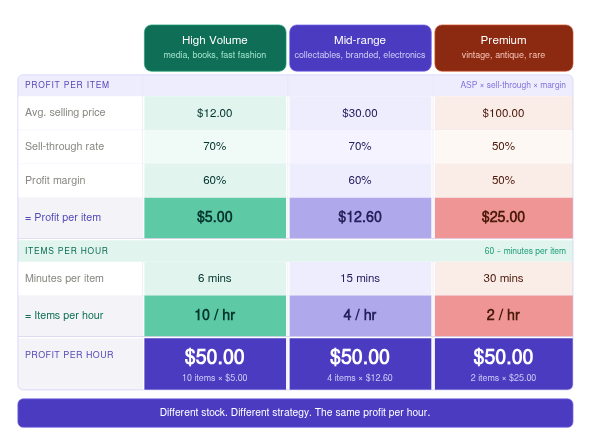
None of these three routes is inherently better. The right mix depends on what you can source reliably and process efficiently in your own market. The word that matters most across all of it is reliable. When your buying improves, everything downstream gets easier.
Avoid "Death Piles" Accumulating
A death pile is stock you've bought but haven't listed. It grows when purchasing outruns processing: a few items at first, then a corner of the room, then a problem you actively avoid thinking about. Every item sitting in it is cash you can't reinvest and a sale that isn't happening. At any real volume, it also becomes a serious mental drag, the exact "ceiling" feeling that makes resellers dread getting home to more stock rather than feel good about it.
The fix is balance. What comes in has to roughly match what gets processed. A simple rule of thumb: don't buy more than two to three weeks of processing capacity at a time, whatever the source. If you're tempted by a bulk discount that would blow past that, the discount usually isn't worth what it costs you in backlog.
Vetting and Verifying What You Buy
The further you move from browsing individual items in person to buying sight-unseen in bulk, the more vetting matters.
With any new wholesaler, treat the first order as a two-way trial. Check reviews on reseller forums, not just the supplier's own site. Ask what happens if a shipment doesn't match the agreed grade before you pay, not after. Request a sample order or recent batch photos before committing to a full pallet. Get their definition of "grade A" in writing, since grading isn't standardized and one supplier's grade A can be another's grade B.
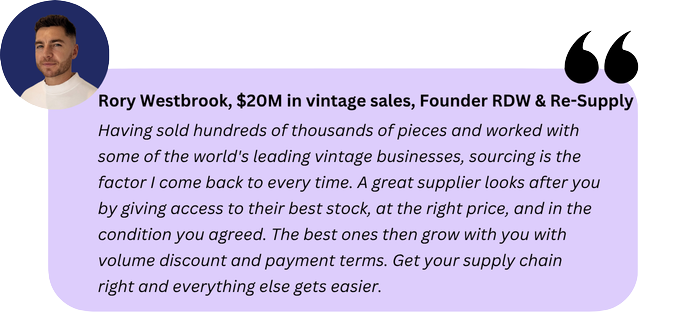
With branded and designer stock specifically, authentication is part of your sourcing process, not an afterthought. A genuine designer bag doesn't turn up at a fraction of its market price without a reason. Authenticity cards alone prove nothing, since they're some of the easiest things for counterfeiters to replicate. Cross-reference hardware weight, stitching consistency, logo font details, and interior stamps against the brand's own official imagery, and use a professional authentication service for anything high-value or uncertain. As Rory Westbrook, who's sold hundreds of thousands of pieces across the vintage industry, puts it: get your supply chain right and everything else gets easier.
Once you find a supplier that works, keep testing one or two others in parallel with smaller trial orders. Relying on a single source for all your stock is efficient right up until that supplier changes pricing, tightens grading, or runs out of your category without warning.
Turning Good Sourcing Into a Repeatable System
The resellers who scale past a hobby treat sourcing as a system, not a series of one-off decisions. That means logging what you bought, where, for how much, and how it performed, so you can answer "should I go back to this source" with data instead of a gut feeling.
It also means recognizing where your actual bottleneck sits. For most committed resellers, the ceiling isn't finding stock, it's getting everything found stock listed before the next sourcing trip. As one Listing Monster customer put it, sourcing became "the push forward to go each Sunday to source more stuff" only once listing itself stopped being the bottleneck. If a growing backlog of unlisted stock is the thing standing between you and buying more, that's a listing capacity problem more than a sourcing problem, and worth solving before you scale your buying further.
Go Deeper: Sourcing Resources
The sections above cover the full sourcing decision framework. The guides below go deeper on specific topics.
-
Best Non-Clothing Items to Resell for Profit in 2026 — the full category breakdown behind the profit-per-hour comparison above, covering electronics, games, books, collectibles, tools, and more.
-
Mistakes to Avoid When Ordering from Vintage Wholesalers — the six most expensive wholesale buying mistakes, including how to vet a supplier and judge grading before you commit to a pallet.
-
How to Authenticate Designer Bags: The Reseller's Guide to Spotting Fakes — brand-by-brand authentication detail for Chanel, Louis Vuitton, Prada, Mulberry, Dior, and Versace.
-
Is Whatnot Worth It for Resellers? The Honest Take on Sourcing and Selling — a full breakdown of sourcing and selling on Whatnot specifically, including real numbers and fees.
Related Reading
Sourcing decisions only pay off if the rest of your workflow works efficiently. Download our free Reseller Handbook for how to get every step of your process working well. Topics included in the guide include:
- Getting Started
- Profit Framework
- Listing
- Marketplaces
- Selling Faster
- Shipping & Storage
- Customer Support & Returns
- Know Your Numbers
- Tools
- Reseller Life
FAQs
What's the best way to source inventory for reselling as a beginner?
Start with thrift stores, garage sales, or estate sales rather than wholesale. They're low-cost, let you inspect every item in person, and teach you to judge sell-through and margin before you risk money on a bulk order you can't see.
- Cap your first few trips at what you can realistically list within a week
- Track what you paid and what it sold for on every early purchase
- Hold off on wholesale until you know your category and processing speed
How do I know if an item is worth buying to resell?
Answer three questions before you commit: what will it realistically sell for based on normal comps (not the best one you've seen), how likely is it to sell at that price, and how easy will it be to process into a listing. If any answer is unclear, the risk on that item is higher than it looks.
How much inventory should I buy at once?
Don't buy more than two to three weeks of processing capacity at your current listing speed, regardless of how good a bulk discount looks. Buying faster than you can list creates a "death pile" of stock that ties up cash and becomes a backlog you avoid rather than an asset you can sell.
Is wholesale or thrifting better for sourcing?
Neither is universally better. Thrifting and garage sales usually give stronger margins per item but don't scale predictably. Wholesale and liquidation scale faster once you've vetted a reliable supplier, but carry more upfront risk if you skip vetting or misjudge grading. Most resellers who scale past a hobby end up running both in parallel.
How do I avoid getting scammed when buying wholesale?
Never commit to a full pallet from an unvetted supplier. Check independent reviews, request a sample order or recent batch photos first, and get their grading definitions in writing before you pay. A supplier unwilling to provide any of these on a first order is a warning sign worth taking seriously.


